
Interstate Removalists Melbourne: What Quotes Really Cover
Getting several quotes and choosing the cheapest is popular moving advice. For an interstate move, it's incomplete. A low total tells you little unless you know which belongings, access conditions, delivery arrangements and damage protections the removalist has allowed for.
When comparing interstate removalists in Melbourne, treat the written scope and the evidence you'll need for a claim as part of what you're buying. The truck matters, but the paperwork determines what happens when settlement slips, an apartment lift isn't available or a cabinet arrives damaged.
Table of Contents
- What Drives an Interstate Removal Quote
- How the Move Runs From First Call to Settlement
- Route Distances and Transit Times From Melbourne
- Insurance and Damage Claims You Need to Understand
- Booking, Access and Paperwork to Sort Early
- Choose a Provider and Confirm Scope in Writing
What Drives an Interstate Removal Quote
| Quote factor | How it changes the price | What to confirm in writing |
|---|---|---|
| Inventory volume and weight | Determines truck size and handling effort; dense items can exhaust payload before space | Itemised inventory from a walkthrough or video |
| Distance and route | Determines driving time, fuel and scheduling | Origin and destination suburbs and proposed route |
| Stairs, lifts and parking | Adds handling time and may require bookings or permits | Stair count, lift bookings and permit responsibility |
| Long carries and narrow streets | Slows loading and may require a smaller shuttle vehicle | Carry distance at each address and truck restrictions |
| Packing and unpacking | Adds labour and materials | Rooms and items included, plus who supplies materials |
| Disassembly and reassembly | Adds work for beds, desks and other furniture | Named items to dismantle and rebuild |
| Specialty items | Requires dedicated handling or protective crating | Named items and whether crating is included |
| Storage between addresses | Adds holding, handling and redelivery costs | Billing period, rate, access hours and release terms |
| Waiting time and date changes | May introduce waiting or rebooking charges | Responsibility for delays and the date-change policy |
An interstate quote combines inventory, route, access and extras. A single hourly rate doesn't reveal how much of that work the provider has included, while a flat total is only useful when its assumptions are visible.
Start with the inventory. Show the garage, balcony and storage cage during the walkthrough, not just the furnished rooms. Identify heavy equipment separately so the estimator isn't treating a book collection like a stack of empty cartons.
Next, check the journey and both entrances. A truck that can park outside a Melbourne house might not reach the destination's basement loading dock. Stair flights, lift dimensions, parking restrictions and the distance from truck to front door should be recorded before the price is accepted.
Separate the move from the extras
Packing needs a defined boundary: wrapping furniture isn't the same as boxing kitchen cupboards. Likewise, dismantling a bed doesn't automatically mean rebuilding it, and carrying artwork doesn't automatically include custom crating.
Storage and waiting deserve separate attention. Establish whether the storage price includes unloading into storage, later reloading and final delivery. A settlement delay can otherwise become a disagreement about several services rather than a simple holding charge.
Consumer Affairs Victoria's removalist pricing warning advises consumers to clarify flat versus hourly pricing and possible extra costs; it also records allegations of overcharging, undisclosed total costs and longer routes used to increase charges.
Use our moving-cost guide to organise your comparison, but judge each quote against the same inventory and access notes. A higher, well-documented quote can be better value than a cheaper offer with important work missing.
Quote rule: Compare the agreed job, not just the headline total.
At House Moving Melbourne, we explain the price effect of a scope change before acting on it. Make advance pricing and approval your rule for extra work, and finish your quote audit with these questions:
- Inclusions: What exactly is included?
- Extra charges: What circumstances trigger another charge?
- Approval: Who can authorise a variation?
How the Move Runs From First Call to Settlement
A clear written quote and a confirmed schedule give each stage of an interstate move a reference point. House Moving Melbourne's process runs from the first conversation through to a follow-up after delivery.
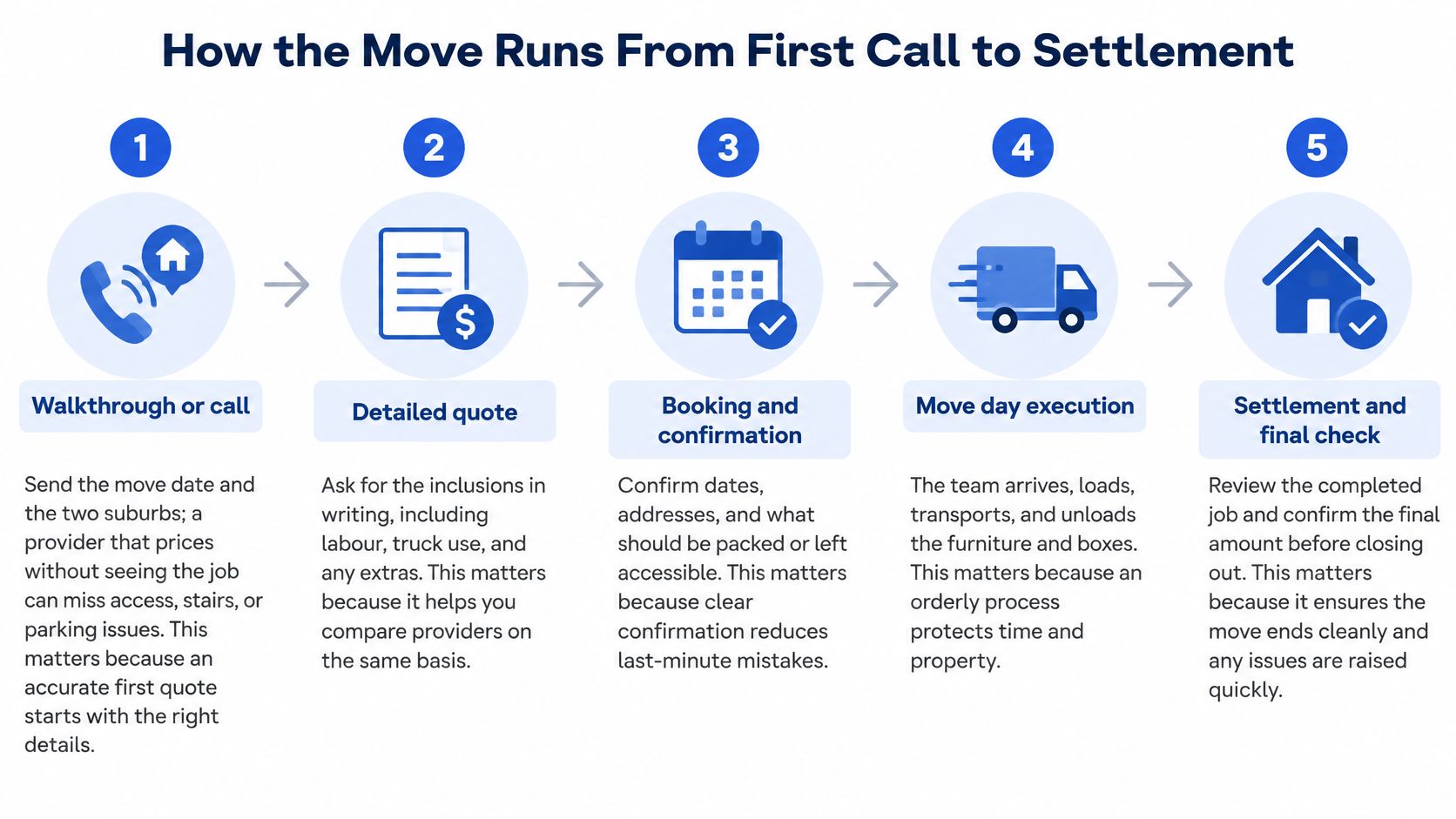
Walkthrough or call. Send your move date and suburb pair. A walkthrough, in person or by video, helps establish the inventory and access at both properties. House Moving Melbourne returns a written quote within one business day. Include sheds, stairs and restricted access, not just the main rooms.
Fixed written quote. The quote sets out the agreed scope and price. Check that it accounts for the items and services you discussed. If the scope changes, House Moving Melbourne explains the price effect before acting on the change.
Confirm and schedule. Once you accept the quote, the date and crew are locked in. Relevant bookings, such as building lifts, loading docks or parking permits, are arranged. Check the confirmed schedule against lease or settlement arrangements, especially if keys and unloading need to happen on the same day.
Moving day. A residential move typically involves protecting floors and doorways, disassembling furniture, and loading items in the order they will be needed at the destination. Keep travel bags, medicines, documents and keys separate from items going on the truck.
Settled in with follow-up. Check furniture placement and agreed reassembly room by room, and record anything incomplete or damaged. House Moving Melbourne calls within a few days to check that nothing was missed. Report visible issues promptly rather than waiting for the follow-up.
Give the schedule room to work safely
The National Heavy Vehicle Regulator's Chain of Responsibility guidance explains that relevant parties must ensure, so far as reasonably practicable, the safety of heavy-vehicle transport activities. Businesses that influence scheduling, loading and other transport decisions share responsibility.
Give the removalist accurate details about stair counts, restricted access and inventory changes. A delivery promise should leave enough time for safe loading, handling and travel.
A door-to-door moving service depends on clear arrangements at both properties. Nominate someone who can answer questions at the destination, particularly if you are travelling separately.
This video provides another way to review the moving process before booking.
Keep a signed inventory, room-by-room completion notes and the written claims procedure. Record exceptions beside the relevant items so there is a clear account of what was delivered and what needs attention.
Route Distances and Transit Times From Melbourne
Interstate distance alone won't tell you when your belongings will arrive. Ask for the quoted road route and a delivery window for the actual collection and delivery addresses. A passenger-car map estimate may not reflect truck access, loading, unloading or freight connections.
| Destination | What to request |
|---|---|
| Sydney, NSW | The quoted road route and a delivery window that accounts for metro access |
| Canberra, ACT | The quoted road route and confirmed collection and delivery dates |
| Adelaide, SA | The quoted road route and delivery window, including any overnight stop |
| Brisbane, QLD | The quoted road route and delivery window based on compliant driving and rest arrangements |
| Perth, WA | The full quoted route and a delivery window, rather than a drive-time estimate |
| Darwin, NT | The proposed heavy-vehicle route and dispatch and delivery windows |
| Hobart, TAS | The road route, delivery window and confirmed Bass Strait freight booking |
Route choice can depend on truck limits and road restrictions. The National Heavy Vehicle Regulator's mass-limit guidance explains that vehicle, axle-group, manufacturer, registration and road limits must be considered, with the lowest applicable limit controlling. A restricted bridge or final-access road may affect vehicle choice even when the main highway is suitable.
List dense items separately
Books, appliances, gym equipment, safes and stone furniture can use a truck's allowable payload before its available space is full. List these items separately, with manufacturer weights or clear photographs of identification plates where available.
Volume alone doesn't determine the loading plan. Heavy items need suitable positioning and securement, with weight distributed across axle groups rather than concentrated in one area. A truck with spare floor space may still have little spare carrying capacity.
House Moving Melbourne is based in Melbourne and works across Victoria, including regional moves, with interstate moves available on request. Give the mover the full route, including regional collection or delivery addresses, rather than naming only the capital cities.
For longer journeys, keep the collection date, expected arrival window and property access time distinct. If settlement is uncertain, arrange suitable storage or a flexible delivery window instead of relying on keys being released that afternoon. Keep bedding, chargers, basic cooking items and essential paperwork with you so you can manage arrival without setting an impractical deadline for the crew.
Insurance and Damage Claims You Need to Understand
An insured badge isn't proof that your belongings are covered. You need to know which policy responds, what circumstances it covers and who must lodge the claim.
Public liability generally concerns injury and damage to third-party property or premises. Goods-in-transit cover concerns belongings being transported, subject to the policy's terms, exclusions, limits and excess. Neither label alone tells you how a damaged dining table will be assessed.
Use this checklist to separate the cover types and supporting evidence.
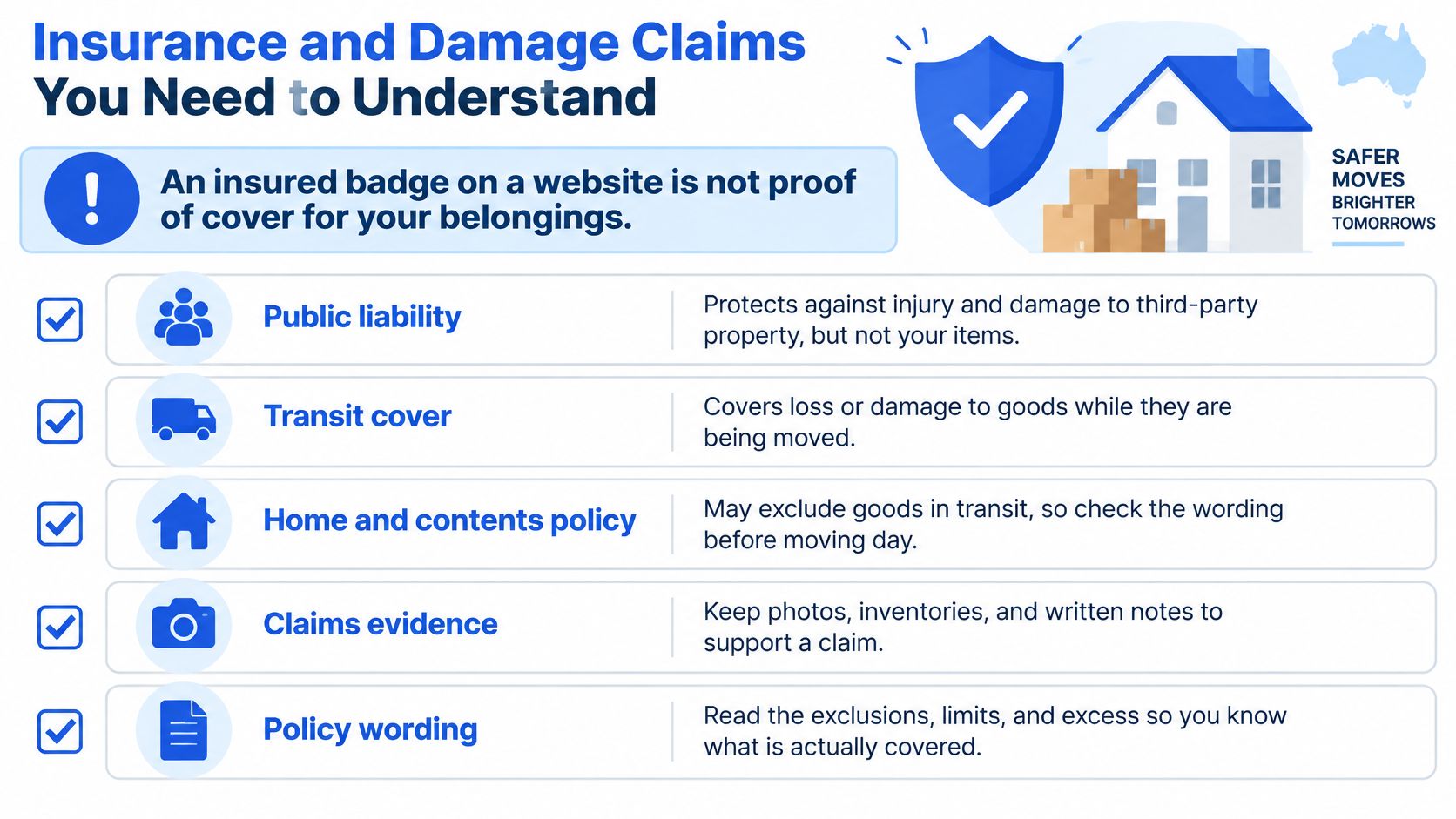
| Cover or right | What it covers | What you must keep |
|---|---|---|
| Public liability | Relevant injury and damage to third parties or premises, subject to policy terms | Current certificate supplied before moving day |
| Goods-in-transit cover | Covered loss or damage to belongings during transport | Certificate, dated pre-move photographs and signed inventory |
| Consumer remedy | Damage or loss arising from a failure to provide services with due care and skill | Quote, inventory, photographs and written correspondence; statutory rights aren't defined solely by a company's reporting window |
We have full transit and public liability cover, and send certificates before moving day. Our explanation of public liability insurance cover helps distinguish premises-related risks from protection for the goods themselves.
Build the evidence before loading
Photograph furniture in good light, including corners, legs, glass edges and existing marks. Take an overall image so the item is identifiable, then close-ups showing its condition. Retain the original files rather than keeping only compressed copies sent through a messaging app.
Match photographs to the inventory with simple item names or carton labels. For a self-packed carton, photograph the contents and cushioning before sealing it, and check whether the policy treats owner-packed goods differently.
Consumer Affairs Victoria's removalist enforcement notice reports court findings that three removalist businesses misled consumers about insurance and didn't enable damage claims; it also explains obligations concerning due care and skill, reasonable time and potential Australian Consumer Law remedies for damage or loss.
Claims preparation: A certificate establishes that a policy exists. Your inventory, photographs and correspondence help establish what happened.
Get the claims procedure in writing, including the contact, who submits an insurance claim and the requested reporting timeframe. Check storage, pre-existing damage and delay-related losses separately rather than assuming transport cover includes them.
Moving-day claims readiness
- Before loading: Save the final inventory, condition photographs, quote and certificates together.
- At delivery: Inspect exposed surfaces and record concerns against the named item.
- When signing: Note unresolved damage or missing goods instead of signing an unqualified completion statement.
- If damage appears: Photograph it, retain packaging and report it promptly in writing.
- Before repairs: Obtain instructions before discarding goods or authorising work that could remove useful evidence.
Booking, Access and Paperwork to Sort Early
Start with the building, not the boxes. A confirmed moving date doesn't automatically give the truck permission to occupy a loading bay or the crew permission to use a service lift.
Check arrangements with building management, the strata manager or body corporate, and the relevant council where parking permission is needed. Once you accept our quote, we lock in the date and crew and arrange bookings such as building lifts, loading docks or parking permits; give us the building's requirements early enough to coordinate them.
Clear the access checklist
Lift and dock bookings: Confirm bookings at both addresses, including the approved entry, lift protection requirements and who opens the loading area. A lift reservation is less useful if nobody can release the dock gate.
Parking approval: Establish where the truck can legally stand and who is responsible for any permit. Don't treat an empty kerb space during a walkthrough as guaranteed moving-day parking.
Building permission: Obtain any required strata or body corporate approval and pass on moving rules. Include restrictions on entry routes, floor protection and when furniture can pass through common areas.
Inventory and access notes: Send the written inventory, stair counts, parking limits, key arrangements and access codes through the agreed channel. Name a contact at each property who can resolve questions without repeated calls.
Storage agreement: If the dates don't align, settle the holding arrangement before collection. Record the rate, access hours, release instructions and how onward delivery will be authorised.
Date-change contact: Know who receives booking changes and use that contact as soon as a change becomes likely. An early warning gives the scheduler more options than a message sent while the crew is approaching.
Check the destination from the truck's perspective
Measure awkward doorways and lift openings, then compare them with the largest furniture pieces. Include tight turns, low branches, overhead clearances and steep driveways in the access notes. A clear photograph looking from the road towards the entrance can explain more than a description such as easy access.
Keep access information separate from carton labels. The crew needs to find the gate code and destination contact without searching through a packing spreadsheet.
Before collection, save the accepted quote, booking confirmation and access notes somewhere available on your phone without relying on the new property's internet connection. Leave a copy with the person receiving the goods if you won't be there.
Choose a Provider and Confirm Scope in Writing
| Check | Sound answer | Warning sign |
|---|---|---|
| Quote method | Walkthrough or video followed by a fixed written quote | Floor-count estimate or hourly rate alone |
| Price breakdown | Base move, packing and extras identified | Total with no explanation of scope |
| Insurance | Transit and public liability certificates supplied before moving day | Insurance assurances without documents |
| Licensing | Relevant licence details supplied for verification | Evasive answers about credentials |
| Fleet and crews | Company trucks and employed crews, with responsibility clear | Last-minute labour without clear supervision |
| Scope changes | Price effect explained before extra work | Unexplained charges after work begins |
| Route and timing | Proposed route and delivery window documented | Unexplained routing that increases charges |
| After the move | Named contact and scheduled follow-up | No clear contact after delivery |
Use these checks to assess how the business will manage the job, not merely how confidently its salesperson answers. A provider that can't document the scope or explain its claim process leaves you accepting uncertainty alongside the price.
Start with the quote method. A room count or office floor count doesn't describe a safe, crowded garage, a dismantling requirement or a loading dock reached through a narrow lane. A walkthrough lets the estimator connect the belongings with the handling work.
Assess accountability as well as equipment
We use walkthrough-based written quotes, operate our own fleet and crews, and don't book day-labour crews in the week before a move. We're fully insured and licensed. Verify the certificates and relevant licence details before relying on any provider's credentials, including ours.
Company-employed crews provide a clear employment arrangement, but that isn't a substitute for checking the actual job plan. Confirm who will supervise collection, who receives questions during transit and who can authorise decisions at delivery.
Likewise, don't dismiss an hourly quote solely because it isn't fixed. It can be reviewable if the provider clearly defines the work and charging basis. The problem is an estimate presented as certainty without enough information to support it.
Choose the provider whose written answers let you make an informed decision, not the one that offers the most reassurance.
Keep a copy of each provider's answers alongside its quote. If an answer changes during a call, request an updated document rather than writing your own interpretation into the margin. Silence about an inclusion isn't confirmation that it's covered.
Acceptance checklist
Before authorising an interstate booking, check the final documents against these points:
- Addresses and inventory: Both properties, access conditions and the agreed belongings are recorded.
- Line items: The base move, packing, extras and any storage are clearly separated.
- Variations: The approval process identifies who can agree to changed work and its price.
- Protection: Insurance certificates and the claims procedure will arrive before moving day.
- Storage: Any gap has documented holding, access and release arrangements.
- Timing: The delivery window and procedure for settlement-date changes are understood.
- People: The crew arrangements and named contact are confirmed.
Don't accept unresolved blanks to secure a date. If a destination detail isn't available yet, identify it explicitly and agree how it will be confirmed before it affects the job.
Call us on (03) 9676 9093 to request a walkthrough and written quote, using this checklist as the agenda. A provider that answers clearly has earned a meaningful price comparison; a vague answer remains a risk even when the total looks attractive.
House Moving Melbourne offers scoped residential and commercial relocations, with interstate moves arranged on request and fixed written quotes. Visit House Moving Melbourne to request an assessment, bringing your move date, suburb pair, inventory and access details so the quote reflects the job you need done.