Door to Door Movers Explained for Melbourne Relocations
You've got a lease ending, a settlement date pencilled in, or a family house full of furniture that has to move without chaos. The truck matters, but it's not the whole job. The practical work begins earlier, with access checks, protection plans, and a crew that knows how to move household goods from one threshold to the next without turning your hallway, lift, or loading bay into a problem.
Table of Contents
- What a Door to Door Moving Day Actually Looks Like
- Defining the Door to Door Service Model
- Door to Door vs Depot and Container Services
- How Movers Protect Your Home and Belongings in Transit
- Transit and Public Liability Insurance in Plain Language
- Apartment and Strata Access Planning in Melbourne
- Fixed Quotes, Pricing Shape and Pre-Move Preparation
- Common Assumptions Worth Challenging and How to Choose
What a Door to Door Moving Day Actually Looks Like
A Melbourne family can feel the day change the moment the crew knocks. Boots come off or get covered, floor runners go down, and the walkthrough begins before a single box is lifted. That first stretch matters because the crew is mapping the house, the building, and the exit route, not just checking what fits in the truck.
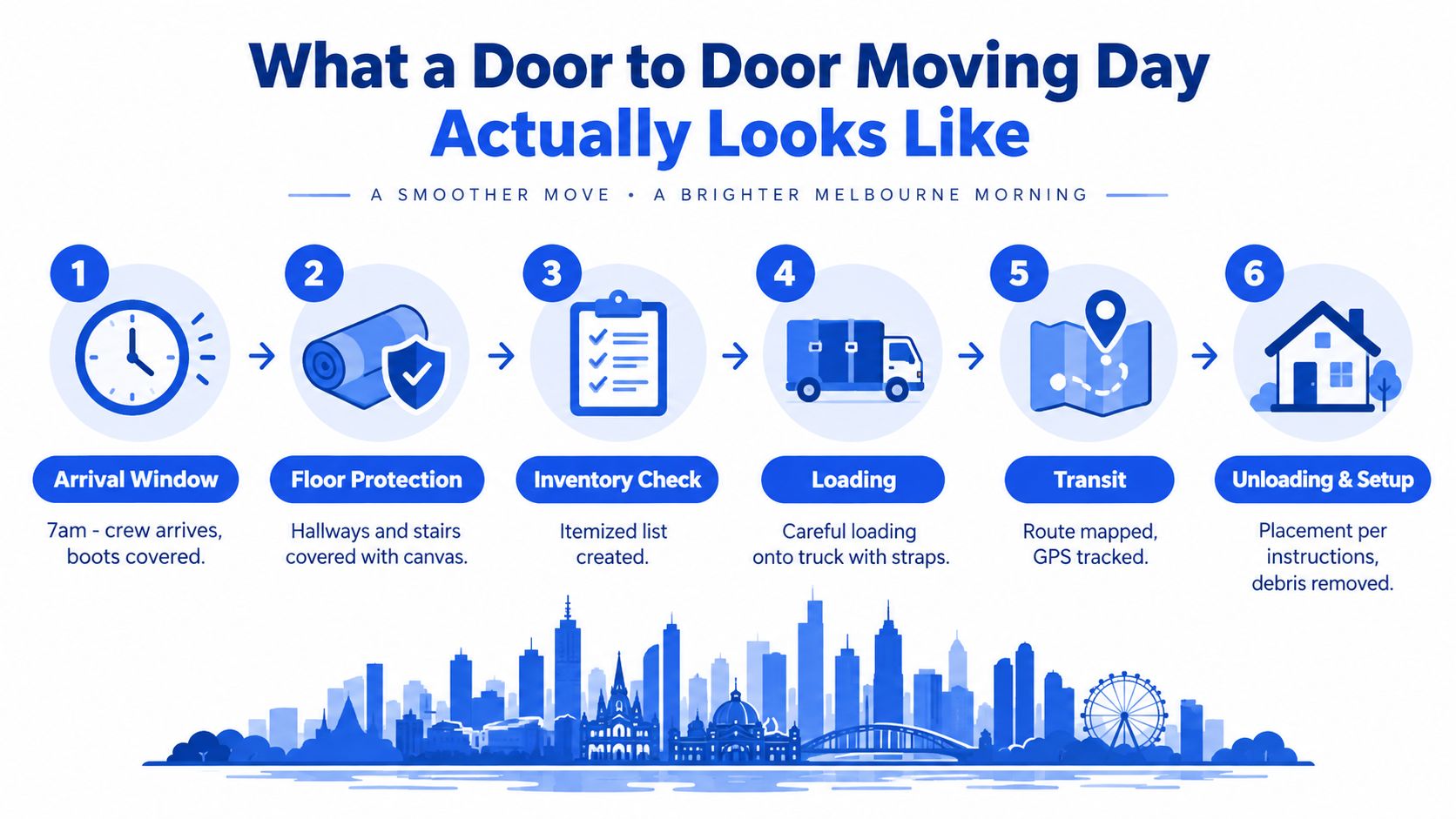
A good move runs on sequence. The team confirms the inventory, wraps fragile items, labels what needs to go where, then loads in an order that suits the delivery plan. At the other end, they follow the room list, place furniture where it belongs, and clear the packaging and debris that came with the job.
Continuity is the quiet advantage. The crew that wraps the dining table is the crew that loads it, straps it, drives it, unloads it, and puts it in the new room. That keeps the handoff consistent, which matters in apartments with lifts and tight hallways, family homes with heavy furniture, and regional moves where the day has more kilometres and more chances for something to be missed.
A practical move can look ordinary from the street and still be carefully managed. The plan is built around access, protection, and placement. Floor protection goes down first. Delicate pieces get extra wrapping. Large items may be disassembled so they can pass through doorways or stairwells without scraping walls.
For a plain-English overview of the sequence, see how the process works.
Practical rule: the service ends when the agreed items are placed at the new address and the customer accepts the handover, not when the truck reaches the driveway.
Defining the Door to Door Service Model
Door to door moving means one provider manages the move from pickup to delivery, with the same crew handling the work end to end. The value lies in one plan, one handoff, and one team keeping track of the access, protection, and placement at both addresses.
That usually covers the practical work that makes moving day run properly. Floor and doorway protection, furniture wrapping, disassembly and reassembly of common items, and placement at the new address are part of the service. In a Melbourne home, that can mean bed frames, dining sets, whitegoods, and boxed household goods all moving through one coordinated chain rather than separate handovers.
The model also makes the boundaries clearer. Specialty handling, extra storage, difficult access, or unusually heavy items may be included, but they need to be named before moving day. If they are left vague, the move turns into guesswork, and guesswork is where disputes usually start.
What you should hear in a proper quote
- Pickup and delivery addresses: both ends should be clear, including apartment level or driveway access.
- Protection scope: ask what gets covered, wrapped, padded, or dismantled.
- Placement instructions: confirm whether the crew will put items in specific rooms or just at the door.
- Exceptions: pianos, artwork, antiques, or tight stair access should be listed separately.
A proper quote should sound like an operations plan, not a broad promise. For an apartment, that might mean confirming lift access and hallway protection. For a family home, it may include where large furniture will be set down and whether items need to be reassembled. For a regional move, the same clarity matters even more because there is less room for surprises once the truck is on the road.
If settlement dates do not line up neatly, storage and removals in Melbourne can sit in the same planning conversation.
Door to Door vs Depot and Container Services
The right moving model depends on how much control you want, how much lifting you're prepared to do, and how complicated the access is at each end. Door-to-door suits households that want the crew to manage the entire handover. Depot and container models shift more work onto the customer, which can suit some moves but creates friction when timing or access is tight.
| Service model | Customer effort | Coverage shape | Typical pricing |
|---|---|---|---|
| Door to door | Low, the crew handles pickup, transit, and delivery | Direct between addresses | Usually quote-based, with scope set in advance |
| Depot transfer | Higher, customer drops off and collects from a hub | Best where a hub is practical | Often shaped by depot handling plus transport legs |
| Container service | Medium to high, customer packs the unit and may wait for collection | Flexible, but less hands-on during transit | Commonly tied to container size, transport, and storage time |
For a one-bedroom apartment with elevator access and a short local move, a direct door-to-door job is often the cleanest fit because the crew can work through the building without extra transfers. For interstate relocations or long regional runs, container or depot formats can make sense when timing is less urgent. For family homes in outer Melbourne or regional Victoria, door-to-door often wins on simplicity because there's less room for missed connections.
The thing people underestimate is the number of handovers. Every extra transfer adds another place where items can be delayed, repacked, or reclassified. If you want to keep the move straightforward, movers in Melbourne should be able to explain which model matches your access, time frame, and household size without pushing one format for every situation.
How Movers Protect Your Home and Belongings in Transit
Protection starts before the first box leaves the lounge room. Hallways get covered, door frames get padded, and fragile items are wrapped or crated so they can survive the trip and the handling around it. The goal is to stop surfaces from scuffing, corners from crushing, and items from shifting when the vehicle brakes or turns.
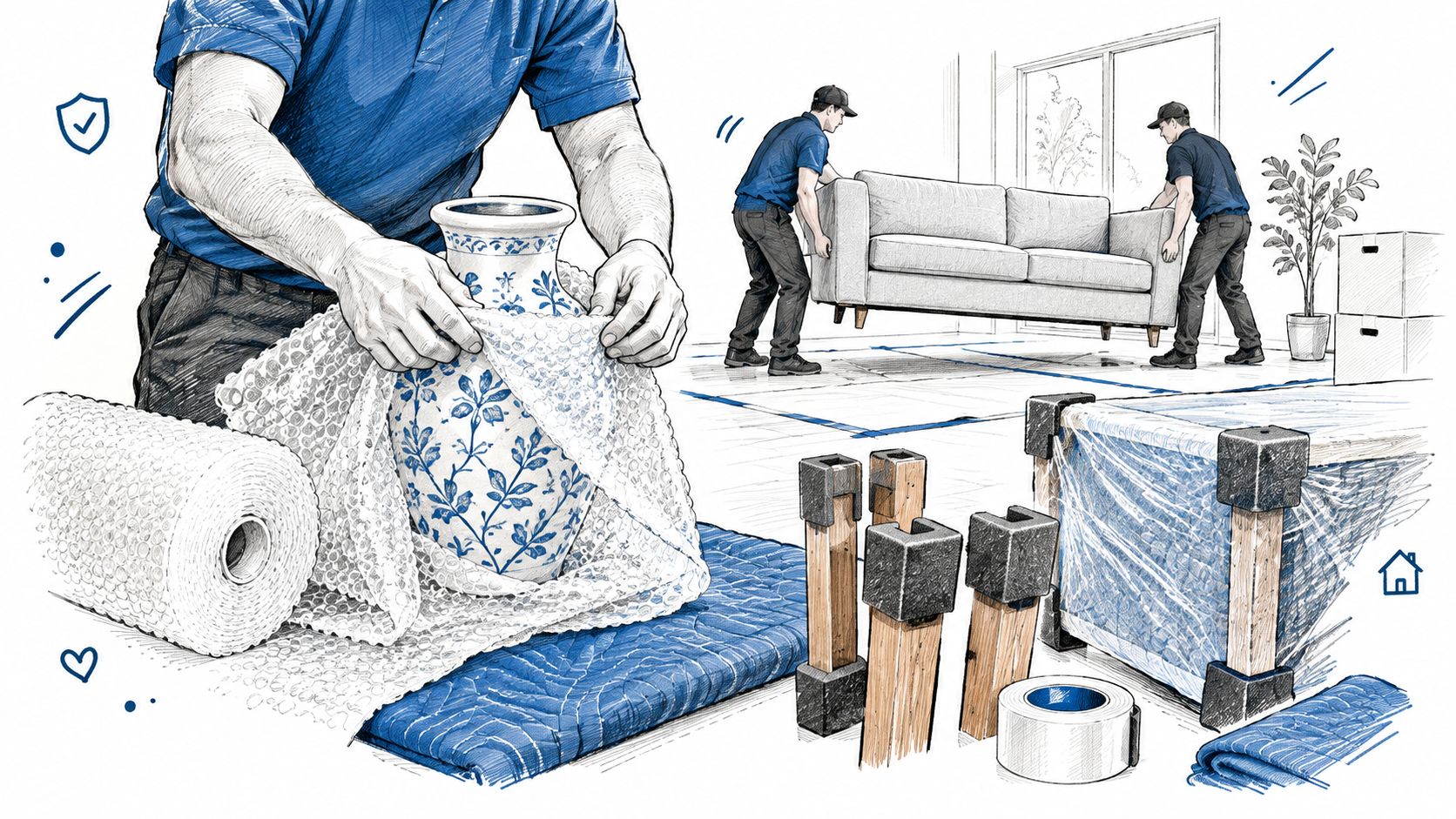
Padding and restraint are not the same thing
Padding absorbs contact. Restraint stops movement. You need both, but they do different jobs. A blanket around a dresser protects the finish, yet it will not stop that dresser becoming unstable if it is left loose in the truck.
That is why load restraint matters so much. The National Transport Commission says heavy-vehicle loads must be restrained against at least 80% of their weight forward, 50% sideways during cornering, and 20% upward where the load is not fully contained, and that loads must not compromise stability, steering, braking, or road-user safety (NTC load restraint guide). In plain terms, dense items should sit low and near the vehicle's centre, while gaps need blocking so things cannot slide into one another.
What a careful loading plan actually does
A good loading plan treats the truck like a moving structure, not a spare room. Heavy appliances, cabinets, and other dense pieces go in first. Fragile cartons are separated from compressive loads, and the team checks tie-downs after the truck starts moving because vibration can shift the load.
If the plan depends on “it should be fine”, the plan is not finished.
That same restraint logic keeps working during unloading and reloading. A moving day often includes stair carries, lift transfers, or short waits at kerbside, and every one of those moments creates another chance for movement, strain, or impact. Good movers treat the whole path as one protection chain, from the apartment doorway to the family home garage or a regional driveway, so the access plan and the packing plan support each other.
Transit and Public Liability Insurance in Plain Language
Insurance usually gets skimmed because the quote already feels long, but it's one of the parts that can save a lot of trouble later. Transit cover applies to the goods while they're being carried in the truck. Public liability is different, it covers damage the crew causes to the building or a third party, which is why building managers often ask for paperwork before the move starts.
The practical step is simple. Ask for the certificate, check that the business name matches the one on the quote, and make sure the cover matches the kind of move you're booking. If you're moving into an apartment, the building manager may want that certificate before they approve lift access or loading bay use.
What to check before moving day
- Policy holder name: the paperwork should match the moving company you hired.
- Coverage type: transit and public liability are separate, so check both.
- Special items: pianos, artwork, or antiques may need separate discussion.
- Expiry dates: stale paperwork helps nobody if the building asks for current proof.
A written quote plus documented insurance is far better than a verbal promise. It gives you something concrete to send to a body corporate manager, a landlord, or a building concierge. It also helps the mover because everyone is working from the same record if there's a claim or access issue later.
Apartment and Strata Access Planning in Melbourne
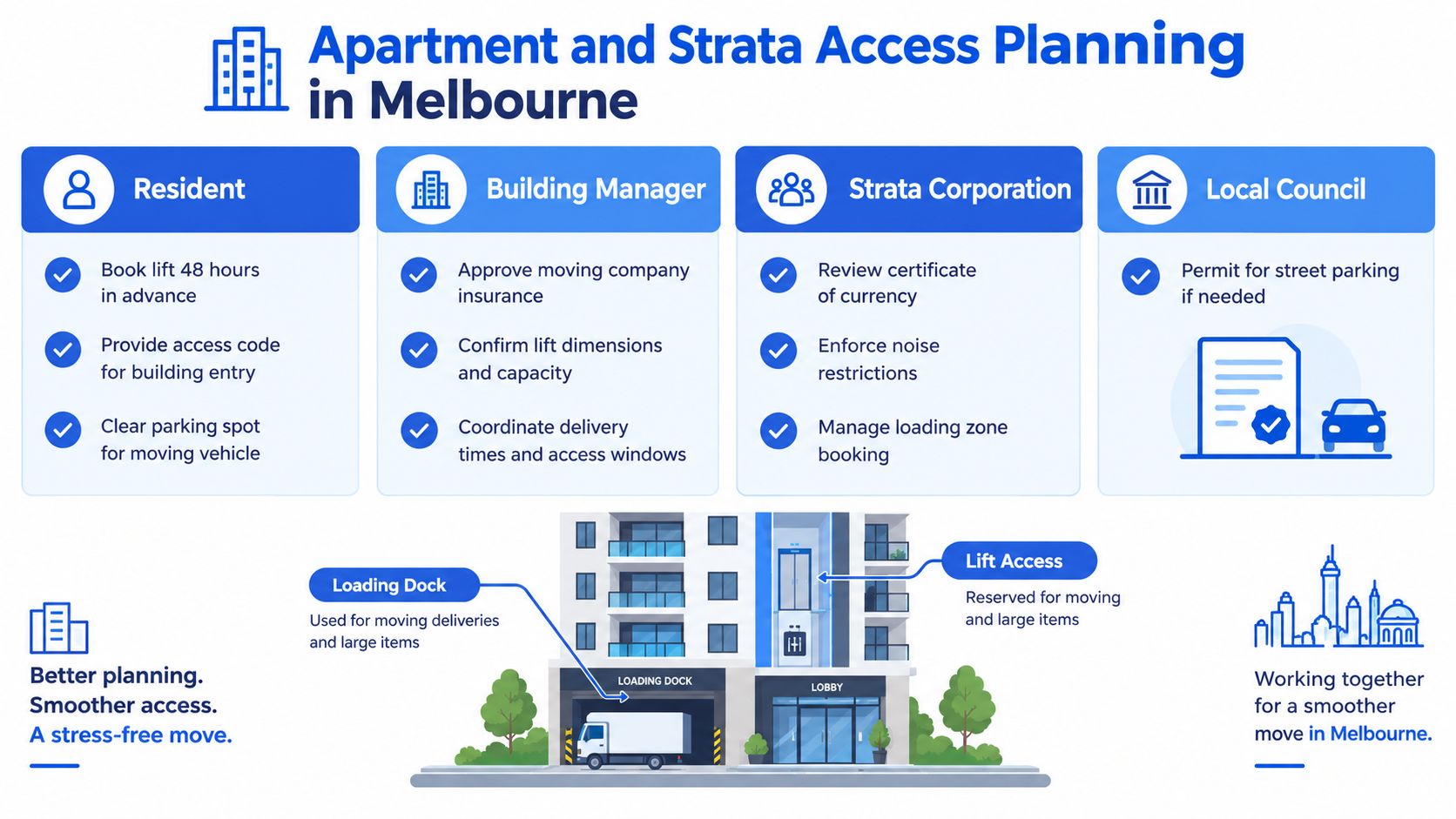
An apartment move in Melbourne often succeeds or stalls before the first box leaves the hallway. The resident books the lift and confirms access, the building manager checks the paperwork, the strata corporation sets the rules for shared areas, and the council may control parking or street permits. If one of those pieces is missing, the crew can be ready and still have nowhere to work.
Who handles what
The resident usually books the lift, shares access codes, and clears a parking spot if one is available. The building manager checks insurance, confirms lift dimensions, and coordinates the delivery window. Strata may set noise restrictions, loading zone bookings, or rules for common property. The council gets involved when street parking or a permit is required.
This is the access layer, the part that determines whether the team can work at all. A Victorian apartment move often depends on shared infrastructure and timed approvals, so a late booking or a changed access window can stop the job even if the packing is finished. In practice, the paperwork works like a gate key. Without it, the truck can be on site and the move still cannot start. Access notes also help in family homes with tight driveways and in regional moves where a long handover window needs to be planned around arrival times.
The safest approach is to document the building requirements before moving day. Keep the lift booking, bay approval, contact name, and any move-in instructions in one place, then share them with the crew. That way, the team is not guessing at the front desk or waiting while someone searches for the right email.
A fallback if the slot is lost
If the lift booking falls through, short-term storage can keep the move alive without forcing a rushed second truck booking. That helps when a settlement date shifts or a lease handover moves. A good removalist will help reschedule the route, but the strongest position is still a confirmed lift, a confirmed bay, and a confirmed insurance pack before moving day.
Fixed Quotes, Pricing Shape and Pre-Move Preparation
Pricing gets messy when the scope isn't clear. A fixed written quote is built from a walkthrough, so the mover can see access, stairs, parking, and any special items before the job starts. Hourly pricing can work for very small jobs, but once the scope grows, the clock becomes another thing the customer has to monitor.
A strong quote normally breaks the move into base transport, packing scope, specialty handling, and storage if it's needed. That matters because a wardrobe move and a full house move aren't the same operational job, even if both use the same truck. If the quote doesn't explain the pieces, the final bill can drift away from the expectation very quickly.
What to do before you book
- Declutter first: less volume means a cleaner quote and fewer surprises.
- Photograph valuables: a quick record helps if something needs checking later.
- Separate an essentials box: keep keys, chargers, medicines, and documents together.
- Confirm parking and access: do this before the truck is committed to a time slot.
One local option that offers fixed, written quotes and a pre-move walkthrough is House Moving Melbourne. That kind of setup suits people who want the job scoped before moving day instead of trying to solve access and pricing issues while the crew is already on site.
Common Assumptions Worth Challenging and How to Choose
A Melbourne move can look simple from the street and still go sideways at the building line. One homeowner may have a careful crew and another may just have a truck, so the difference sits in the planning, protection, and accountability behind the move. Hourly billing can also look cheaper on paper, then grow more expensive once access is tight or the scope shifts during the day.
The biggest risk is often the building access, the lift booking, or an unconfirmed parking slot, not the sofa or the glass table. A family home with a narrow driveway, an apartment with a booked lift, and a regional move with a long carry each need a different access plan. That is why the best filter is practical, not flashy. Ask for a written quote, a single point of contact, and a clear insurance pack. The crew should be able to explain how they will protect floors, walls, door frames, and furniture before the first item is lifted.
A useful test is direct. Ask who confirms the lift, who handles the insurance certificate, and what happens if the loading bay is unavailable.
If they cannot answer cleanly, the move is not ready. If that's the standard you want, book early, lock down the access details, and choose the provider that treats the paperwork as seriously as the lifting.