What Is Public Liability Insurance Cover? Moving Day Guide
Public liability insurance covers a business when it is legally responsible for injury or damage to other people's property resulting from its operations, but it does not cover the business's own trucks and tools, nor does it automatically replace a customer's belongings. If a removalist drops your dining table and it gets scratched, do you think that means the policy pays to repair it? Many assume so, and that is exactly where the confusion begins.
That assumption mixes up three different kinds of cover. Once you separate harm to other people, damage to goods in the mover's care, and your own extra costs, the certificate in front of you becomes much easier to read.
Table of Contents
- Public Liability Cover in Plain Terms
- Which Consequences Public Liability Covers on a Move
- Why Removalists and Clients Need Public Liability Cover
- Limits, Excess and Exclusions to Check in the Policy
- How to Get and Check a Certificate of Currency
- Confirm Your Certificate Before Booking Your Move
Public Liability Cover in Plain Terms
Say a crew carries a bookcase down a shared apartment stairwell. A neighbour comes around the corner, trips over a trolley left in the path, and injures a wrist. In the same move, the bookcase knocks plaster from the stairwell wall. Those two problems, injury to a third party and damage to someone else's property, are the centre of public liability cover.
The Australian Government business guidance on types of business insurance describes public liability insurance as designed to respond when a business's negligence causes a third party to die, suffer injury, or have property damaged. It lists potentially covered consequences including bodily injury or death, emotional distress or a recognised psychiatric illness, physical property damage such as a fire, and consequential loss where another business loses expected revenue. It also recommends checking what insurance is legally required and matching cover to the business's risks.
Public liability pays for harm you cause others, not for your own losses.
Think of it as a safety net under the removalist for harm done to other people while work is under way. The truck needs motor insurance. Injured crew need workers compensation. Your furniture in transit needs transit or goods-in-care cover, and bad advice may fall under professional indemnity.
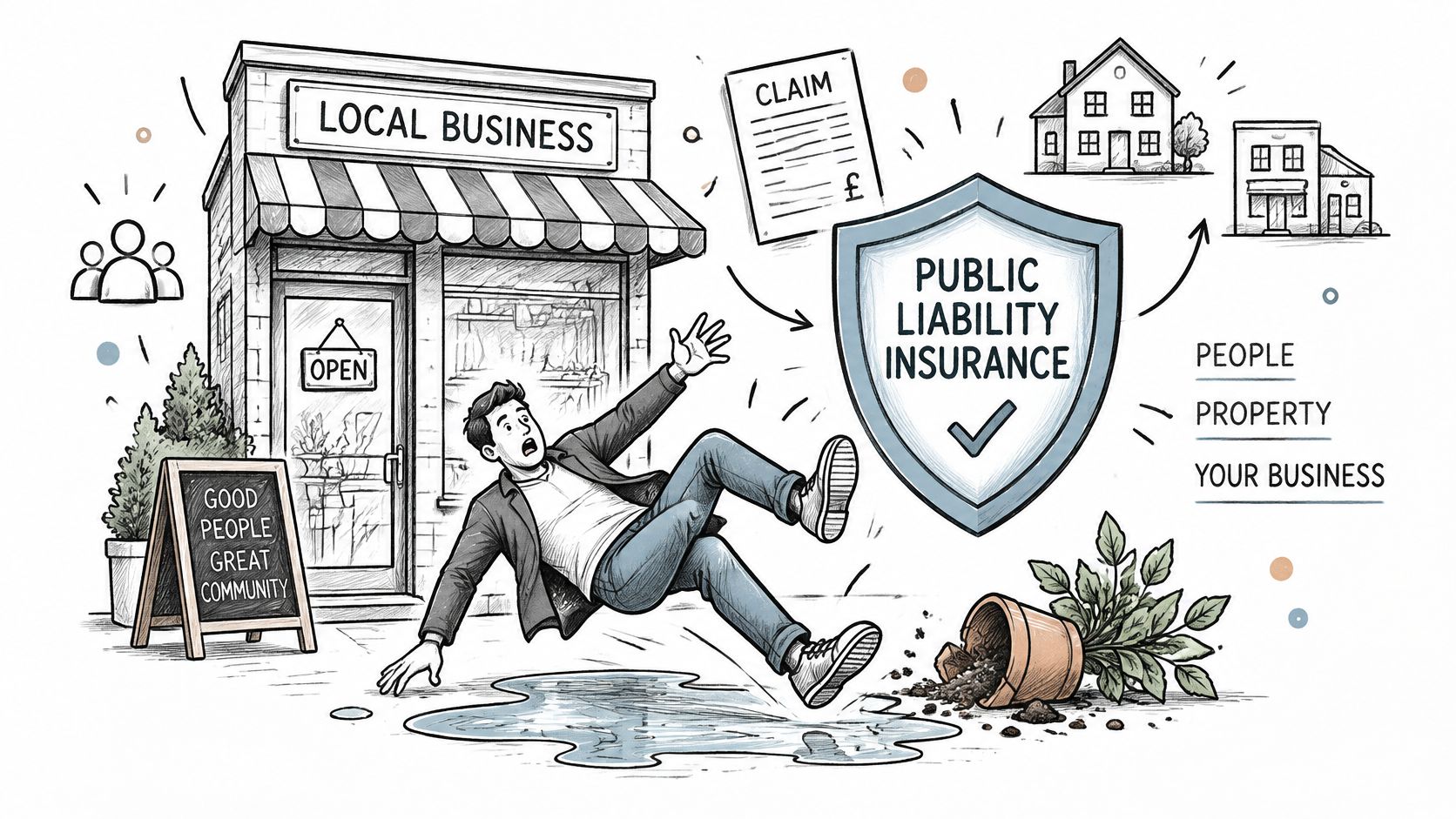
That distinction matters because many customers hear "insured" and picture their own contents policy. Contents insurance protects your belongings. Public liability protects other people and their property from the business, and protects the business from the cost of a claim made against it.
Why the wording still governs
Even a clear incident doesn't guarantee payment. The insurer checks the policy wording, exclusions, insured limit, excess, claims conditions, and whether the activity was disclosed. Keep that plain definition in mind whenever you read a certificate, because the certificate proves a policy exists, while the wording decides what is public liability insurance cover for that particular business in practice.
Which Consequences Public Liability Covers on a Move
Use this table as a quick reference before you test any real incident against a policy.
| Consequence | Move-day example | Public liability responds? | Where to look instead |
|---|---|---|---|
| Bodily injury or death | A bystander is hurt when a wardrobe tips in a driveway | Yes, if the business is legally liable | Workers compensation covers crew injuries |
| Emotional distress or recognised psychiatric illness | Claim follows a serious injury to a third party | Yes, when linked to an injury or negligence | The injured person's own cover |
| Physical damage to third-party property | A client's timber floor cracks when a table is dropped | Yes, if the business is legally liable | Goods-in-care cover for the customer's own items |
| Consequential loss to another business | A neighbouring shop closes for a day after a lift is damaged | Possibly, where negligence causes the loss | Read the policy wording and exclusions |
| Damage to the mover's own trucks and tools | A ramp damages the removalist's truck | No | Motor and tools cover |
| Advice-based errors | Wrong advice about access or insurance requirements | No | Professional indemnity |
| Accidental damage to the customer's own goods | A scratched sofa with no proven negligence | Generally not automatically | Goods-in-care or transit cover |
The APRA explanatory notes for the National Claims and Policies Database are a useful reminder of scope, because that database covers Australian-based public and product liability policies while domestic householders' or tenants' liability sold with home or contents policies is excluded. Published public liability figures therefore don't give a complete picture of household moving losses. For your move, the policy wording matters more than any broad statistic.
The key point is narrower than many people expect. Cover generally responds only where the business is legally liable for bodily injury or property damage arising from its operations. It isn't a no-fault promise to reimburse accidental damage or replace belongings.
Run every incident through three questions
Ask these in order and don't skip ahead to price or blame.
- Legal liability: Is the business legally liable, usually through negligence, for injury to a person or damage to third-party property?
- Goods in care: Is the damaged item the customer's belonging while it was in the carrier's care, which points to transit or goods-in-care cover?
- Follow-on loss: Is someone claiming a contractual or consequential loss, such as lost revenue, rather than the physical damage itself?
Those questions sort most moving-day problems quickly. They also stop you treating one policy as if it answers all three.
Practical rule: First work out whose loss it is, then ask which policy was bought for that loss.
Five incidents tested
The scratched dining table. The table is your property and it was in the mover's hands. Question two does most of the work here, so you need the policy's treatment of customer goods in care, packing standards, and any requirement to prove negligence. Don't assume public liability automatically repairs it.
The marked stairwell wall. The wall belongs to the landlord, body corporate, or building owner, not to you or the mover. That's third-party property, so question one leads. If the crew failed to use padding on a tight turn and the business is legally liable, public liability is the relevant policy to examine.
The damaged lift lining. A torn or dented lift panel is also third-party property, usually controlled by building management. Liability still has to be established, and the wording needs to include loading, unloading, and work in shared building areas. Photographs of the lift before the first load help everyone work out what changed.
The torn sofa. A sofa ripped on a door frame looks similar to the wall, but the owner is different. It's your item in the carrier's care, so it belongs mainly under question two, even if carelessness caused it. Whether public liability also treats goods in care a particular way depends entirely on the wording and any exclusion for property being carried.
The neighbour's lost trading day. Say a damaged lift forces a neighbouring shop to close and lose expected revenue. That's question three, consequential loss, and it's the least automatic of the five. The claimant and insurer will look at negligence, causation, evidence of lost revenue, and whether the policy extends that far.
What doesn't follow automatically
Delayed settlement, missed work, hotel bills, and a tenant's rent feel like natural follow-on costs after a bad move. They're not paid automatically just because they're real costs. Each one needs a legal basis, a covered cause, and policy wording that doesn't exclude it.
Before booking, ask in writing how the policy treats loading and unloading, temporary storage, specialty items such as pianos or artwork, subcontractors, and damage discovered after delivery. Photograph goods, floors, walls, and lift surfaces at pickup and delivery. Those time-stamped photos often decide arguments that memory can't settle a week later.
Why Removalists and Clients Need Public Liability Cover
A building manager asks for a certificate of currency before approving your Saturday lift booking. The crew arrives with a truck, trolleys, and blankets, but no current proof of cover, and the manager refuses access. Your move stalls in the loading bay before a single box reaches the lift.
That scenario explains why this cover belongs in move planning, not in a folder you check afterwards. Crews carry heavy furniture through homes, apartments, offices, loading bays, and shared lobbies where customers, neighbours, tradespeople, and cleaners are moving too. A trolley in a corridor, a ramp on a wet driveway, or a fridge turning through a doorway can injure someone or damage shared property in seconds.
Who asks for proof
You may never ask to see the certificate, but other parties often do.
- Landlords and agents: They want protection for floors, walls, and common property.
- Strata and body corporate managers: They commonly check cover before reserving lifts and loading docks.
- Office and building managers: They need proof before crews enter tenancies and shared areas.
- Commercial clients: They may set insurance as a condition in the moving contract itself.
As at December 2024, the APRA National Claims and Policies Database statistics reported that its database contained every open, reopened or finalised public and product liability claim underwritten since 2003 by Australian APRA-regulated general insurers. That doesn't count removal claims on their own. It shows liability claims are routine enough across industries to be tracked nationally over decades.
For clients comparing movers in Melbourne, current cover does two jobs. It gives an injured person or property owner a policy to claim against, and it clears the practical hurdle of building access. Treat it as a condition of entry and a financial backstop, not as an optional extra a good crew doesn't need.
Limits, Excess and Exclusions to Check in the Policy
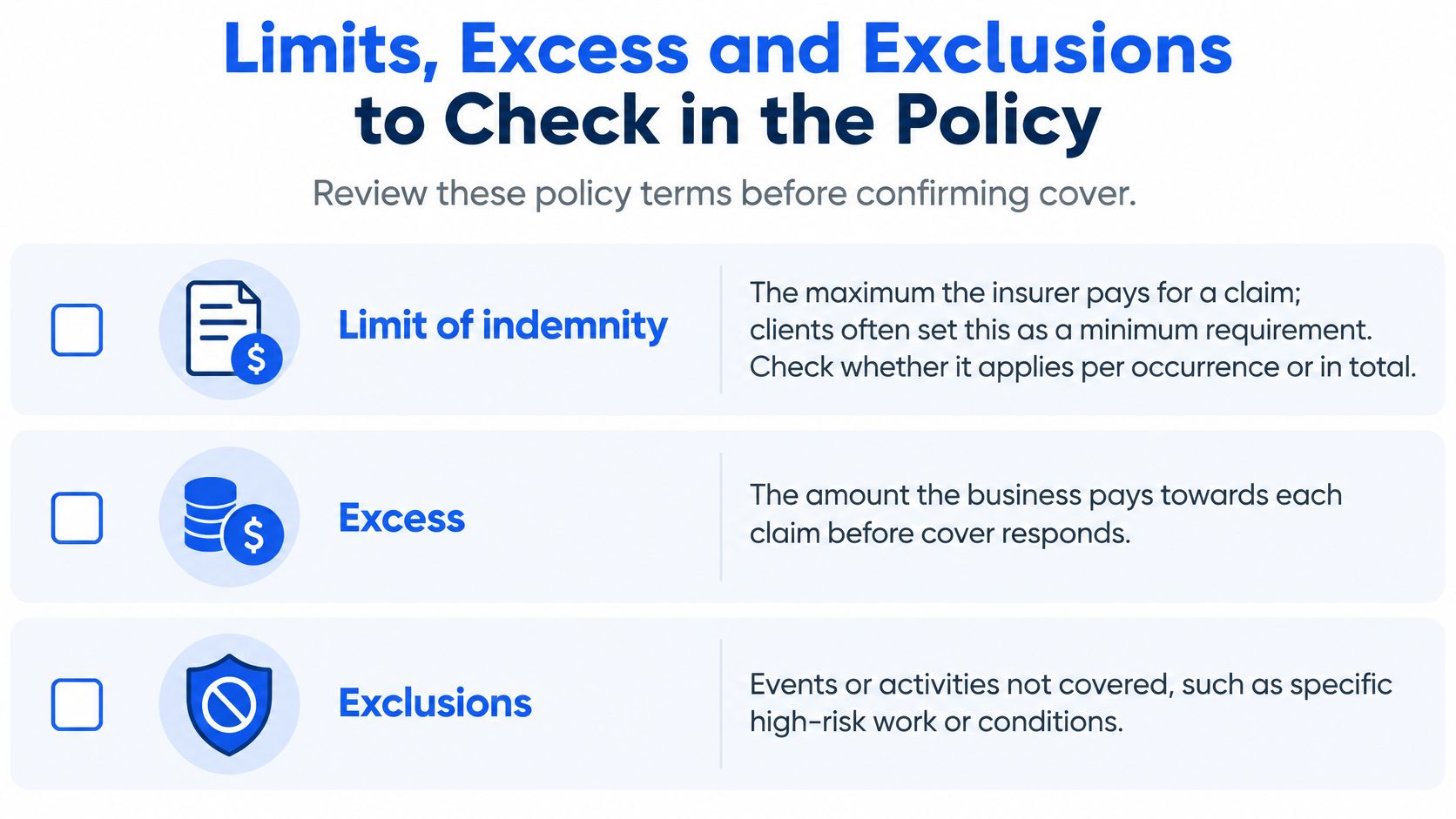
Start with the two numbers, because they decide who pays first and where payment stops. The limit of indemnity is the maximum the insurer pays for a claim, and buildings or clients often set it as a minimum requirement. Check whether that limit applies per occurrence or in total, and compare it with the building's requirement rather than assuming any figure is standard.
The excess is the amount the business pays before cover responds. A claim can be valid and still recover less than the repair bill once that excess is applied.
The visual below summarises the three terms to locate first on any policy schedule.
| Term | What to check | Why it matters |
|---|---|---|
| Limit of indemnity | Maximum paid per claim, per occurrence or in total | Must meet the client or building requirement |
| Excess | Amount the business pays before cover responds | Reduces what the claim recovers |
| Exclusions | Specific activities, vehicles, subcontractors, specialty or high-value items | Can remove cover for an otherwise valid claim |
| Insured activity | Moving, loading, unloading, packing and temporary storage listed | A missing activity can leave a valid claim uncovered |
| Insured party | Named business, trading name and labour hire staff | Must match the company you hire |
| Period | Start and end dates against the moving date | Check renewal timing |
| Claims conditions | Notification deadlines, reporting and cooperation duties | Late notice can jeopardise a claim |
Exclusions that catch people out
Read exclusions as a list of situations where the answer changes. A policy may treat particular vehicles, subcontractors, storage arrangements, specialty items, or work outside the disclosed activities differently. Damage that didn't arise from an insured legal liability can also fall outside cover, even when the damage itself is obvious.
The same care applies whether you're hiring a local crew or door to door movers for a longer trip. Check who is named, which activities are listed, and whether labour hire staff are included. Then check the dates against your actual moving day, including a renewal that falls the week before.
This short video is a useful pause point before you compare those terms with a real certificate.
A low limit or one missing activity can leave a genuine claim uncovered. That's why "fully insured" on a website isn't enough on its own, since the schedule has to match your building, your date, and the work the crew will do.
How to Get and Check a Certificate of Currency
Ask for the certificate when you request the quote, not on moving morning. Work through it line by line while there's still time to fix a mismatch.
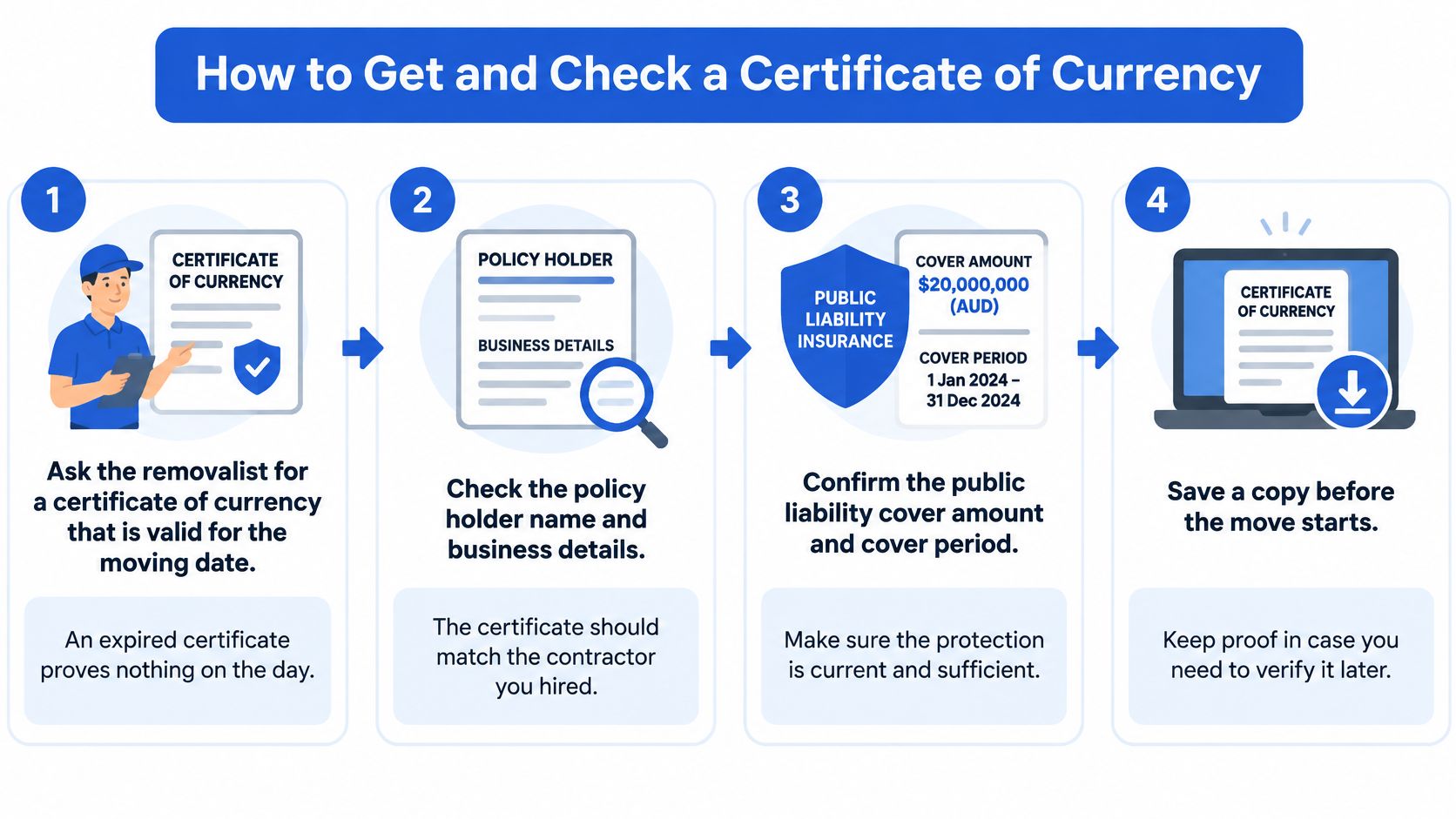
- Ask for a current certificate of currency that covers your moving date. An expired certificate proves nothing on the day the truck arrives.
- Check the insurer, policy number, and policy period. Those details identify the actual policy and confirm it runs across pickup, any storage, and delivery.
- Match the insured name to the business you're hiring, including any trading name. The cover has to belong to the party you're paying, not a related company you haven't contracted with.
- Compare the limit, excess, and listed activities with your building or client requirement. A limit below that requirement can fail the building check even if the policy is current.
- Confirm subcontractors and labour hire staff are covered if they'll be on your job. Unnamed helpers can create a gap when everyone assumed the main policy included them.
- Save the certificate with your booking and send it to the building manager or landlord when requested. Keeping it with lift bookings and access instructions saves frantic searching later.
- Request an updated certificate if renewal falls near the move. A policy renewed after you booked may have a new number, period, or limit that building management needs to see.
We have full transit and public liability cover, and we send certificates to customers before moving day. That timing matters because you can forward the document to building management and resolve any question before the crew is standing in the loading dock.
If the certificate is missing or doesn't match the booking, stop, request it in writing, and don't accept verbal assurance.
That escalation rule protects you without turning the booking into an argument. A business with current cover should be able to produce the document, explain the named party, and confirm the period in writing. If answers stay vague, you've learned something useful while you can still choose another mover.
Confirm Your Certificate Before Booking Your Move
Make one decision before you book. Request a current certificate of currency with the quote, check the name, dates, limit, excess, and listed activities, and ask how the policy treats customer goods, loading, temporary storage, and specialty items. Get those answers in writing rather than relying on a reassuring phone call.
Keep the certificate in your moving file and share it with building management where the building requires it. Do that comparison at least a week before moving day, so a renewal gap, low limit, or missing activity can be fixed while you still have time to change the plan or the booking.
We're fully insured and licensed, so you can ask us directly for our certificate and written answers on those points. Whether you're moving a house or arranging office movers in Melbourne, those are details to confirm in advance, not a guarantee of any claim outcome. A policy responds according to its wording and the facts of an incident, which is why checking early matters more than collecting promises.
Request your certificate of currency with your quote from House Moving Melbourne, compare its limit, dates, and listed activities against your building requirements, and ask us in writing how customer goods, loading, storage, and specialty items are treated. We'll send the relevant certificates before moving day so you can share them with building management and book with the paperwork already sorted.