How to Move Piano Without Injury or Damage
A grand piano can weigh about 300–550 kilograms, according to the Australian Piano and Heavy Item Moving SWMS. That changes the question from whether your friends can lift it to whether trained handlers can control it through every doorway, turn and loading point.
A household move is only realistic for an upright on a verified flat route with trained handlers and suitable equipment. A grand, stairs or a tight landing calls for a specialist crew. Knowing how to move piano equipment safely starts with access and insurance, not buying straps.
Table of Contents
- Piano Weights and When DIY Is Realistic
- Measure the Route Before You Load
- Wrap Crate and Protect the Case
- Move an Upright or Grand Step by Step
- Match Cover Then Book the First Tune
- Book a Crew When the Route Is Not DIY
Piano Weights and When DIY Is Realistic
Piano type, weight and whether DIY is realistic
| Situation | Typical weight | Who should handle it | Essential gear | Household attempt |
|---|---|---|---|---|
| Upright on one clear level | Approximately 200–350 kg | Trained handlers, with crew size set by the handling plan | Rated piano dolly, hump straps, blankets, tail-lift truck | Only with a flat, verified route and trained handlers |
| Grand piano | About 300–550 kg | Specialist crew | Padded skid board, lid restraint, corner pads, lift-equipped truck | No |
| Any piano on stairs or a tight landing | Use the instrument's confirmed weight | Trained crew and a lift supervisor | Suitable stair trolley or hoist, planned rest and escape points | No |
| Older Australian upright | Confirm from its model or specialist assessment | Specialist preferred | Protective wrapping and a pre-move inspection | Rarely |
An upright on a clear level may be manageable on a rated dolly, but only when experienced handlers have checked the entire route, including loading and unloading.
A grand requires a different support and dismantling method, so having enough people to lift it doesn't make a household attempt sensible.
Stairs and tight landings introduce changes in balance and limited escape space that require planned load control, not extra muscle.
An older upright needs its condition assessed before movement because loose joints, damaged feet or previous repairs can make apparently solid handling points unreliable.
Weight doesn't tell you whether the route works
A piano is awkward as well as heavy. Its centre of gravity isn't obvious, its polished case offers poor purchase, and decorative parts aren't lifting points. A short move across a room can still go wrong when a castor catches or a handler pushes from the wrong position.
The practical distinction isn't professional versus willing. It's trained versus improvised. Someone who has moved wardrobes isn't automatically equipped to control an upright as its weight transfers onto a dolly.
A wide doorway also doesn't prove that the piano will fit. The case needs room to approach, turn and leave the opening while handlers remain in safe positions. If people must squeeze between the instrument and a wall, the route needs reassessment.
Choose equipment for the whole job
The dolly's load rating is only part of the decision. Wheel condition, contact points, restraint arrangements and floor suitability all matter. A furniture trolley that can technically support the weight may still be the wrong shape to support the case securely.
Floors, door frames and lift interiors need consideration alongside the instrument. Small wheels concentrate loads, and a sideways bump can damage both the piano's finish and the building.
Decision rule: If the plan relies on someone catching the piano when it tips, you don't have a handling plan.
Choose your row before hiring a truck or buying straps. If it calls for a specialist, stop the household lifting plan there.
Measure the Route Before You Load
Walk the complete path with a tape measure before anyone tilts the case. Measure both properties, not just the difficult-looking departure point.
WorkSafe Victoria's moving and lifting guidance treats large, heavy, bulky, unstable or awkward objects as hazardous manual handling and doesn't prescribe a universal safe weight limit. Force, posture, twisting, repetition and the environment matter alongside the load; employers must provide appropriate information, instruction and training.
Use this checklist to start the access survey.
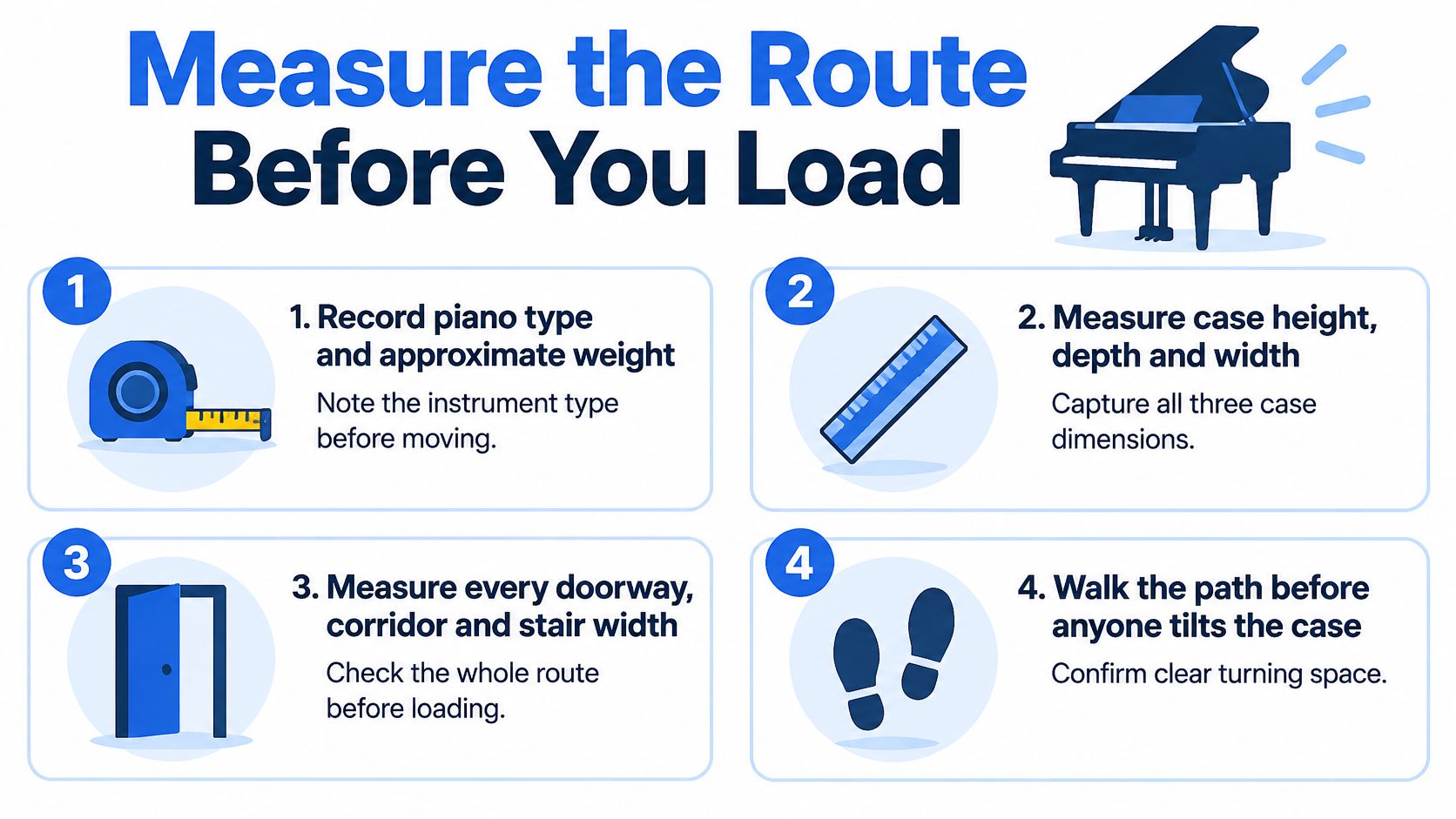
Survey from the piano to the truck
Identify the instrument. Record its type, maker, model and approximate weight. Photograph the back, feet and any existing damage without moving it to get a better picture. If its construction or condition is uncertain, arrange an inspection.
Measure the case height, depth and width, including projecting handles and fixed trim. Then measure every doorway and corridor at the narrowest usable point. Stop if clearance requires removing piano parts without a specialist's approval.
Check the turns. Record stair width, tread layout, handrails, ceiling clearance and landing dimensions. A case that fits between the walls may still be unable to rotate on the landing. Don't proceed without a demonstrated turning plan.
Follow the route outdoors. Note thresholds, gravel, broken paving, slopes and the truck's parking position. Photograph the approach from both directions. Stop if the ground won't support controlled movement or the truck can't reach its planned loading position.
Confirm building restrictions. Check lift door size, internal dimensions, posted capacity and booking requirements. Include the handlers and equipment when checking the intended load. Obtain loading-dock access and building protection requirements before booking the vehicle.
Turn measurements into a working plan
Nominate a supervisor and agree on commands for moving, pausing and stopping. Identify where the load can safely rest and where handlers can step clear. Keep children, pets and bystanders outside the working area.
Substitute carrying with a rated dolly, piano skates, suitable stair-climbing equipment, tail-lift or hoist wherever practical. Ordinary luggage straps and a back belt don't provide load control. Equipment must suit the actual route, not merely be available for hire.
If a sofa also blocks access, arrange its removal before piano day. Planning couch removal in Melbourne separately can free turning space without leaving handlers surrounded by other furniture.
Protect floors, corners, door frames and lift interiors before movement starts. Use stable, secured floor protection that won't bunch beneath the dolly.
Compare the route with the survey on moving day. A parked car, wet driveway or unavailable lift can invalidate the plan. If a critical measurement or access arrangement is missing, the piano stays put.
Wrap Crate and Protect the Case
Wrap the piano before its first tilt, not once it's standing beside the truck. Protection needs to stay in position while the crew transfers the load, turns through openings and secures it for transport.
The wrapping arrangement should protect projecting edges without hiding unsafe lifting points or obstructing the crew's grip.
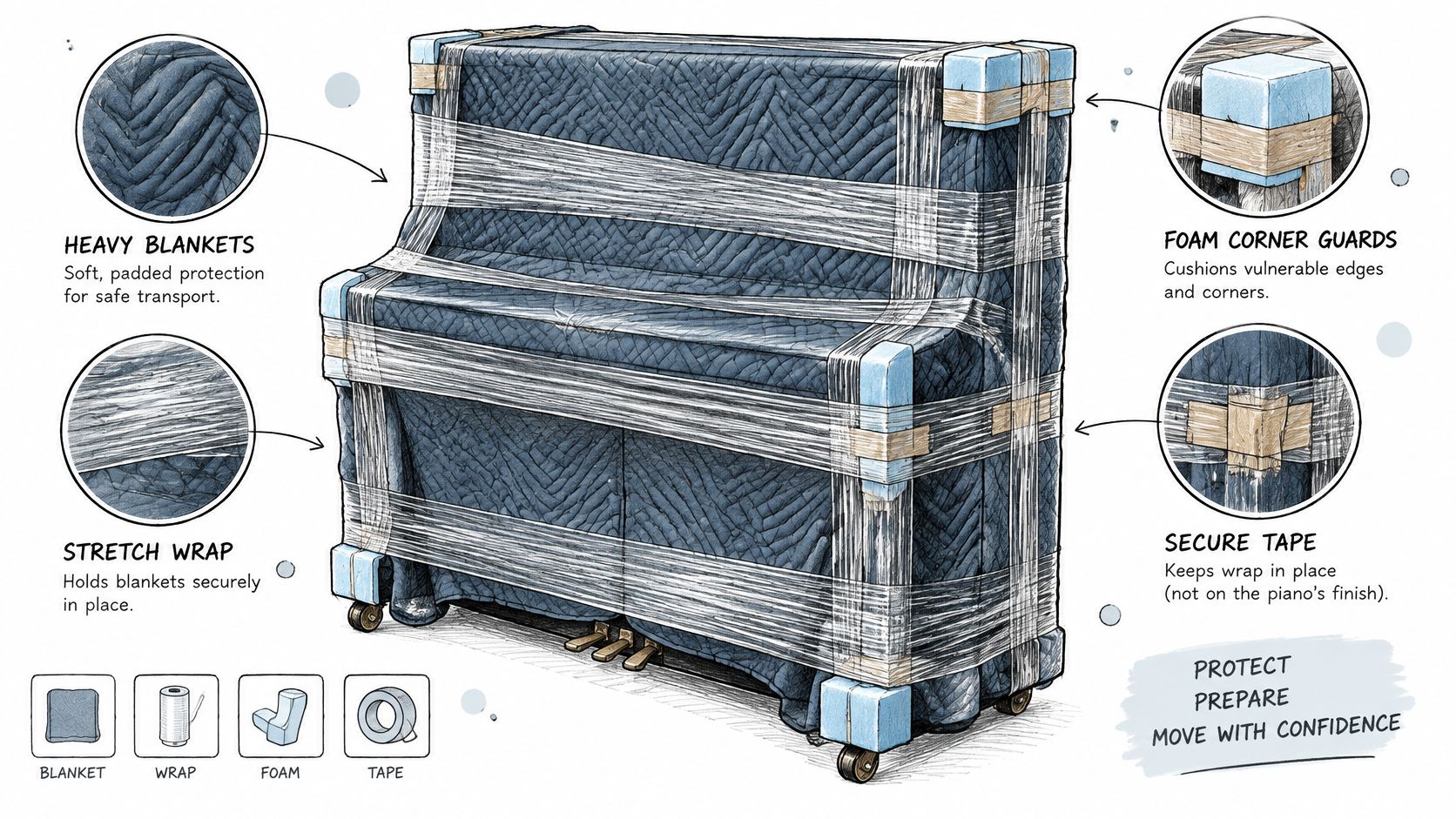
Build protection from the case outwards
Start with clean, heavy moving blankets. Grit trapped against polished timber can scratch it even when the outer wrapping looks tidy. Cover the broad faces, then pad the corners, cheeks and other projections with suitable foam guards.
Use stretch wrap over the blankets to hold them together. Tape the wrapping to itself, never directly to veneer, lacquer or polished timber. Don't overtighten the wrap around delicate trim or trap exposed hardware against the finish.
- Protect the pedals. Pad around them without using them as attachment or lifting points.
- Separate accessories. Pack the lamp, music books and removable accessories in labelled cartons. Wrap the bench separately rather than strapping it against the case.
- Contain removed hardware. Have the specialist bag and label fittings with the component they belong to.
- Keep restraints separate from padding. Blankets cushion contact; rated restraints control movement.
Furniture sliders aren't a substitute for a piano dolly. Where they're appropriate for a controlled positioning adjustment, they belong on a clean, protected floor and under suitable bearing points.
Decide whether a skid or crate is warranted
A long transport leg, valuable finish or storage transfer can justify a custom crate or full skid arrangement. The piano must be supported and restrained inside it; an oversized timber box alone won't stop the instrument moving.
Ask the packer how the case will be supported, where restraints will bear and how the assembly will be handled at delivery. A crate also changes the shipment's dimensions, so it must be included in the access assessment.
Use the video as a visual reference, not a replacement for a site-specific handling plan.
Inside the truck, secure the protected piano to rated anchorage points using suitable load restraints. Never attach a tie-down to the lid or decorative handles. Keep appliances and loose furniture from bearing against it, and don't stack cartons on the case.
Avoid heat and storage shortcuts
Don't leave a loaded van baking in Melbourne summer heat. Sharp changes in temperature and humidity can affect timber, glue joints and the instrument's stability. Plan loading and delivery so the piano isn't left waiting unnecessarily.
If settlement or key collection is delayed, choose climate-controlled storage rather than a garden shed. Confirm the holding arrangement, access conditions and who is responsible for each transfer.
Before the first movement, check that the lid is secured, blankets are snug, corner guards project beyond vulnerable edges, and loose hardware is contained.
Blankets stop scuffs. Restraints stop movement. You need both.
Move an Upright or Grand Step by Step
These sequences describe controlled handling by trained people. They aren't instructions for an untrained household to attempt a heavy lift, and they assume the instrument is already wrapped and the route approved.
An upright and a grand need different support arrangements. Don't apply an upright's lifting habits to a grand just because the same trolley is nearby.
Use the diagram to distinguish the handling paths before the crew starts.
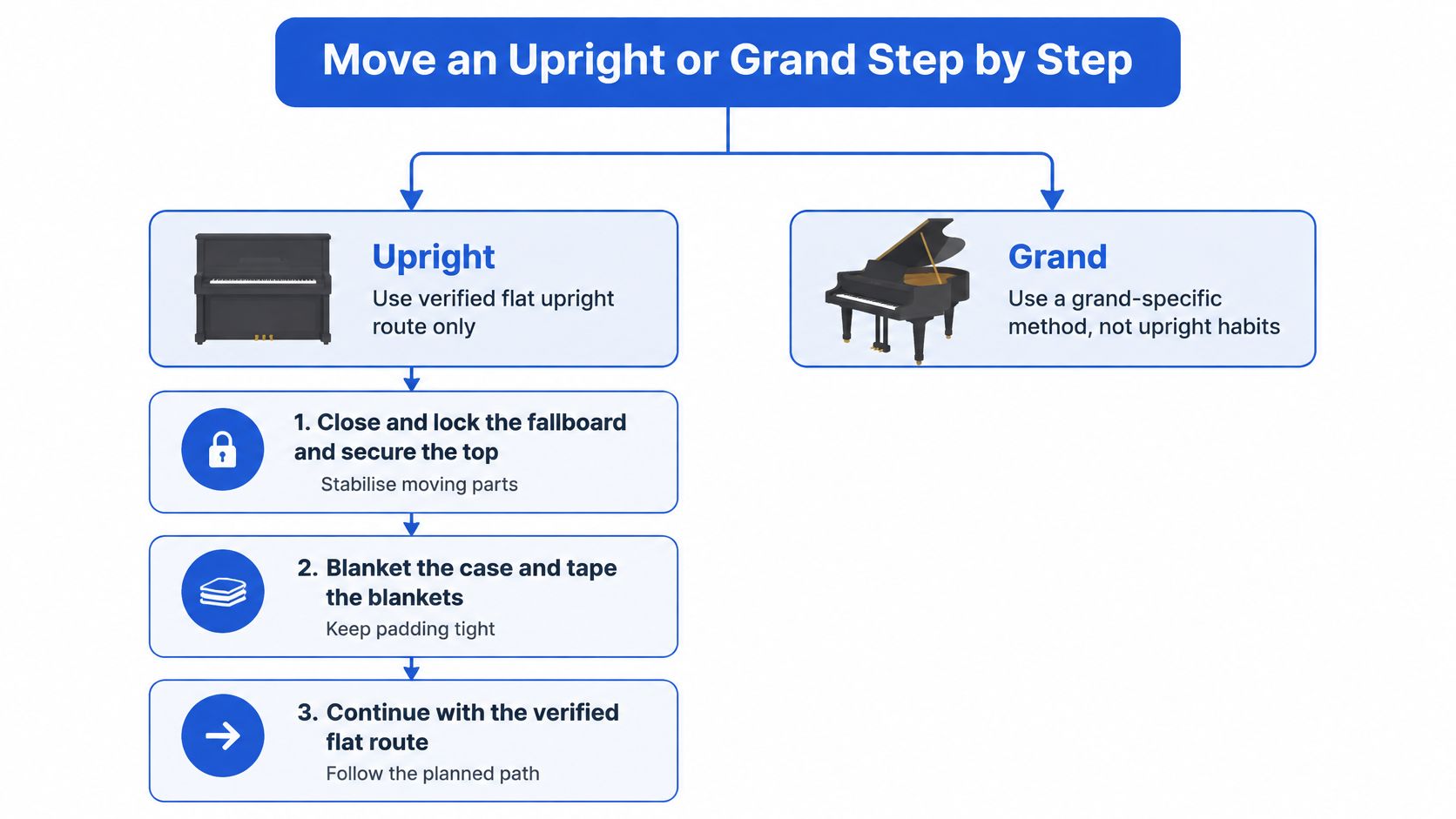
Upright on a verified flat route
Check the closures and support points. Close and secure the fallboard and top without forcing a lock or relying on a damaged latch. Identify structural bearing points beneath the case; legs, pedals and decorative handles aren't suitable substitutes.
Position the rated piano dolly close to the instrument before transferring weight. The crew should use the planned lifting aid or controlled tilt method, taking only the movement needed to position the dolly beneath sound support points. Don't lift from an end and twist the case into place.
Centre and restrain the load. Confirm the piano sits securely on the dolly before rolling. Assign handlers to control the front, ends and back as the plan requires, keeping hands out of pinch points. Nobody should stand where a loss of balance would trap them.
Roll slowly and pause before each turn or threshold. Keep the case upright and avoid sudden starts, sideways shoves or pulling from the keyboard assembly. If a wheel jams, stop rather than applying more force.
Load with the planned equipment. Use the tail-lift or other rated loading system specified for the job. Check the platform can accommodate the piano, dolly and required handlers, and control the load throughout the transfer. Don't improvise a ramp from loose boards.
At delivery, reverse the controlled transfer onto the approved route. A stair trolley belongs only in a specialist plan that already addresses the steps, load restraint and supervisor's commands. Encountering an unexpected step isn't permission to try it manually.
Choosing a piano-moving trolley means matching its support platform, wheels and restraint system to the instrument, not just comparing advertised carrying capacities.
Grand piano under specialist control
Confirm the dismantling method. A specialist should decide whether the music desk, pedal lyre, lid or other components need removal and arrange their refitting. Don't unscrew fittings just to make the case smaller.
Secure the lid and check the padding around the rim, cheeks and corners. The team must know which parts can accept support and which cannot before changing the piano's orientation.
Support the body before removing legs. The crew uses a padded grand-piano skid board and a coordinated transfer method. Nobody should be left holding an unsupported rim while another person works on a leg fixing.
Restrain the supported instrument to its board before travelling. The board, dolly and piano must function as a controlled assembly, with straps bearing on protected, appropriate areas.
Follow the planned loading orientation. A specialist must set the orientation for any ramp or tail-lift transfer according to the equipment and instrument. Don't assume a universal keyboard-first or tail-first rule is safe for every arrangement.
Refit components while the body remains properly supported. Check leg fixings, the lyre and stability before removing handling equipment. Never roll a grand over tiles or thresholds on its own legs.
Finish with a placement check
Set the piano in its agreed position, clear of direct afternoon sun, heaters and damp walls. Use suitable castor cups or supports where needed, and have unevenness assessed rather than wedging loose scraps beneath a foot.
Check that it stands firmly without rocking. If a component appears displaced, don't play it until a technician has inspected it.
Match Cover Then Book the First Tune
Insured doesn't automatically mean adequately insured. Australian piano-moving guidance from Posch & Silva distinguishes transit protection from public liability and notes that high-value instruments may need specific disclosure. You need written answers about your instrument, route and handling arrangements, not just an assurance that the truck is insured.
Piano-move cover and what it leaves out
| Cover | What it is for | Gap to check |
|---|---|---|
| Goods in transit | Loss or damage during transport, subject to the policy wording | Whether loading, unloading, doors, stairs and crane handling are included |
| Accidental handling | Drops and impacts during handling when expressly included | Difficult access, exclusions and responsibility at both addresses |
| Public liability | Liability for injury or third-party property damage, potentially including floors, walls and lifts | It isn't a substitute for cover on the piano itself |
| Household contents | Belongings covered under your home policy | Transit exclusions, removalist conditions and limits below the piano's value |
Send specific questions before paying a deposit
A restored or inherited piano may be worth more than its purchase price suggests. Conversely, sentimental value doesn't automatically establish an insured value. Ask what valuation evidence the insurer needs and have any antique or restored status recorded.
A marked lift wall and a damaged soundboard are different losses. Confirm who handles each claim and whether the mover's responsibility changes when a subcontractor, storage operator or crane contractor takes possession.
Include these requests in your booking email:
- Certificates of currency. Ask for current transit and public liability documentation, then request the relevant terms and exclusions.
- Declared value. State the instrument's proposed value and ask whether it has been accepted for cover.
- Handling scope. Confirm protection during loading and unloading at both addresses, not just while travelling.
- Access and transfers. List stairs, lifts, crane work, difficult access and storage transfers, and request written acceptance.
- Claim costs. Ask about excesses, limits, repair assessment and the process for reporting damage.
Don't treat a certificate as the complete policy. It demonstrates that a policy exists, but it doesn't answer every question about what your particular move includes.
Before booking: Ask the mover to explain the likely claim pathway if the piano is damaged while crossing your front threshold.
Arrange tuning around the instrument's condition
Book a piano technician, but let them set the tuning date according to the move, storage history and new room conditions. There isn't a useful universal waiting period for every instrument and every property.
Keep the room conditions reasonably stable while it settles. Light playing is reasonable if the piano is stable and appears undamaged, but stop if notes stick, the action behaves differently or you hear an unfamiliar mechanical noise.
Ask the technician to inspect the action and accessible fittings as well as tune it. Photograph the piano after placement and compare it with the pre-move condition record. Report suspected transport damage promptly under the policy's notification requirements rather than waiting for the tuning appointment.
Book a Crew When the Route Is Not DIY
If your route includes a tight heritage doorway, restricted lift or uncertain landing, book an assessment rather than recruiting more helpers. High declared value or fragile condition is also a sound reason to hire a specialist, even when access looks straightforward.
Melbourne's older instruments deserve particular care: the Wertheim factory produced approximately 18,000 upright pianos between 1908 and 1935, according to Steinway Australia's account of Australian piano history. An inherited upright may need a condition assessment and a handling method suited to its construction, not the approach used for a modern digital keyboard.
Give the estimator a complete picture
Send the piano type, model if known, approximate weight and clear photographs. Include the departure room, destination position, external approach, stairs, lift and truck parking area. Describe repairs, loose fittings or anything you're unsure about.
House Moving Melbourne is one option among Melbourne removalists for specialty-item handling, packing, transport and storage across metropolitan Melbourne and regional Victoria. It offers in-person or video walkthroughs, fixed written quotes and a single point of contact; custom crating is available on request.
Ask the assessor who will carry out the work and what piano-specific equipment they'll bring. Confirm whether the employed crew assigned to the plan will complete the move, including placement, rather than handing the instrument between unidentified teams.
Make the quote describe the actual move
A useful written quote separates the base move, packing and extras. It should also record the assumptions that could change the job.
- Access costs. Include stairs, lift bookings, loading-dock restrictions and the distance from the truck.
- Handling resources. Specify crew requirements, loading equipment and any skid or crate.
- Storage arrangements. Record holding charges, climate control and delivery coordination.
- Insurance additions. Identify any extra cover, declared-value requirements or specialist handling conditions.
If settlement dates clash, ask about climate-controlled storage billed weekly and how transfers will be managed. Storage doesn't eliminate handling, so establish who is responsible from collection through final delivery.
Keep the survey, quote, access approvals and insurance confirmations together. Book the assessment before clearing the hallway or committing to a hire truck. The right booking decision comes from the route and the instrument's condition, not from how many friends are available.
House Moving Melbourne offers piano handling, protective packing, custom crating on request and climate-controlled storage when moving dates don't align. Visit House Moving Melbourne to arrange an access walkthrough and request a fixed written quote covering your piano, both properties and any special handling.