Piano Moving Trolley Guide for Safe Melbourne Relocations
A piano rarely becomes difficult at the front door. The trouble starts when the crew reaches the narrow footpath, the first threshold or the stairwell turn. A heavy upright may have to leave a Brunswick terrace, cross a tram-lined street and pass through an apartment lobby before it reaches the truck. Without the right equipment, every change of level becomes a lift, a pivot or a last-second catch.
A piano moving trolley gives the crew a controlled way to roll, steer and stop the instrument across suitable surfaces. It doesn't remove the need to measure the route, secure the piano or provide enough trained hands. In Melbourne and regional Victoria, trolley selection is only one part of the decision. The load rating, wheel design, access path and crew plan all have to agree.
Table of Contents
- What a Piano Moving Trolley Actually Does
- Types, Frames, and Load Ratings
- Piano Trolley vs Standard Dolly and Other Options
- Matching the Trolley to Your Access
- Safety, Force Limits, and Crew Sizing
- Hiring vs Buying a Piano Trolley
- Practical Safety Checklist for a Piano Move
- When a Professional Piano Crew Is the Better Answer
What a Piano Moving Trolley Actually Does
A piano moving trolley is a purpose-built heavy-duty hand truck or platform designed to support a piano while movers control its movement. Unlike a basic furniture dolly, it normally has a broad support area, padded contact points, large wheels or castors, and places to attach straps. Those features help keep the instrument supported near its centre of gravity instead of allowing it to rock on a small, unstable platform.
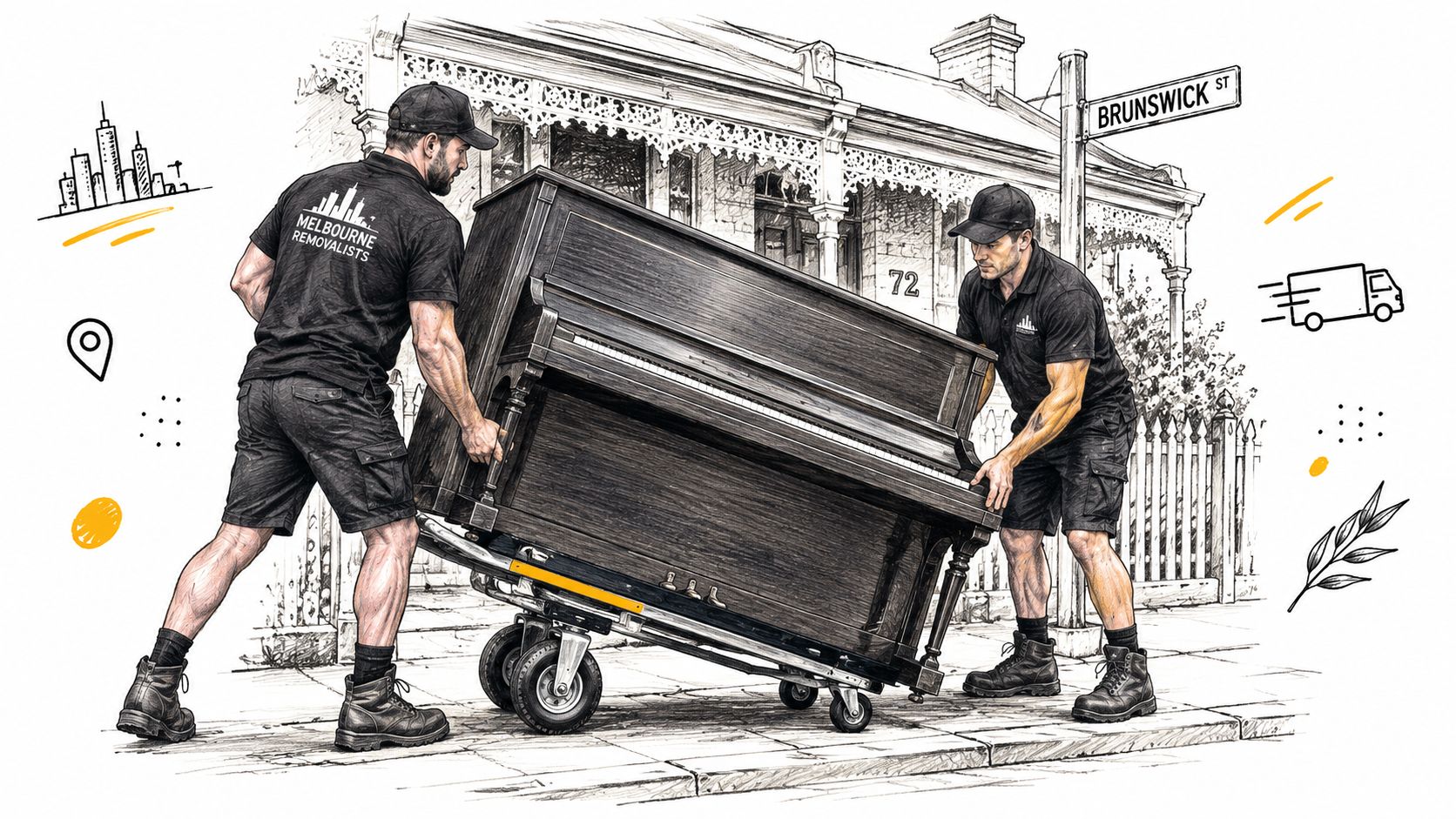
The practical problem it solves is simple. A piano is awkward to grip, difficult to balance and vulnerable to impact, so a crew needs to turn the load into something that can be rolled and restrained. On flat paving, a suitable trolley can make the kerb-to-door section far more controlled. It can also help on short ramps or carefully managed thresholds, provided the wheels, frame and straps are appropriate for the load and surface.
The trolley doesn't lift the piano by itself. Movers still need to tilt, position and strap the instrument, and they must control it whenever the load changes height or direction. A trolley is also not a long-haul transport device. It handles the controlled movement between the vehicle and the building, while the piano must be secured separately for travel in the truck or trailer.
Practical rule: Treat the trolley as the load-control point, not as a substitute for route planning or a trained crew.
Victorian kerbs, cracked footpaths, narrow side gates and apartment lobbies expose weak equipment quickly. A small wheel can catch at a threshold, while an overloaded frame can twist when the piano turns. The right trolley reduces those risks only when the route permits rolling. If the piano has to be carried over a landing, dragged around a switchback or held on a steep descent, the job has already moved beyond ordinary trolley work.
Types, Frames, and Load Ratings
A trolley that is strong enough on paper can still be the wrong choice for a Melbourne move. Match the safe payload to the piano first, then check the frame, wheels and route. A compact trolley may suit a smaller upright on a flat path, while a full-size upright needs more support and a wider safety margin. If the access includes stairs, tight turns or uneven paving, the rating alone does not make a basic trolley suitable.
Australian equipment listings provide useful reference points. One piano trolley is listed with a 300 kg safe payload, a 13.5 kg trolley mass, a 260 mm by 370 mm by 760 mm frame and 220 mm puncture-proof wheels (Australian piano trolley specifications). The equipment's own weight matters less than how its wheels, frame and support points handle the instrument. A trolley can meet the payload requirement yet become unstable when the piano sits off-centre or crosses a threshold.
Other Australian piano-trolley listings place equipment in the 250 kg to 450 kg range, with reinforced models listed at 450 kg on frames measuring 860 mm by 500 mm, using 200 mm solid rubber or 250 mm pneumatic wheels (Australian piano trolley hire specifications). These figures help with selection, but they are not permission to work at the maximum rating. Supplier guidance still needs to be checked against the instrument, the load position and the conditions of the move.
Match the frame to the instrument
A lighter upright or spinet may work with a compact upright trolley if the frame supports the base and the path stays level. A full-size upright needs a stable contact area, firm strap points and wheels that will not deform as the load turns. For a grand piano, use a piano board or dedicated grand support system. Do not balance the instrument on an ordinary upright hand truck.
For an owner-mover in Victoria, the practical test is simple: weigh or verify the piano's mass, compare it with the trolley's safe payload, then inspect the route before hiring equipment. Allow margin for the piano's uneven centre of gravity and for jolts at kerbs, door sills and cracked paving. A narrow frame may pass through a doorway but leave too little support under the instrument. A broad frame may carry the load better but fail at a gate or tight landing.
| Trolley Type | Typical Capacity | Best For |
|---|---|---|
| Compact upright trolley | Australian listings commonly range from 250 kg to 300 kg | Smaller uprights and flat, unobstructed access |
| Heavy-duty upright trolley | Australian listings commonly range from 250 kg to 450 kg | Heavier uprights where the frame and wheels provide adequate margin |
| Grand piano board trolley | Local equipment references list models around 400 kg to 600 kg | Grands secured to a board, with a trained crew |
| Four-wheel piano dolly | Australian listings commonly range from 300 kg to 600 kg | Flat loading docks, truck floors and clear internal runs |
Powder-coated steel generally provides stiffness and impact resistance. Aluminium reduces equipment weight, but it must still resist twisting under an uneven piano load. Check toe-plate width, padding, strap points, wheel diameter and tyre type. Pneumatic wheels can handle some outdoor irregularity. Solid rubber or puncture-proof wheels remove puncture risk and may be preferable where reliability matters more than cushioning. If the route requires stairs, a skid board, stair climber or specialist piano crew is the safer equipment decision.
Piano Trolley vs Standard Dolly and Other Options
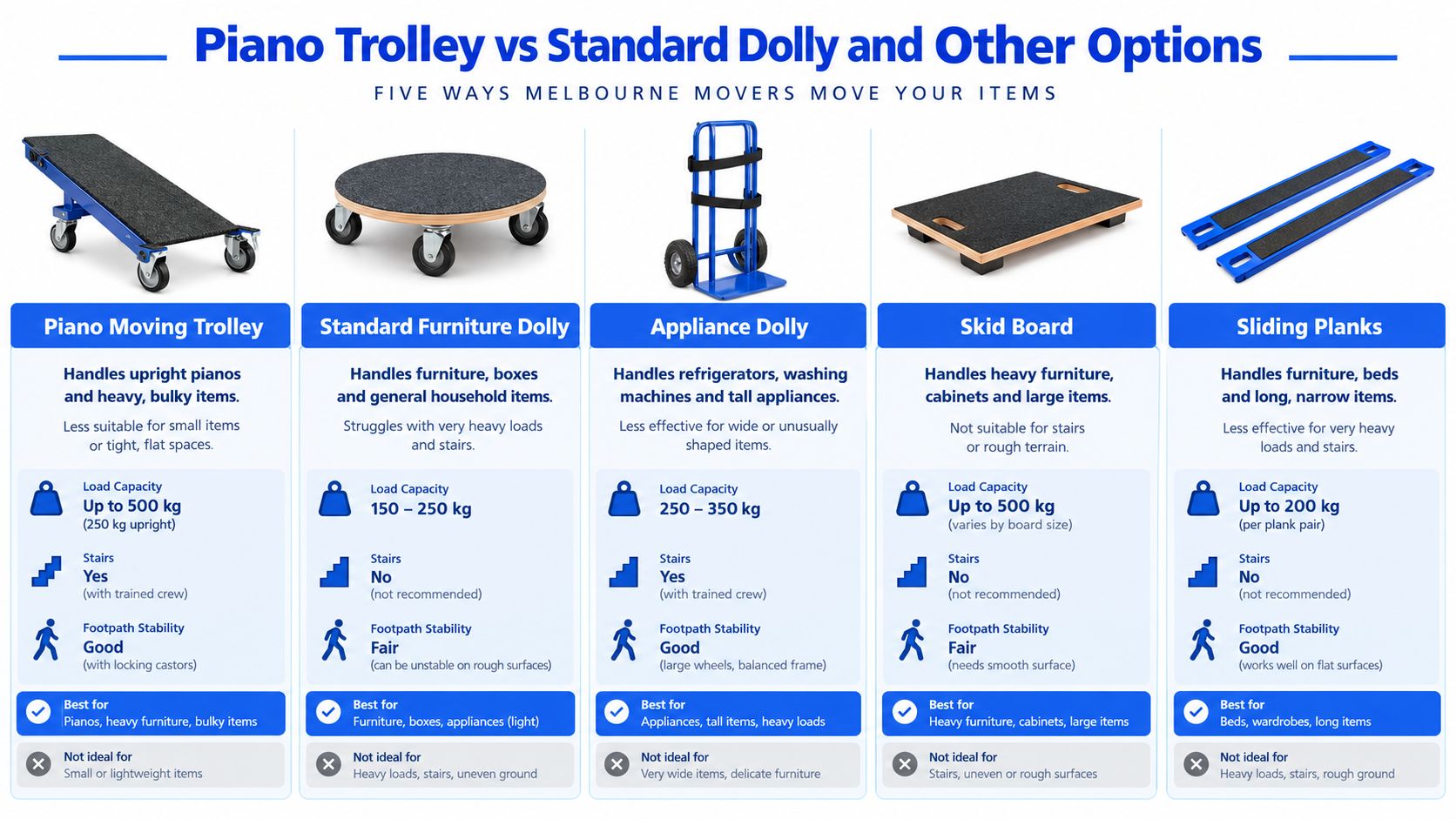
On a Melbourne footpath, a standard furniture dolly is usually the wrong first choice for a piano. It works well after the instrument is on a level truck floor, where its low platform can roll across a smooth, straight surface. Kerbs, tilted loads and sloping driveways are different. The dolly gives the operator less control, and a round platform can let a top-heavy piano shift if the load is not secured properly.
Furniture skates suit short internal repositioning. Use them to move a piano or piano board across a smooth warehouse floor, loading dock or room. They are poor choices for footpaths, lawns, stair flights and broken driveways because the small wheels offer little control over uneven ground. An appliance dolly may resemble an upright piano trolley, but its frame and contact points may not suit the piano's shape, finish or centre of gravity.
Check the rating before choosing any substitute. The equipment must carry the piano, its board and protective materials with working margin, not merely match the instrument's estimated weight. A correctly rated appliance dolly may handle a simple upright move, but it still leaves questions about padding, strap points, frame width and the route itself. If those points are uncertain, use a piano-specific trolley or change the moving plan.
A stair-climber or stair robot is the better fit when stairs prevent ordinary wheels from staying stable. It takes more setup and may be harder to hire, but it is designed for controlled movement on a flight. A skid board offers another specialist method. The piano is secured to the board, then the crew controls the board along the stair path instead of balancing the instrument on small wheels.
Where each option earns its place
| Equipment | Works Well On | What It Doesn't Solve |
|---|---|---|
| Piano moving trolley | Paved flat ground, controlled thresholds and loading areas | Stairs, soft ground and uncontrolled steep descents |
| Standard furniture dolly | Smooth truck floors and level internal surfaces | Kerbs, stairs and top-heavy tilting |
| Appliance dolly | Some upright moves when correctly rated and padded | Piano-specific support, awkward stair geometry and fragile finishes |
| Skid board | Planned stair work with trained operators | Fast movement across rough outdoor ground |
| Furniture skates | Smooth floors and short internal repositioning | Footpaths, ramps, stairs and broken surfaces |
A combined setup often makes the move workable. Use a piano moving trolley for the kerb-to-door leg, then change to a piano board, stair-climber or skid system where wheels stop giving reliable control. Route planning guidance also supports using straps and corner protection, while checking doorways, stair turns and lift clearance before the move (Australian route-planning and equipment guidance).
Book the stair-climber or skid board for the stair section and the trolley for the kerb-to-door leg. Hiring one tool for both sections is a common cause of a stalled move.
Matching the Trolley to Your Access
A trolley is suitable only when the access path lets the crew maintain control of the load. Start at the kerb and walk all the way to the piano's final position. Don't inspect only the front door. Measure every doorway, side gate, landing, lift and turn, then identify where the instrument would have to leave the wheels.
Older Melbourne terraces often combine narrow entries with sharp turns and stairwells that give movers little room to reposition. Newer apartments may offer flatter access but impose lift-cage limits, loading dock rules or strict booking windows. A regional property can present a different problem, such as a sloping drive, loose gravel or soft ground beside the entrance.
The go or no-go checks
Check the following before the trolley arrives:
- Doorways and turns: Measure the clear opening, not the nominal door size. Include the piano board, padding and the space needed for movers to hold the frame.
- Thresholds and steps: Identify every raised lip, step-down and drainage channel. A small change in level can shift the centre of gravity when the trolley crosses.
- Stairs: Count the flights, inspect the tread condition and look at landings. A straight flight may permit a skid system, while a switchback can require a specialist plan.
- Lifts: Confirm the cage depth, door opening, building weight restriction and booking requirements. A piano may fit through the door but fail to turn inside the cage.
- Ramps and driveways: Judge the gradient, surface grip and stopping space. A trolley that rolls safely on level concrete may not be controllable on a steep or wet slope.
A route is not suitable just because the piano can physically pass through it. The crew must also be able to stop, turn and recover without placing hands or feet in the line of travel.
| Access Condition | Upright Trolley | Stair-Climber or Skid Board | Piano Board and Skates |
|---|---|---|---|
| Level paved path | Usually suitable if rated and strapped correctly | Usually unnecessary | Suitable on smooth surfaces |
| Single threshold or small step | Assess wheel diameter, approach and landing space | May provide better control | Suitable only when the board can cross safely |
| Straight stair flight | Generally unsuitable as a basic rolling tool | Purpose-built option | Suitable with trained operators and a controlled system |
| Tight switchback stairs | Usually unsuitable | Requires specialist assessment | Requires specialist assessment |
| Lift with a clear, level approach | Often suitable after checking cage dimensions | Usually unnecessary | Suitable if the board and skate footprint fit |
| Gravel, lawn or soft ground | Risk of sinking or wheel instability | Depends on the equipment and surface | Generally unsuitable without a firm route |
For a broader move involving apartment access, parking and room placement, the residential moving planning process should include the piano route rather than treating the instrument as an ordinary item.
If the answer is clearly no at any point, stop comparing trolley models and change the handling plan. The right response may be a stair-climber, a skid board, temporary protection and a specialist crew.
Safety, Force Limits, and Crew Sizing
WorkSafe Victoria provides a practical force benchmark for trolley selection. Where employees push a trolley more than 3 metres, the rolling force shouldn't exceed 12 kg-f, according to its guidance on choosing and using trolleys. That isn't a piano weight limit. It is a handling check that helps identify whether the trolley, wheels, floor and route are creating excessive resistance.
The distinction matters. A piano may sit within the trolley's safe payload and still be unsafe to move if the wheels bind, the surface is uneven or the operator must pull sideways to keep it aligned. Comcare's national guidance also directs workers to push trolleys forwards rather than pull them, which reinforces the importance of direction and control for awkward heavy loads.
Build the crew around the hardest movement
A flat, clear path may allow a smaller trained crew to control an upright, but no one should treat a piano as a one-person trolley job. Stairs, ramps, tight turns and grands increase the number of people needed because the crew must control both the load and the surrounding space. Assign one person to steer, another to manage the opposite end or stabilise the frame, and a spotter to protect doorways and warn of changing conditions.
Keep the load centred over the axle or support area. Clean the wheels before the move, remove loose objects from the route and don't use a rope or improvised tie that can slip. Strap the piano to the trolley, protect the cabinet and keep bystanders away from the line of travel.
- Push in the direction of travel: Avoid sideways pulling that can rotate the load unexpectedly.
- Stop before every change of level: Reassess the threshold, ramp or landing rather than carrying momentum into it.
- Lock the trolley when stationary: Never leave a loaded piano unattended on a slope or near a doorway.
- Use protective equipment: Closed-toe footwear, suitable gloves, floor protection and a piano cover should be ready before loading.
- Stop when conditions change: A wet surface, damaged strap, unstable wheel or unexpected obstruction is a reason to reset the plan.
The legal duty doesn't disappear because the move is private or familiar. A business conducting the work must manage manual-handling risks, and workers must take reasonable care of themselves and others. If the force required rises beyond controlled pushing, the trolley isn't performing an acceptable handling function on that route.
Hiring vs Buying a Piano Trolley
For a single household move, hiring usually makes more sense than buying. You can select equipment for the actual piano and access route, avoid storing a bulky frame and ask the hire provider whether the trolley is intended for thresholds, loading docks or stairs. The hire decision should still include a proper inspection. A trolley with worn wheels or missing straps isn't a bargain.
Ownership becomes more sensible for a removalist, school, church, venue or piano technician that moves instruments repeatedly. Regular users can justify secure storage, planned maintenance and a consistent equipment setup. They also learn which frame widths and wheel designs suit the buildings they service.
The hidden ownership costs
The purchase price is only one part of ownership. A trolley kept outdoors can suffer bearing and weld damage, while straps need replacement when webbing, buckles or stitching show wear. A model that suits one upright may not provide enough platform width or payload margin for the next job. Storage space also matters because a frame that blocks a passage or sits unprotected in a vehicle creates its own hazard.
For owner-movers, a competent crew plus a suitable hire package is generally the more defensible choice when the move is occasional. Hire a piano board or stair equipment when the access requires it instead of buying a basic trolley and trying to make it cover every situation.
Ownership test: Buy when the equipment will be used repeatedly, inspected routinely and stored properly. Hire when the move is unusual, access is uncertain or the required tool changes from job to job.
Before booking, provide the piano type, approximate mass if known, photographs of every access point and the full route from parking to destination. A pre-move walkthrough is more valuable than choosing a trolley from a product photograph. For a general explanation of how a move can be assessed and organised, see how the moving process works.
Practical Safety Checklist for a Piano Move
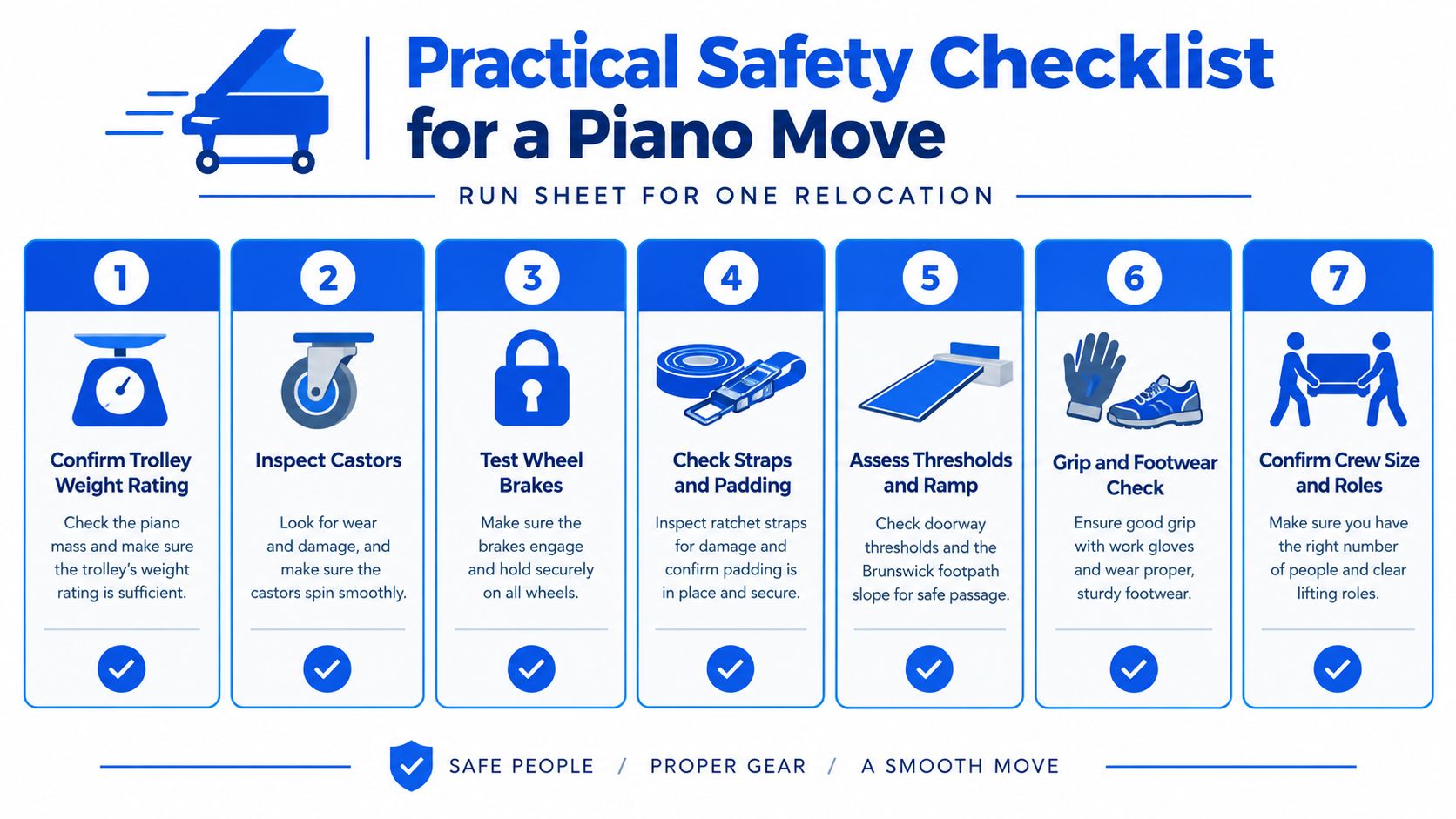
Use this as a run sheet, not as a substitute for a competent assessment. If one answer is uncertain, pause before the piano is tilted.
- Confirm the load rating. Check the piano's known or estimated mass against the trolley's safe payload. Allow for the board, padding and the way an uneven load will sit on the frame.
- Inspect the trolley. Spin each wheel, look for damage and check that the frame doesn't flex or twist under hand pressure.
- Test the restraints. Inspect ratchet straps, padding, attachment points and toe locks. Replace anything cut, frayed, bent or unreliable.
- Walk the route. Remove rugs, door stops, loose mats, cords and furniture. Mark thresholds, steps, lift doors and any surface that may reduce wheel grip.
- Set the roles. Name the steering operator, the stabilising operator and the spotter. Use one clear command at a time, especially at a doorway or change of level.
- Prepare protection. Have gloves, closed-toe or steel-cap footwear, floor protection, corner protection and a piano cover on site before loading.
- Stop on a failed control. A wobbling piano, soft ground, broken strap, seized wheel or unexpected step means the move is aborted until the method changes.
During movement, keep the load balanced and use controlled pressure rather than sudden force. Nobody should place a foot under the frame or try to catch a piano that begins to fall. If the trolley starts to roll away, clear the line of travel and let the crew use the planned restraint or recovery method.
The handover is not complete when the wheels stop. Secure the load in the vehicle, strap the lid and other loose parts, protect the destination floor, and confirm that the piano is stable before removing the trolley. Once positioned, allow the instrument to settle in its new environment before arranging any follow-up service.
When a Professional Piano Crew Is the Better Answer
A basic piano moving trolley is a good fit for an upright or smaller instrument on a measured, paved and mostly level route. It reaches its limit when the crew must lift the piano off the wheels in an unsuitable place, control a steep driveway, cross soft ground, negotiate curved stairs or protect a floor that cannot tolerate a mistake.
The handover triggers are practical:
- The route needs uncontrolled lifting: If the piano must be carried over a landing or held away from the trolley, use a different system.
- The stairs dominate the move: A stair-climber or skid board may be needed, particularly where landings and turns prevent a straight approach.
- The instrument is unusually heavy or valuable: A grand or a delicate heritage instrument deserves an equipment and insurance plan built around it.
- The floor and building are vulnerable: Polished timber, heritage finishes, tight lifts and shared apartment spaces leave little room for recovery.
- The crew cannot document the controls: If nobody can explain who steers, who spots, how the piano is restrained and how the route is protected, the move isn't ready.
A specialist piano crew can bring piano boards, skid systems, stair equipment, heavy-duty trolleys, lifting straps and a documented access plan. It can also coordinate building access, floor protection and insurance requirements. Australian guidance on fragile piano delivery highlights the need to assess manual handling, use suitable equipment and secure unstable loads rather than relying on improvised methods (Australian fragile-delivery and handling guidance).
| Scenario | Piano Trolley for an Owner-Mover | Specialist Piano Crew |
|---|---|---|
| Level path from vehicle to room | Possible after rating and route checks | Suitable, with a managed setup |
| Narrow terrace entry with sharp turns | Often a poor fit | Better for route planning and controlled positioning |
| Stairs or multiple changes of level | Basic trolley is usually unsuitable | Can select a stair system and trained crew |
| Heavy grand or awkward board load | May exceed the equipment or crew plan | Specialist equipment and handling method |
| Heritage floor or high-consequence damage | Limited recovery options | Protection, documented controls and insurance planning |
Simple rule: Use a piano moving trolley for the easy, firm and measurable path. Use a specialist piano crew for everything that requires a lift, a stair system, unusual equipment or a recovery plan.
For a move where protection and liability documentation matter, review the moving coverage information before confirming the booking. The safest decision isn't always the trolley with the highest advertised rating. It's the method that keeps the piano, crew, building and route under control from the first strap to the final placement.
If your Melbourne or regional Victorian piano move includes stairs, narrow access, a lift booking or a difficult threshold, House Moving Melbourne can assess the route and plan the required equipment and crew. Visit House Moving Melbourne to arrange a practical walkthrough and request a fixed, written moving plan for your piano.