Couch Removal Melbourne: How to Move a Sofa Safely
The replacement couch is on its way, but the old sofa hasn't made it past the hallway. You've taken off the cushions, shuffled it towards the door and discovered that the armrest catches the jamb just as the back hits the opposite wall. Another push won't solve that geometry.
For couch removal in Melbourne, start with the route, not the weight. A manageable sofa can still be impossible to turn on a landing, while a bulky sectional may leave easily once its connectors are released. Measure the pinch points, choose the destination and organise the carry before anyone lifts.
Table of Contents
- Couch Sizes and Measurements to Take First
- Check Council Rules and Reuse Before You Book
- Stairs, Lifts and Tight Access Plans
- Choose DIY or a Removalist for Your Couch
- How to Remove a Couch Step by Step and Fix Problems
Couch Sizes and Measurements to Take First
Say a three-seater needs to leave a terrace through a hypothetical 80 cm doorway, followed by a tight hallway turn. The doorway measurement alone won't tell you whether it fits. You also need space to rotate the back, clear the arms and keep your hands out of the squeeze.
The deciding measurement is the tightest usable opening along the whole route. Door handles, handrails, skirting boards and ceiling bulkheads can reduce that opening.
Measure the couch and its exit route
Use a tape measure and write down:
- Overall dimensions: Record length, depth and height, including projecting arms, feet and backrests. Measure again after removing detachable parts.
- Doorways and corridors: Measure the clear opening with the door in its intended position, not the outside of the frame. Include the space opposite each doorway.
- Stairs and landings: Record stair width, overhead clearance and landing dimensions. Check where the couch's top corner will travel during a turn.
- Lift access: Measure the lift doorway and cabin separately. Confirm the posted weight limit and include the carriers and equipment in the load assessment.
A diagonal measurement can help you assess a tilt, but it doesn't prove that a sofa will turn through adjoining spaces. Sketch the corner and mark the couch's rigid frame dimensions, rather than measuring only compressible cushions.
Typical couch dimensions and carry notes
There's no reliable standard dimension to substitute for measuring your own couch. Use the manufacturer's specification as a starting point, then check the actual frame.
| Couch type | Carry note |
|---|---|
| 2-seater | Plan a paired carry; remove loose cushions and check whether legs detach |
| 3-seater | Arrange helpers and assess a controlled tilt on stairs before lifting |
| Chaise or L-shaped sofa | Separate connected sections where the design allows |
| Modular sectional | Check every module and connector; awkward sections may need a removalist |
| Recliner sofa | Check the closed dimensions, moving mechanism and transport-lock instructions |
The broader disposal problem is substantial: an RMIT PlaceLab poster records City of Melbourne hard rubbish increasing from 230 tonnes in 2009–10 to 940 tonnes in 2016–17. Those figures cover all hard rubbish, not couches alone, but reinforce the value of checking whether furniture can be moved or reused before arranging disposal.
Practical rule: If the measured clearance leaves no comfortable room for hands, blankets and a controlled turn, plan disassembly or professional handling. Don't treat upholstery compression as your clearance allowance.
Check Council Rules and Reuse Before You Book
Start with the couch's condition. Clean, dry, pest-free and structurally sound furniture is a candidate for donation, sale or a giveaway. Photograph the seat cushions, arms, underside and any marks truthfully, then confirm acceptance before promising delivery.
A charity collection isn't a rubbish service. Check its condition requirements and access arrangements through a furniture donation pick-up guide for Melbourne, and keep the couch sheltered until collection.
Match the route to the council rules
The City of Melbourne hard-waste guidance provides ratepayers with one free collection of up to 1 cubic metre per financial year, with household furniture among the accepted items. That's a municipal allowance, not a Melbourne-wide rule, and a couch isn't automatically eligible just because it's furniture.
Confirm your property's council, remaining allowance, booking process and approved placement location. Ask how the council assesses an awkwardly shaped sofa against its volume limit, especially if you're disposing of other items with it.
Lawful couch disposal routes compared
| Route | Best for | Limit or requirement |
|---|---|---|
| Donate, give away or sell | Clean, dry, pest-free couch in good condition | Recipient must accept its condition and collection arrangements |
| Council hard-waste collection | Furniture that meets the property's collection allowance | Confirm eligibility, book where required and follow placement timing |
| Dynon Road Waste and Recycling Centre | Hard waste when collection timing or capacity doesn't suit | Check current accepted items, access and charges before travelling |
| Private removal | Sectionals, several sofas or difficult access | Obtain a written scope, quote and agreed destination |
| Illegal dumping | None | Leaving furniture without an authorised arrangement isn't a disposal route |
Don't move the sofa onto the nature strip while you're still deciding what to do. Historical reporting by Inside Waste put Melbourne metropolitan councils' illegal-dumping cleanup expenditure at at least $10.8 million per year.
Before booking any service, send a short scope note covering dimensions, quantity, stairs, lift restrictions, doorway clearance, parking distance and disassembly. For wet, damaged or infested upholstery, disclose the condition first and obtain explicit acceptance from the disposal provider.
Stairs, Lifts and Tight Access Plans
A building changes how a couch can be handled. A straight staircase may offer a workable carry, while a wider staircase with a cramped landing can stop the same sofa completely. Assess the entire movement, including where the carriers will stand.
Access situations and the plan for each
| Access situation | Carry plan | Watch for |
|---|---|---|
| Straight flight of stairs | Consider an end-on carry where the frame and headroom allow | Ceiling, handrail clearance and secure footing |
| Stair turn or landing | Plan the pivot before lifting; remove detachable legs if helpful | The back corner sweeping into the wall |
| Narrow doorway or hallway | Assess door removal with the owner's permission | Handles, stops, hinges and space beyond the opening |
| Apartment lift | Check doorway, cabin and permitted load | Booking rules, protection and room for carriers |
| Upper-floor apartment, no lift | Use capable carriers or a removalist with suitable stair equipment | Fatigue, safe set-down points and restricted landings |
| Parking well away from entry | Seek a lawful closer loading position or arrange permissions | Uneven surfaces, gates and an extended carry |
| Narrow street or nature strip | Confirm an accessible, approved collection position | Pedestrian access and collection timing |
Stair turns need a pivot plan
On a straight flight, an end-on position may reduce the footprint, provided the ceiling and couch frame permit it. The upper carrier helps guide the leading end, but neither person should rely on the other to catch an uncontrolled load.
At a landing, consider the sweep of the couch, not just its width. The lower end may clear the stair while the upper corner hits the ceiling or the opposite wall. Work out the rotation while the couch is supported, and agree on a safe place to put it down if the angle fails.
Removing a door can recover useful space, but hinge pins aren't removable on every door. Get permission, use the right screwdriver or driver bit, support the door's weight and leave fire doors or building-controlled fittings to authorised people.
A lift must fit the load and the people
Check the lift entrance before celebrating the cabin dimensions. A sofa that fits inside may not pass through the doorway at the angle available from the corridor.
Ask building management about lift reservations, protective curtains and loading access. Nobody should have to stand squeezed against the controls or underneath a tilted couch to make the journey possible.
A route that works only if someone lets go, stands under the load or pushes blindly isn't a workable carry plan.
For a long outdoor approach, map gates, gravel, slopes and kerbs. A suitable trolley can reduce carrying, but small wheels and rough paving are a poor combination. Arrange lawful loading access rather than assuming the truck can stop wherever it's convenient.
Choose DIY or a Removalist for Your Couch
DIY makes sense for a manageable couch with clear, ground-floor access, capable helpers and suitable transport. Hire a removalist when the route requires difficult rotations, stair equipment or protection you can't confidently provide.
Use this comparison as a starting point, then judge your actual route.
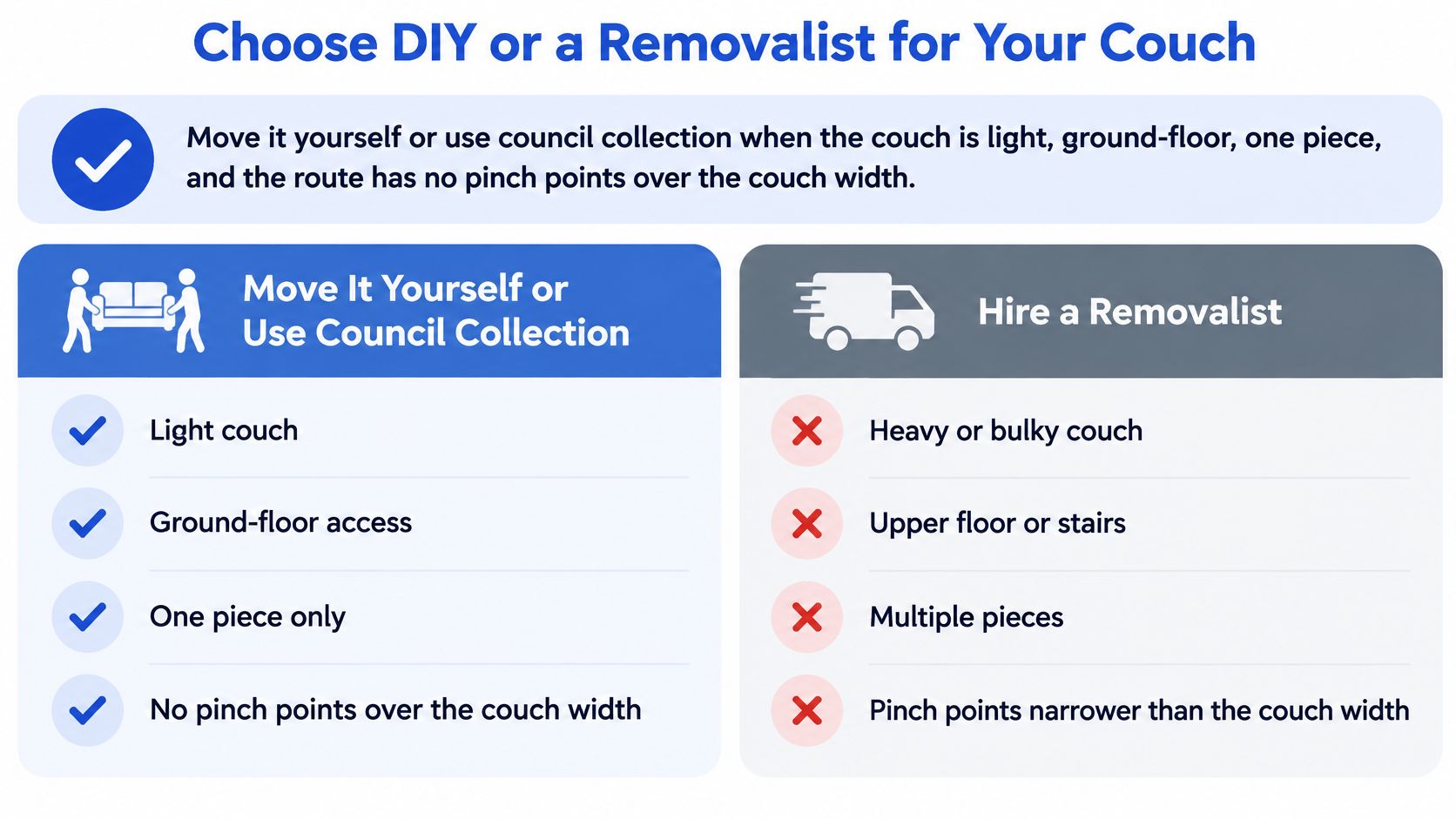
DIY, council collection or removalist compared
| Criterion | DIY or council collection | Removalist |
|---|---|---|
| Cost | Check council eligibility; otherwise allow for vehicle, fuel and equipment | Request an exact written price after an access assessment |
| Time | You organise preparation, helpers, transport or collection timing | Agree on the visit and scope before booking |
| Stairs and lifts | You organise safe handling and building access | Confirm the crew's equipment and protection plan |
| Risk | You manage injury exposure and potential property damage | Check transit and public liability cover, including exclusions |
| Best for | Manageable couch, straightforward route and suitable vehicle | Awkward sectionals, upper floors and valuable or fragile furniture |
Ask for a quote that describes the job
A useful walkthrough follows the couch from its current room to its destination. It records access at both properties, parking, disassembly, floor protection and whether the service includes disposal or transport only.
The publisher's Melbourne moving service is one option offering in-person or video assessments, fixed written quotes, the same crew throughout and transit and public liability insurance, with certificates available on request. Council collection or a suitable donation recipient may still be the better fit when you don't need a relocation service.
Ask what happens if the agreed route proves unusable. A quote should explain scope changes before work proceeds, not leave you negotiating with a couch halfway down the stairs.
Insurance isn't a substitute for a workable plan. Confirm what's covered, who handles dismantling and whether the destination has accepted the item before you commit.
How to Remove a Couch Step by Step and Fix Problems
Prepare the route before wrapping or lifting. Decide who directs the movement, which words mean stop and where the couch can safely rest if someone needs to change grip.
These preparation steps make the carry easier to control.
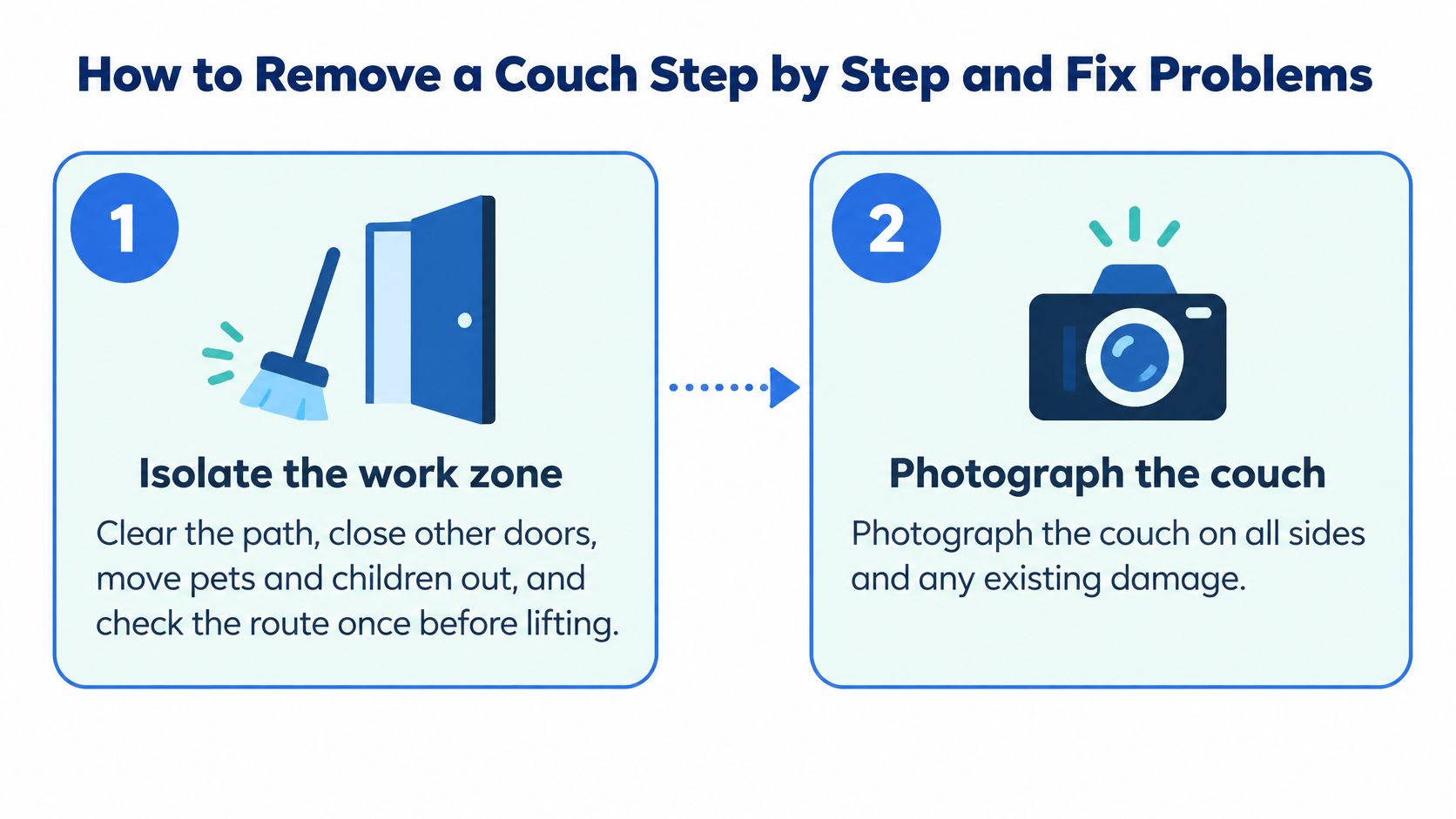
Prepare, protect and move
Isolate the work zone. Move shoes, rugs, boxes and trailing cables out of the route, and keep children and pets elsewhere. Secure doors that need to stay open without obstructing shared exits.
Photograph the condition. Capture the couch on all sides, including existing tears, loose joints and stains, and retain the timestamped files. Photograph vulnerable doorframes and flooring too, so pre-existing marks are documented.
Remove loose and detachable components. Take off cushions, approved removable legs and backrests according to the manufacturer's instructions. Label hardware in a sealed bag and secure it without putting adhesive on finished timber or fabric; unplug powered recliners and secure their leads.
Protect the surfaces. Lay a secured, non-slip floor runner and use moving blankets around the frame, with corner guards at vulnerable jambs. Loose cardboard can slide, so don't create a slipping hazard while trying to prevent scratches.
Lift from sound structural points. Coordinate the lift, keep the load close and turn with your feet rather than twisting under it. Don't lift by cushions, fabric, recliner footrests or decorative arms, and don't assume a paired carry makes an excessive load safe.
Keep the route controlled. Move slowly through transitions and stop before either carrier loses sight of their footing or runs out of grip. Use agreed set-down points rather than trying to finish a difficult manoeuvre while fatigued.
Load and restrain the couch. Choose a stable orientation that supports the frame, then restrain it to suitable vehicle anchor points with rated straps. Pad strap contact points and protect dry upholstery from rain without trapping existing moisture inside wrapping.
Record the handover. Keep the donation acceptance, disposal receipt or collection confirmation, along with the agreed destination. If a contractor takes it away, ask where it's going rather than accepting an unsupported promise that everything gets recycled.
For heavy frames, use equipment suited to the route and load. A flat furniture dolly helps on a level surface but isn't stair equipment; the principles in this piano-moving trolley guide are useful when assessing support, restraint and wheel clearance.
This video offers another visual reference for couch handling.
Separate reuse from disposal
Keep reusable furniture apart from contaminated loads before loading begins. Ask the recipient or facility about acceptance, dismantling and unloading arrangements, and disclose dampness, mould or pests before anyone handles the upholstery.
WM Waste's mattress collection and recycling service illustrates why recycling claims need to identify the item and service involved. A mattress recycling pathway isn't proof that every upholstered couch will be recycled; ask what can be recovered from your load.
The demand for lawful couch disposal is tangible: Waste Management Review's reporting on Hume's waste response records residents dropping off 403 couches during three Clean Days. Leaving yours outside without an accepted collection arrangement doesn't guarantee a similar outcome.
Before handover: Confirm the recipient, the item's accepted condition, the loading arrangements and the destination. A clear receipt is more useful than a vague environmental claim.
Fix the cause before trying again
If the couch jams, stop pushing. Put it down securely, protect exposed edges and identify whether the obstruction is the frame, a removable component or the angle of approach.
Couch removal problems, causes and fixes
| Problem | Likely cause | Fix |
|---|---|---|
| Couch stuck on stairs | The couch was measured, but its turning path wasn't | Set it down, reassess the pivot and remove detachable parts where appropriate |
| Scratched floors or walls | Missing protection or uncontrolled contact | Stop, inspect damage and fit secured runners, guards and blankets |
| Council refuses collection | Booking, timing, item or volume requirements weren't met | Confirm the reason and arrange compliant collection or an accepted facility |
| Mouldy or wet upholstery | Condition wasn't disclosed | Isolate it, tell the provider and follow their containment and disposal requirements |
| Couch left on nature strip | No authorised destination or collection was arranged | Organise lawful removal and keep pedestrian access clear |
Don't cut a couch apart just because it won't turn. Recliner mechanisms, springs, staples and concealed wiring can make improvised dismantling hazardous, and exposed sharp parts create another handling problem. If the frame must be dismantled, have someone competent assess its construction and disposal requirements first.
When the measured route still doesn't work after sensible preparation, stop DIY. Another helper can improve control, but additional people won't make a rigid frame fit an impossible corner.
House Moving Melbourne offers walkthrough-based planning, fixed written quotes, furniture protection and coordinated couch transport as part of residential moves. Visit House Moving Melbourne with photos of your couch, its dimensions and the tightest access points to arrange an assessment before moving day.