
Removalists in Richmond: Your Local Moving Guide
You've booked a moving date, started filling boxes and then noticed the problem outside: there's nowhere obvious for a truck to stop. The street is narrow, the building manager wants a lift booking, and the nearest clearway may make an otherwise simple unload impossible. In Richmond, those details can determine whether your move runs smoothly or spends hours waiting beside the kerb.
The best removalists in Richmond plan more than furniture volume. They assess truck access, parking permissions, stairs, lifts, rear lanes and the distance from the vehicle to the front door. That local preparation matters just as much for a small apartment move as it does for a full household relocation.
Table of Contents
- Navigating the Unique Challenges of Moving in Richmond
- Understanding Richmond Housing and Tenant Turnover
- Securing Parking Permits and Managing Street Access
- Comparing Hourly Rates and Fixed Written Quotes
- Handling Specialty Items and Commercial Relocations
- Executing a Seamless Move from Assessment to Unpacking
Navigating the Unique Challenges of Moving in Richmond
A Richmond move often starts with a familiar assumption: the truck will arrive, park outside, and the crew will carry everything straight in. That plan can fail before the first sofa leaves the property. A single-fronted terrace may have no practical kerbside loading area, an apartment may require a confirmed lift slot, and a street near Swan Street or Bridge Road may have restrictions that make casual parking risky.
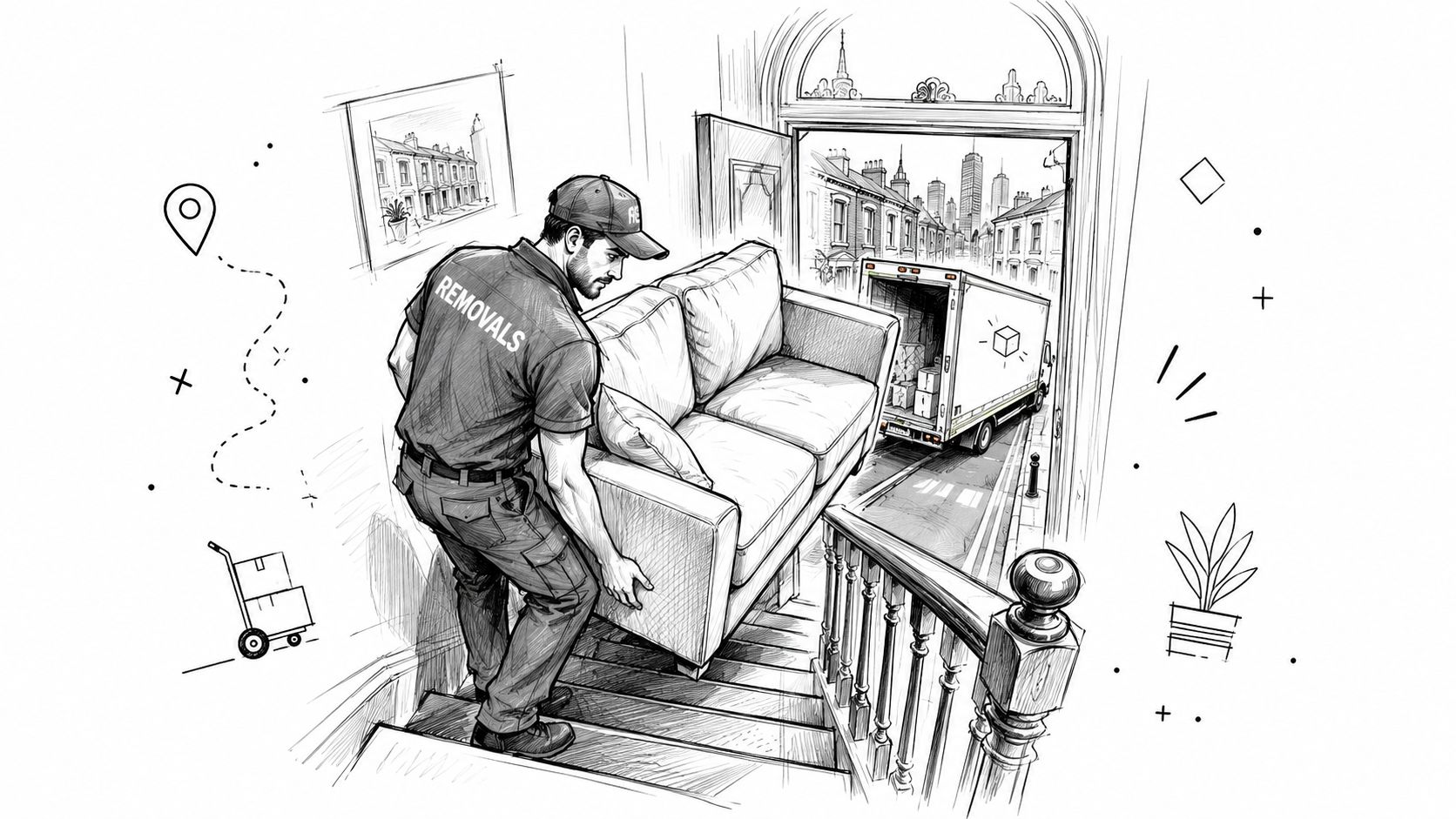
Richmond's street network combines narrow residential roads, apartment buildings, clearway corridors and loading constraints. Local moving guidance identifies access around Swan Street, Bridge Road, Church Street, Punt Road and Burnley Street as a practical concern, particularly when a truck needs to remain close to the property during loading or unloading. The same guidance recommends verifying access early, reserving space and matching the truck to the street geometry, not just the number of items being moved. (Richmond moving access guidance)
That distinction changes how a crew works. A truck that can carry the contents of a two-bedroom apartment may still be unsuitable if it can't approach the building safely. A smaller vehicle, a longer carry and additional handling may be more efficient than forcing a large truck into a tight street. Conversely, choosing a vehicle that's too small can create another problem, with an extra trip and another round of parking coordination.
The access problems people notice too late
The most common surprises are practical rather than dramatic:
- The truck can't stop at the front door: A clearway, permit restriction or occupied kerb space forces the crew to carry furniture farther.
- The building lift isn't available: Without a booking, the crew may need to use stairs or wait while other residents use the lift.
- The terrace loads better from behind: A rear lane may offer safer access than the narrow street frontage.
- The item list hides the actual work: A sofa, mattress or wardrobe may require stair carries, doorway protection and careful turns even when the total volume is modest.
Practical rule: Treat parking, lift access and carry distance as part of the move itself, not as details to solve after the truck arrives.
A local removalist should ask for photographs, a video walkthrough or a detailed description of both addresses before confirming the job. The useful questions are specific: Is there a rear lane? Which floor is the apartment on? Does the building have a loading bay? Are there height restrictions? Who books the lift? Where can the crew legally wait if the kerbside space is occupied?
Richmond moves become predictable when those questions are answered before moving day. The service is no longer just transport. It's a coordinated plan for getting furniture through a constrained inner-city environment without blocking the street, damaging common property or exhausting the crew before the main work begins.
Understanding Richmond Housing and Tenant Turnover
Richmond's housing mix creates a different moving brief from a typical outer-suburban house relocation. Apartments, Victorian terraces, share houses and compact rental properties often sit on streets with limited frontage, tight side access and little room to stage furniture. The result is a high proportion of moves where access planning matters as much as the volume being transported.
Vacant properties and frequent tenancy changes can create short lead times, overlapping lease dates and last-minute changes to the item list. A tenant may be moving only a bedroom and living-room setup, while another job involves a full terrace transfer with furniture stored in a rear room, garage or shed. The truck size alone will not reveal the work involved.
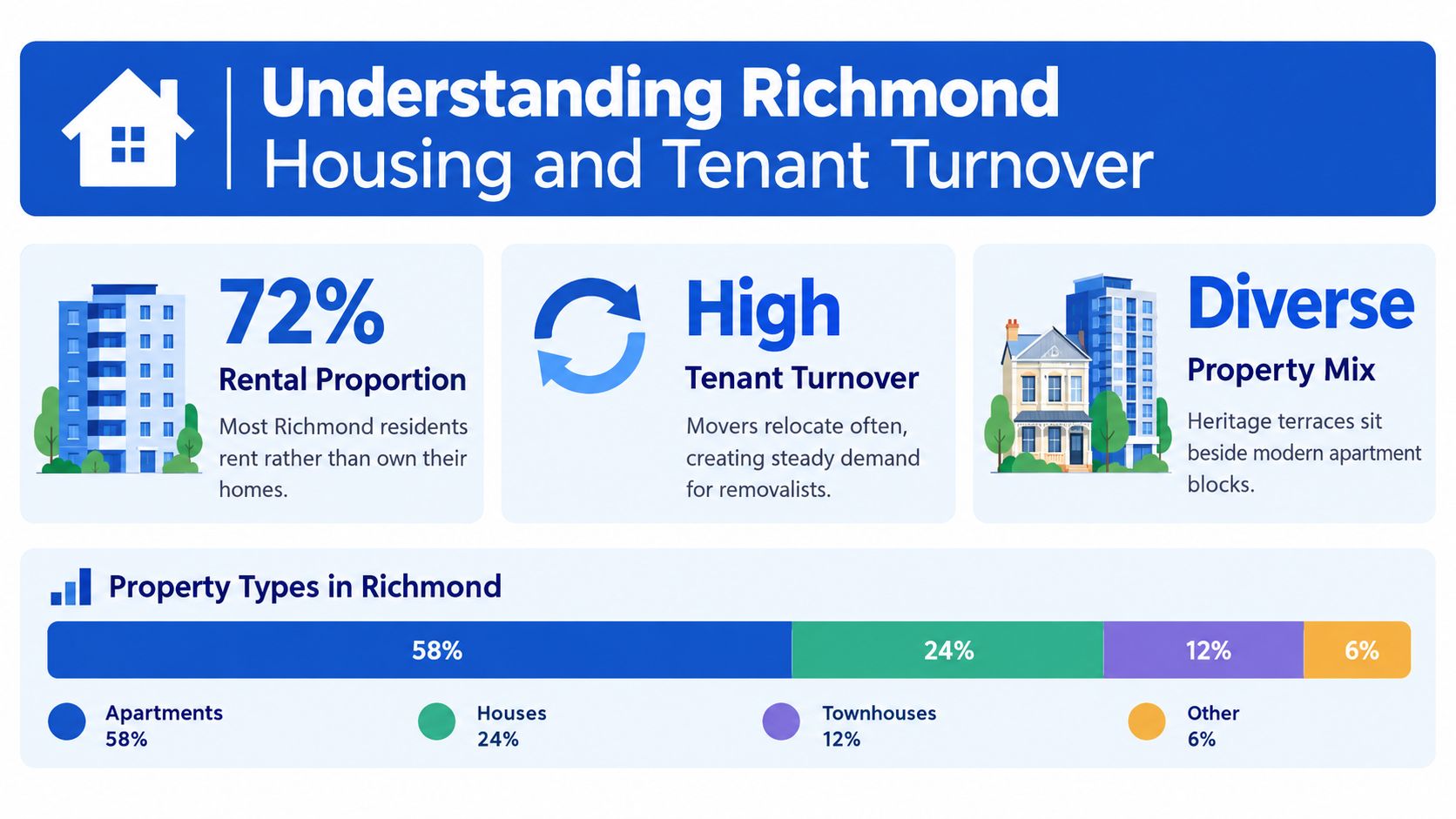
Why apartment experience matters
An apartment move carries different risks from a freestanding house relocation. Building management may impose access hours, require a lift booking, request lift padding or restrict the loading point. Some buildings also require proof of insurance before the crew can enter common areas. If the booking is missing or the allocated window is too short, the crew can lose productive time before the first item reaches the truck.
A Richmond terrace creates another set of constraints. Narrow front rooms, steep stairs and rear-lane access can change the safest handling route. A large sofa may need to leave through the back rather than the front door, while wardrobes may require partial disassembly before they can pass a landing. Removalists familiar with inner-Melbourne properties will ask for measurements and photographs instead of relying on a generic room count.
Richmond's rental activity also produces many small-to-medium moves. These include partial furniture transfers, downsizes, furnished apartment changes and relocations between lease dates. A crew that mainly works from wide suburban driveways may not have a reliable method for moving a wardrobe through a tight stairwell or coordinating a terrace with restricted rear access. Check the provider's furniture removalist occupation and industry profile for broader context on the trade.
Ask potential movers how they handle:
- Lift bookings: Who contacts building management, and what happens if the allocated window changes?
- Protection: Do crews bring floor runners, corner guards and doorway protection?
- Short access windows: Can loading be organised around building rules and settlement timing?
- Incomplete inventories: How will the quote change if a storage cage, balcony or garage is added?
- Delivery placement: Will furniture go into the correct rooms or stop inside the front door?
A Richmond move may also sit between tenancy dates, settlement appointments or temporary storage. That makes an accurate inventory and fast communication more useful than excess truck capacity. For context on housing costs and relocation pressure across Melbourne, this guide to Melbourne's most expensive suburb offers a comparison point. Choose movers who can coordinate vertical access, rental turnover and building requirements, not only loading and driving.
Securing Parking Permits and Managing Street Access
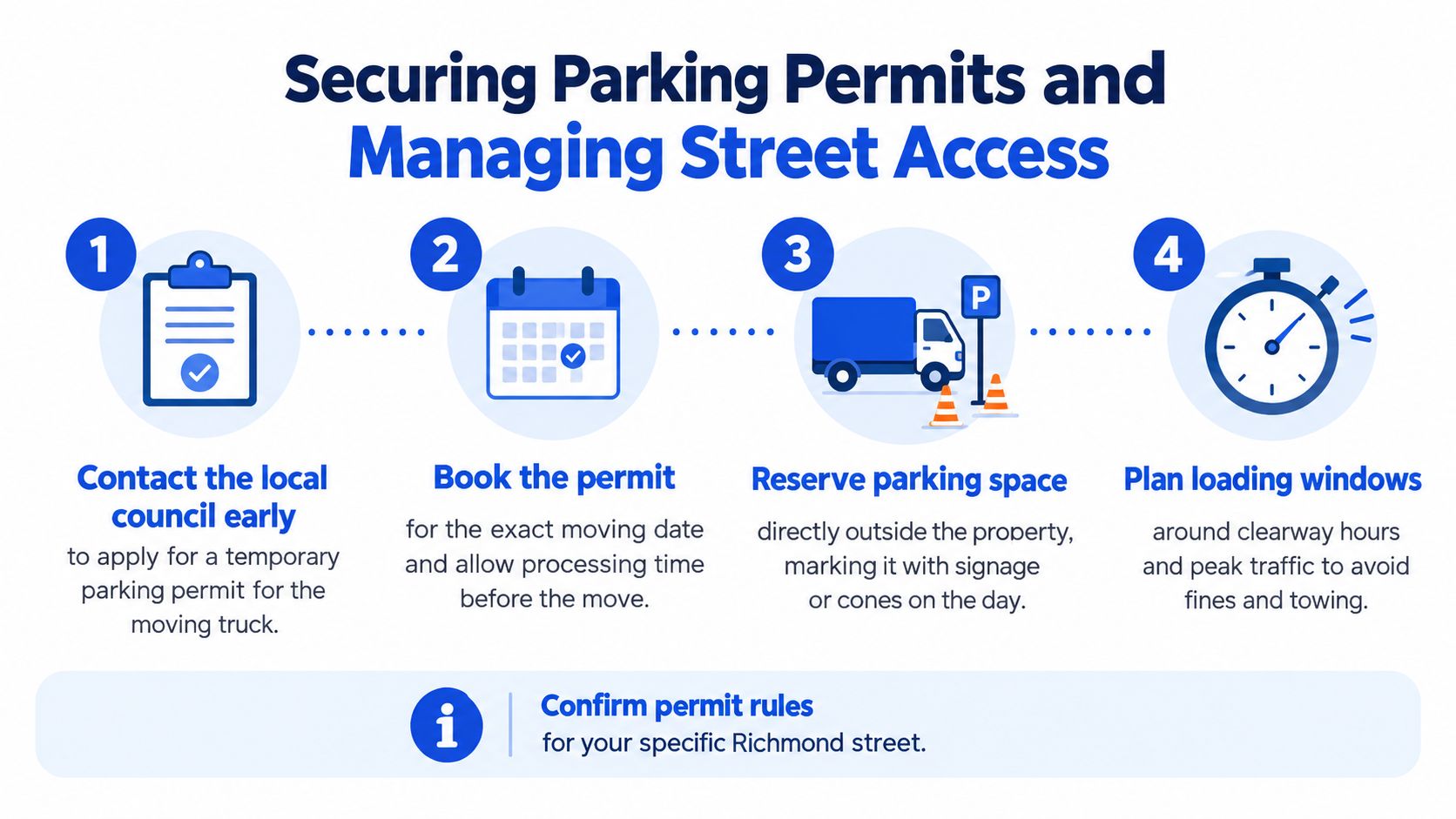
The truck can be ready, the crew can be on time and the boxes can be labelled. If the vehicle can't legally stop near the property, the move is already compromised. Richmond moves in the City of Yarra commonly require a temporary parking arrangement or permit, and the relevant window can depend on the exact date and location. (Richmond parking and removalist guidance)
Start with the address, not the truck. Identify the street, nearby intersections, clearway signs, apartment loading points and any rear-lane option. Streets around Swan Street, Bridge Road, Church Street and Punt Road can bring additional timing and loading considerations, so a general assumption that kerbside parking will be available isn't a safe operating plan.
A workable access sequence
1. Confirm the street conditions.
Walk both addresses before booking the move if possible. Note the width of the street, overhead obstructions, tram or traffic conditions, nearby driveways, clearway signage and the distance from a possible truck position to the front entrance. Photograph the approach and send those images to the removalist.
2. Check the council requirement early.
Contact Yarra City Council or use its current parking information to confirm whether a temporary parking arrangement or permit is needed for the moving vehicle. Permit conditions can vary by date and location, so don't rely on a permit obtained for a different address or an informal agreement with a neighbour.
3. Submit the request ahead of moving day.
Allow time for the application to be processed and confirm the approved date, location and operating window. Keep the approval details with the move documents, and make sure the removalist knows exactly where the truck is expected to stand.
4. Plan the loading position.
A legal space directly outside the property is ideal, but it isn't always available. For an apartment, coordinate the loading bay and lift booking with building management. For a terrace, check whether a rear lane provides a shorter or safer carry route. Independent Richmond moving guidance notes that permit-only streets may fill by mid-morning and that some single-fronted terraces are better served from rear lanes than from the street frontage. (Richmond moving and access advice)
5. Match the crew to the carry distance.
The item count doesn't tell the whole story. A modest apartment inventory can take substantial labour if the truck must stop away from the entrance, the crew needs to use stairs or every item must pass through a narrow hallway. Tell the removalist the estimated carry distance and the number of flights, rather than saying only that the property is “easy access”.
Clearways, rear lanes and failed unloads
Clearway corridors create a timing problem as well as a parking problem. A truck may be able to load at one time and become an obstruction later, particularly if the move runs over because the lift is delayed or the crew encounters a difficult staircase. Build the schedule around the permitted loading window, and leave a practical buffer for furniture that needs disassembly or protective wrapping.
Rear-lane access works well when it has been inspected in advance. Measure the lane approach, check gates and confirm whether the truck can enter, turn or stop without blocking residents. Never assume a lane is usable because a van fits through it. A moving truck needs clearance for its body, mirrors, doors and loading operation.
If the building has no loading bay, ask who controls the closest legal space and what the crew should do if it is occupied. A written access plan should state the fallback, such as a nearby legal stopping point, a second crew member assigned to shuttle items or a revised arrival window. That preparation protects the move from turning into an improvised carry across a busy street.
Comparing Hourly Rates and Fixed Written Quotes
An hourly rate looks simple until the clock starts during a parking delay, a lift wait or a long carry from the truck. Richmond apartment moves expose that weakness because the work often includes access tasks that aren't visible in a basic inventory. A fixed written quote can cost more at the outset, but it may provide better protection when the conditions are difficult to predict.
Recent Australian reporting found that renters spent an average of $5,128 to move house nationally, rising to $7,676 when lost time was included. The same reporting placed Victoria's average moving cost at about $4,700 over the last decade, which shows why an apparently cheap hourly arrangement can become a serious household expense once delays and time away from work are counted. (Australian moving cost reporting)
Hourly rates versus fixed quotes
| Pricing Model | Best Suited For | Primary Risks in Richmond | Cost Predictability |
|---|---|---|---|
| Hourly rates | Clearly accessible moves with a confirmed inventory and uncomplicated loading | Parking delays, lift waits, stairs, long carries, minimum time requirements and additional trips can extend the job | Lower, because the final amount depends on elapsed time |
| Fixed written quotes | Apartment moves, terrace relocations, specialty items and jobs with several access constraints | The quote must accurately record the inventory, stairs, parking, packing and any agreed exclusions | Higher, provided the scope is documented and changes are approved |
| Hybrid pricing | Moves with a defined transport component and optional packing or storage | Optional services can be misunderstood if line items aren't separated | Moderate, depending on how variable work is priced |
Hourly pricing isn't automatically wrong. It can suit a straightforward move where the truck can stop close to the door, the lift is available and the inventory is complete. The problem appears when a client compares rates without comparing the assumptions behind them. A lower hourly figure may come with a minimum booking, travel charges, stair fees or a crew that needs more time because the access plan wasn't completed.
What a useful written quote includes
A strong quote should make the job visible on paper. Look for:
- The full address details: Include floor level, lift access, stairs, rear-lane use and the proposed truck position.
- The inventory and exclusions: List bulky, fragile or unusually heavy items, along with anything being discarded or stored.
- The service scope: Separate packing, transport, disassembly, reassembly, unpacking and storage so you know what you're buying.
- The access assumptions: State whether a permit, loading bay or lift booking is required and who is responsible for arranging it.
- The change process: The mover should explain what happens if the inventory changes or the actual conditions differ from the walkthrough.
A fixed quote only works when it is based on a proper assessment. A rushed estimate that ignores the narrow stairwell isn't fixed in a useful sense. Ask for an in-person or video walkthrough, then check that the final document reflects what the crew will face.
The best comparison isn't “Which company has the lowest rate?” It's “Which quote accounts for the work?” For Richmond renters, predictability can be more valuable than a low starting price, particularly when lease dates, bond payments and time away from work are already placing pressure on the household budget. You can use this guide to compare Melbourne movers while checking whether each provider has addressed access rather than just volume.
Handling Specialty Items and Commercial Relocations
Richmond's terraces, apartments and boutique commercial spaces create handling problems that a standard trolley and a few blankets won't solve. Pianos, artwork, antiques, glass cabinets and large appliances need an agreed route from the original room to the truck, with protection applied at each point where an item could strike a wall, floor or doorway.
Begin with an inventory of specialty items, not a general note saying “some fragile furniture”. Record dimensions, weight where known, condition, detachable parts and the narrowest point on the route. A grand piano may require a different plan from an upright piano. An antique cabinet may need internal packing, corner protection and a decision about whether it can be safely carried through a stairwell.
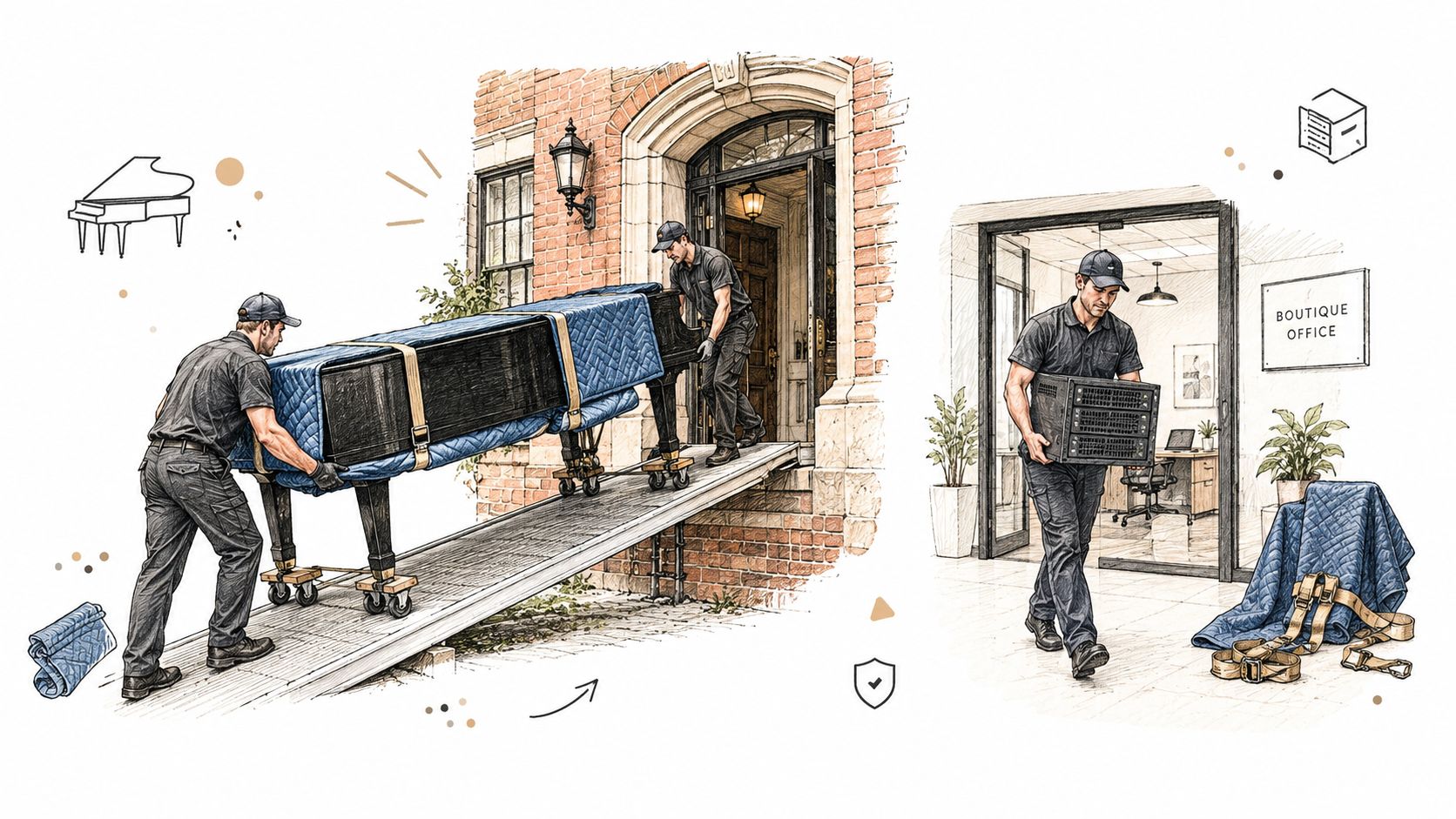
A protection plan for difficult items
Photograph condition before wrapping.
Take clear photographs of polished surfaces, corners, legs, joins and existing marks. This creates a practical record and helps the crew decide how to wrap and position the item.
Measure the route.
Check doors, stair turns, lift interiors, landings and ceiling height. Remove doors or detachable components only when the removalist has the right tools and a documented reassembly plan.
Use the right protection.
Furniture blankets help prevent surface contact, while floor runners, doorway guards and corner protection reduce the risk to the property. Artwork and delicate antiques may need dedicated packing or custom crating rather than a blanket wrapped around the outside.
Secure items inside the vehicle.
The crew should prevent movement with suitable restraints and place vulnerable pieces away from pressure points. A specialist item shouldn't be treated as filler between ordinary boxes.
For clients moving a piano through a constrained entrance, a piano moving trolley can be part of the equipment discussion, but equipment alone doesn't replace route planning. The crew still needs to confirm floor surfaces, gradients, corners and the final position inside the destination.
Office moves need an operating plan
Commercial relocations add a second form of risk. The objective isn't only to transport desks and computers. Staff need to find labelled equipment, files need to arrive in the correct area and the office needs to become functional without avoidable downtime.
An effective office plan assigns labels by room, workstation or department. Desks, monitors, servers, files and personal storage should follow the supplied layout rather than being unloaded wherever space is available. Floor and doorway protection matters in commercial buildings because lifts, foyers and corridors may be shared with other tenants.
After-hours or weekend scheduling can reduce disruption for businesses that trade during the week. It also gives the crew more control over access when building traffic is lighter. Before booking, confirm loading dock rules, lift access, security requirements, alarm procedures and who will approve the final placement.
A reliable commercial move ends with reassembly and a functional handover. The cheapest transport-only option may leave staff facing a second job, searching for cables and shifting desks. A properly scoped relocation treats labelling, protection and setup as part of the operational result.
Executing a Seamless Move from Assessment to Unpacking
The move should be designed before anyone arrives with a trolley. A pre-move assessment, whether in person or by video, gives the removalist a chance to record stairs, lift dimensions, parking constraints, rear-lane access, fragile goods and the order in which rooms should be loaded.
The assessment should produce a room-by-room plan, not just an estimated truck size. It should show which items need disassembly, what will be packed by the crew, where the truck can stand and which building contacts need to confirm access. If the property sits between a lease end and a new settlement, the plan should also identify whether storage is required.
The practical sequence
- Before moving day: Confirm the inventory, quote, permit arrangements, lift booking, insurance documents and contact details for building management.
- At the origin: Protect floors and doorways, label rooms clearly and load heavy or vulnerable items according to the agreed sequence.
- During transport: Keep the same point of contact for changes, access issues and delivery instructions.
- At the destination: Place furniture by room, reassemble agreed items and check walls, floors and the condition of specialty goods.
- After unloading: Complete a short handover, identify any issue promptly and arrange follow-up while the job details are still clear.
Company-owned trucks and employed crews can make coordination easier because the people who understand the plan remain involved from start to finish. That doesn't remove the need to check credentials, insurance and scope, but it reduces the confusion that occurs when a booking is passed between several unknown teams.
Unpacking should also be defined in advance. Some clients need only kitchen boxes opened, while others want full unpacking, shelf placement and removal of packing materials. A clear instruction such as “place books in the study shelving and keep fragile ceramics on the kitchen bench” is more useful than a general request to unpack everything.
Richmond moves become manageable when each handover is deliberate. The client confirms access, the removalist documents the physical work, the building approves its requirements and the crew follows one shared plan. That is how a difficult kerbside unload, tight stairwell or apartment lift booking becomes a controlled sequence instead of a move-day surprise.
House Moving Melbourne provides residential and commercial relocations across Melbourne and Victoria, with pre-move walkthroughs, parking and lift coordination, specialty handling, packing, storage and fixed written quotes. Visit House Moving Melbourne to arrange a practical assessment that accounts for Richmond's street access and apartment logistics before moving day.