Business Relocation Service: A Practical Guide
Friday evening. The office is half packed, the lease clock is running, and a manager is watching a crew carry desks towards a lift that the building manager may close before the last cabinet reaches the loading dock. Everyone expects the new workplace to be ready on Monday. Nobody wants to discover at 8:30 am that the printer is in the wrong room, the network rack wasn't planned, or essential files are still inside an unlabelled carton.
That is why a business relocation service should be judged by downtime control, not by the number of trucks or the lowest hourly rate. A successful move gets people, equipment, access, technology, and the workplace itself ready in the right sequence. Before you sign a quote, make sure the provider can show you how that sequence will work.
Table of Contents
- Why Office Moves Feel Risky
- What a Business Relocation Service Actually Does
- The Core Scope of a Commercial Move
- Realistic Timelines for an Office Relocation
- When Moving Is Not the Right Answer
- Choosing a Provider That Reduces Downtime
- Making the Move and Keeping the Team
Why Office Moves Feel Risky
An office relocation creates several risks at once. Staff may be unable to work, customers may struggle to reach you, building rules may delay loading, and critical equipment may arrive before the room is ready for it. The removalist invoice is visible, but lost trading hours and an unusable Monday morning often create the larger operational problem.
A residential move can tolerate a few boxes arriving late. A business move usually can't. A missing workstation may prevent a team member from serving customers. A misplaced contract file can delay a decision. A disconnected server or badly sequenced network installation can affect the whole office rather than one room.
Practical rule: Measure the move by the time your business remains fully operational, not by how quickly the crew loads the truck.
Treat downtime as a project constraint
Start with the operating deadline. Write down the last time the old office can function, the first time the new office must be accessible, and the earliest time staff can return. Then identify the systems and people that must be ready before normal work resumes.
A useful readiness list includes:
- Critical equipment: Identify servers, network hardware, printers, specialised machinery, secure cabinets, and other items that can't be handled as ordinary cartons.
- Essential records: Separate files and documents needed on the first working day from material that can remain in storage or arrive later.
- Access dependencies: Confirm loading docks, lifts, parking areas, security procedures, keys, swipe cards, and building contacts at both sites.
- Operational checks: Assign someone to test power, internet, workstations, meeting rooms, printers, and shared areas before staff arrive.
The provider should then build the physical move around those constraints. That may mean moving furniture before technology, staging cartons near their destination rooms, or scheduling reconnection work separately from general unloading. The point isn't to make the move look busy. It's to make the next working day predictable.
Price per truck is a weak comparison
Two quotes can describe the same number of desks while carrying very different levels of risk. One may include a walkthrough, protection, labels, disassembly, reassembly, building coordination, and post-move checks. Another may only cover labour and transport, leaving your team to solve access and placement problems during the move.
Victoria's relocation market also needs local capacity. The Australian Government's 2024 Population Statement estimated Greater Melbourne's population at approximately 5.4 million in 2023–24, around 77% of Victoria's population, while Victoria's population was projected to rise from 7.0 million in 2023–24 to 8.2 million in 2034–35. That scale supports demand across established offices, growing suburbs, and regional transfers, but it doesn't remove the need for a site-specific plan.
A specialist provider earns its fee by reducing uncertainty before the first item is lifted. If the quote doesn't explain how the move protects your operating deadline, it isn't complete.
What a Business Relocation Service Actually Does
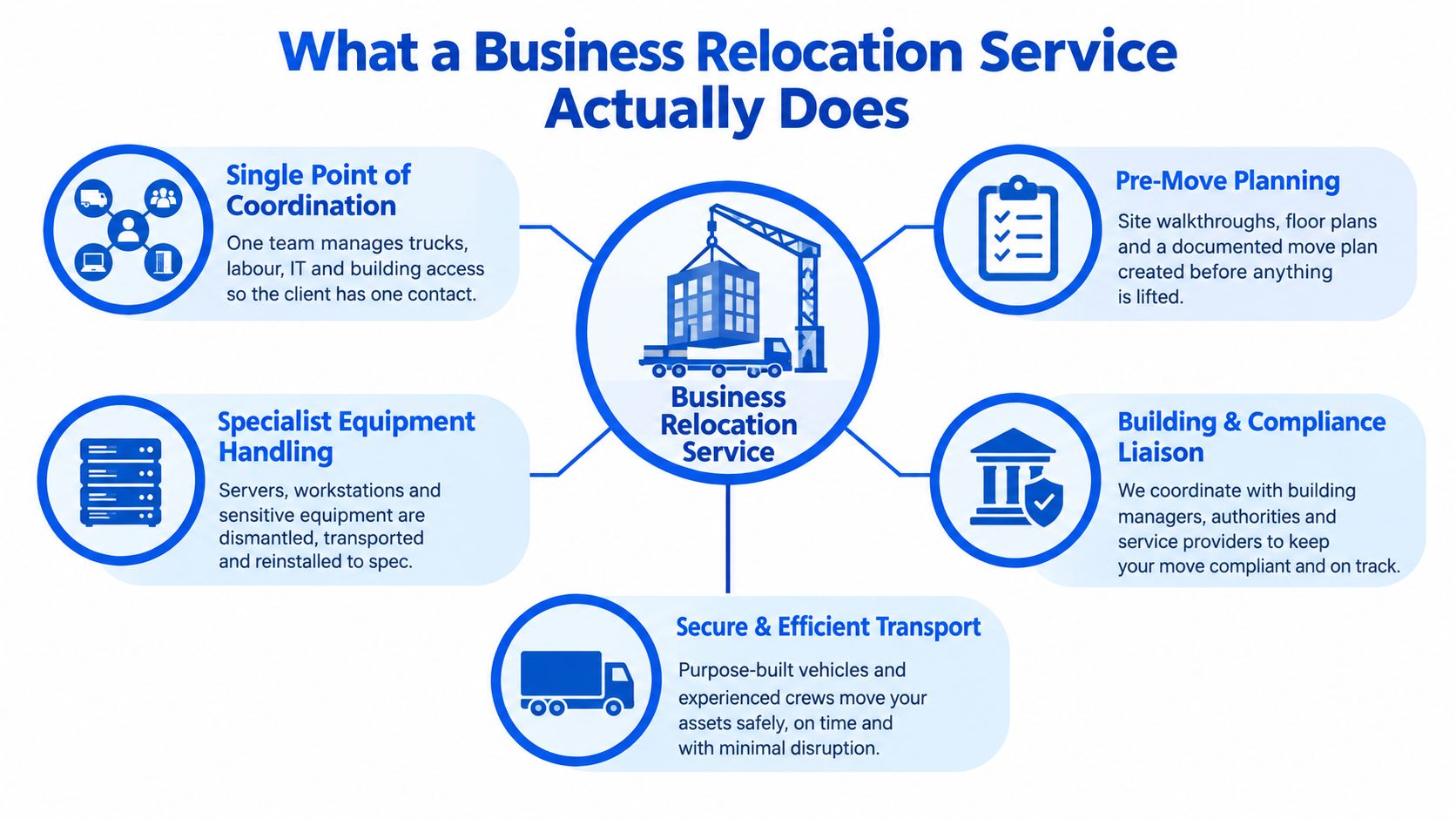
A commercial relocation provider coordinates a move as a project. The crew matters, but so do the documents, decisions, access arrangements, labels, sequence, and single point of contact that make the crew effective.
A residential mover may be perfectly capable of carrying desks and cartons. A business relocation service should also understand room-by-room placement, building requirements, equipment sensitivity, staff communication, and the consequences of getting one dependency wrong. Think of the provider as an orchestra conductor. The removal crew is one section, while building management, IT, facilities, security, parking, and your internal team all need to follow the same score.
The documents should exist before moving day
A competent provider should turn the walkthrough into a practical scope. Expect to see:
- A site assessment: This records stairs, lifts, loading docks, parking, corridors, door widths, floor surfaces, and restricted access.
- A move schedule: This shows what moves first, what needs special handling, and what must be ready before the next stage begins.
- A labelling plan: Every carton, desk, cabinet, and equipment item should connect to a destination room or workstation.
- A responsibility matrix: Your team should know who handles building access, IT shutdown, staff communication, security, permits, and final checks.
- A written quote: The price should identify included work, exclusions, assumptions, and the process for approving a scope change.
The provider should also ask questions that expose operational risk. Which equipment must remain powered until a specific time? Which documents can't leave the building before a security check? Does the destination have a different lift booking process? Where will the crew stage items without blocking fire exits or shared access?
A walkthrough is not a formality
A video call can help with early scoping, but a physical walkthrough often reveals the issues that change the plan. A narrow turn, a fragile floor surface, a loading restriction, or a long route from the dock to the tenancy can affect equipment, labour, and sequence.
WorkSafe Victoria identifies hazardous manual handling as the biggest cause of workplace injuries in the state and explains that employers must eliminate associated musculoskeletal-disorder risks where reasonably practicable, or reduce them through controls. Its guidance on moving or lifting objects supports a site-specific approach involving mechanical aids, clear pathways, smaller loads, and reduced carrying distances.
The deliverable isn't just a truck arriving at the address. It's a controlled plan that tells every participant what happens, where it happens, and who confirms completion.
The Core Scope of a Commercial Move
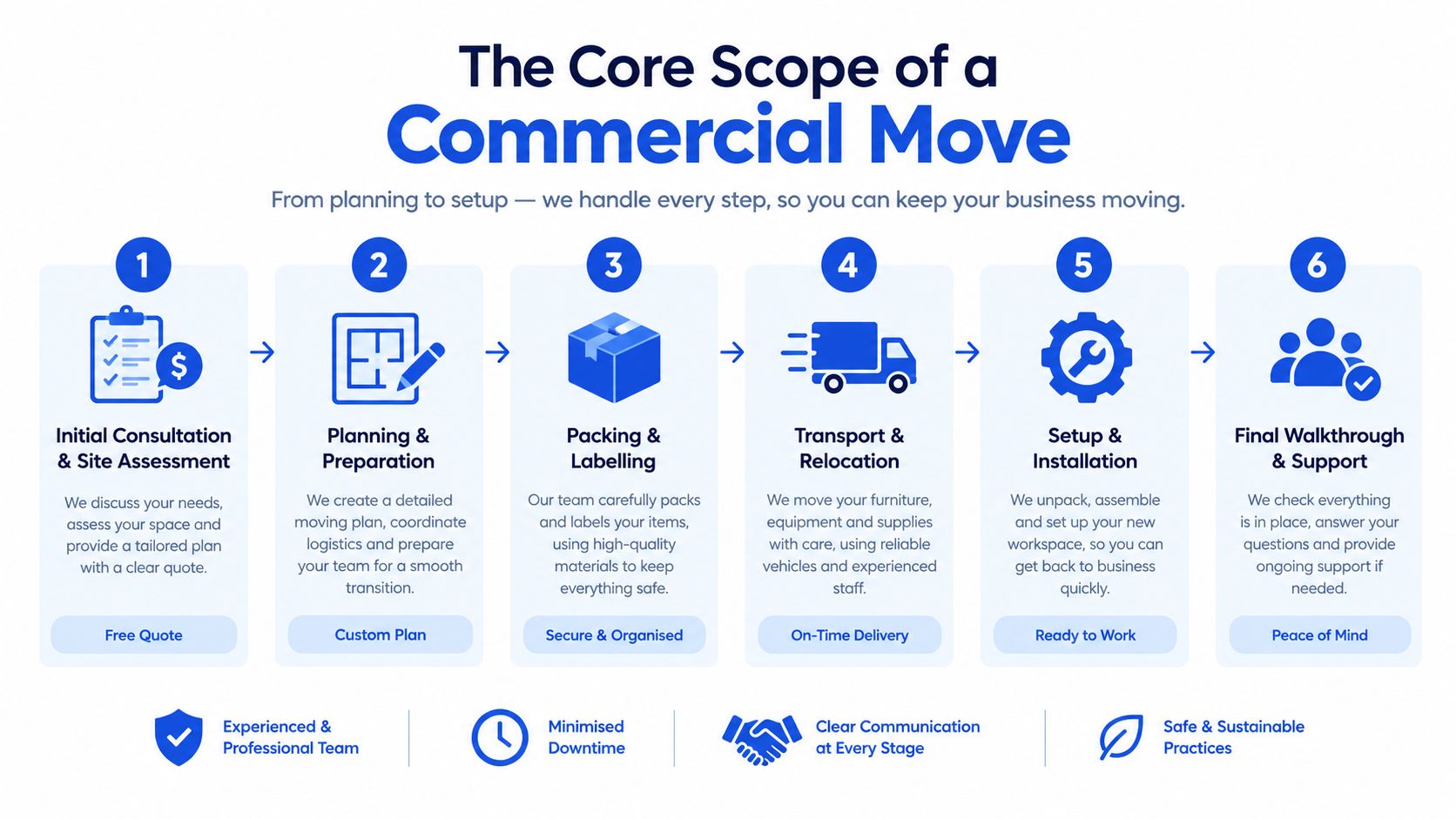
A commercial move should have four connected phases: planning, labelling, technology handling, and after-hours execution. Treating them as separate add-ons creates gaps. Treating them as one timeline gives you something concrete to check against the quote and the project deadline.
Planning creates the control document
The first phase begins with a walkthrough at both sites. The provider should document access points, loading conditions, lift bookings, stairs, floor protection, parking, security procedures, and any building restrictions. Your team should provide a current floor plan and identify priority rooms, equipment, staff workpoints, and items requiring specialist treatment.
The output should be a room-by-room move plan, not a vague promise to “handle everything”. It should identify the sequence, crew requirements, equipment, access windows, and decision-maker for the day. For a Melbourne office, a properly scoped office removal service should be able to connect the plan to the actual building conditions rather than quote from a rough item list.
Labelling reduces rehandling
Labels should link each item to its destination. Use a room code, workstation identifier, or another system that remains clear when cartons are stacked. Apply the same identifier to desks, chairs, pedestals, monitors, archive boxes, and other grouped items.
The receiving crew should be able to place items directly into the correct room. That prevents the common failure where cartons are left in a corridor, furniture is placed in a convenient but incorrect area, and your staff spends Monday morning moving everything again.
IT handling needs its own sequence
Computers, servers, printers, network equipment, and cabling shouldn't disappear into a general packing list. Agree who powers equipment down, who labels cables, who uses antistatic protection, who reconnects systems, and who tests them.
For server-heavy offices, the move plan should include a shutdown order, transport method, arrival sequence, rack or room placement, and reconnection responsibility. The removalist may handle physical movement, while your IT team or technology contractor handles shutdown and validation. Put that boundary in writing.
WorkSafe Victoria notes that carrying, pushing, or pulling loads while walking increases physical demand, particularly over long distances, uneven surfaces, inclines, and stairs. Its office health and safety guidance supports minimising handling distance, keeping routes clear, using suitable trolleys or powered devices where practicable, and reducing heavy or bulky loads.
After-hours execution protects trading time
Weekend and night work only reduces disruption when the building will support it. Confirm lift access, loading dock hours, security attendance, noise limits, parking permits, contractor induction, and waste arrangements before the schedule is locked.
Connect the phases into one timeline:
- Walkthrough and scope: Record the site conditions and agree the included work.
- Floor plan and labels: Assign every item to a destination.
- Technology plan: Confirm shutdown, packing, transport, reconnection, and testing.
- Building coordination: Secure access, permits, lift bookings, and protection requirements.
- Physical move: Load, transport, place, assemble, and remove agreed packing material.
- Operational check: Test the destination and record outstanding defects.
If a quote doesn't show where these phases connect, ask the provider to revise it before you compare prices.
Realistic Timelines for an Office Relocation
A properly planned office move starts before packing. The calendar should protect the deadline by forcing decisions early, especially when the destination has strict access rules or the move includes servers, archive files, or multiple floors.
Use a working schedule, not “it depends”
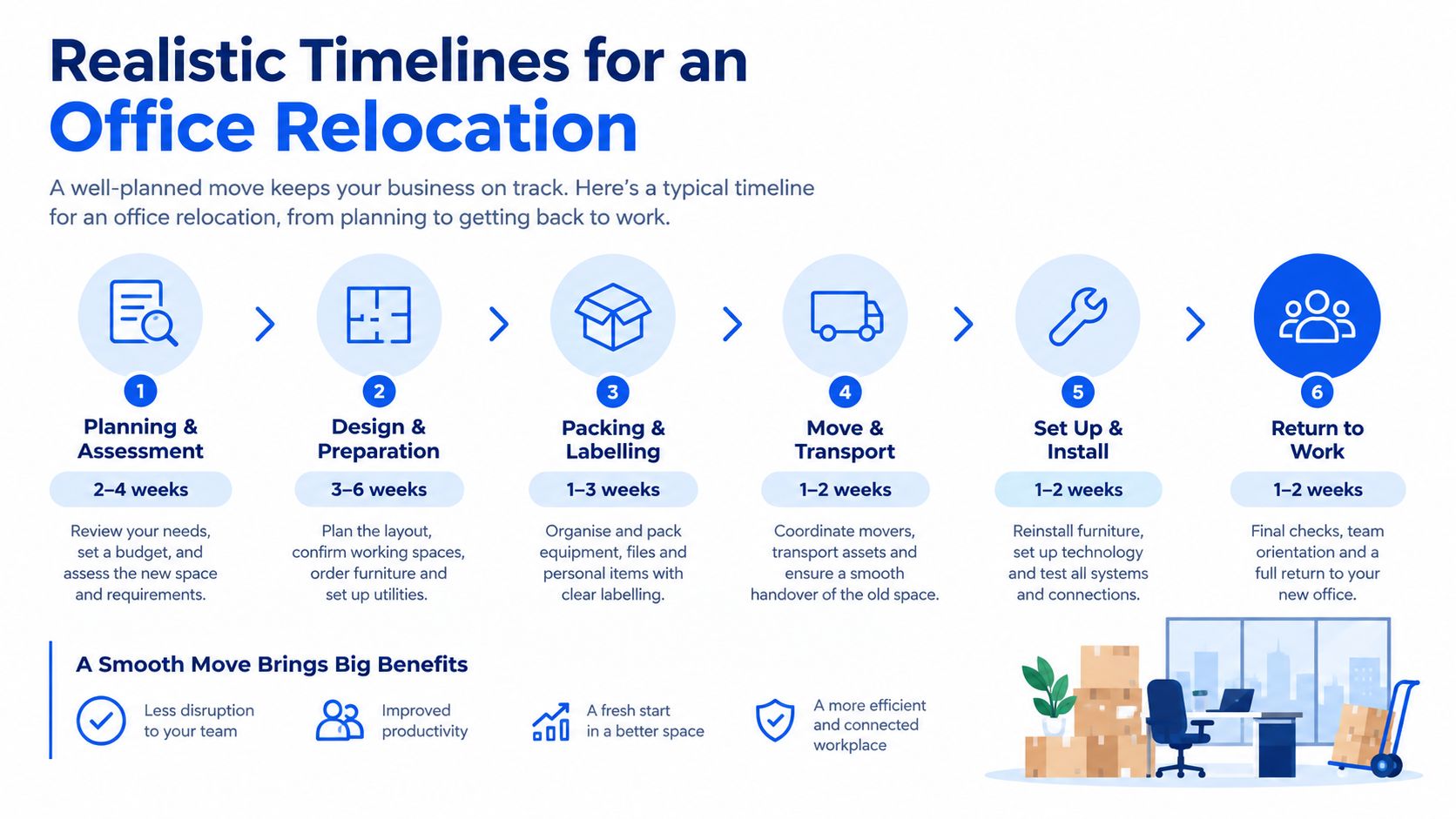
For a typical project, use these anchors:
- Week one, scope and quote: Complete the walkthrough, confirm the inventory, inspect both buildings, define exclusions, and issue the written quote.
- Week two, access and technology: Book lifts and loading areas, confirm permits, finalise floor plans, and agree the IT shutdown and reconnection sequence.
- Week three, staff communication and labels: Tell employees what changes, issue packing instructions, assign room or workstation codes, and identify items that will not move.
- Week four, packing and pre-stage: Pack non-essential material, consolidate archives, protect priority equipment, and stage items where the building permits.
- Move weekend: Shut down agreed systems, complete the physical relocation, place furniture and cartons, reassemble items, and reconnect technology in the planned order.
- Early follow-up: Walk the new office with the provider, record missing or damaged items, test shared equipment, and resolve defects before they become routine complaints.
Small offices may compress this process into two to three weeks when access is straightforward and the inventory is well defined. Multi-floor or server-heavy moves generally need four to six weeks because more parties, equipment, and dependencies must be coordinated. Those timeframes are planning guidance, not a substitute for a walkthrough.
Protect the final working day
Don't schedule the move backwards from the first morning alone. Start with the last acceptable operating time at the old office and reserve time for shutdown, packing, loading, travel, unloading, assembly, reconnection, testing, and correction.
Your lease, settlement, or fit-out date may look fixed, but access often isn't. Ask when the building will release keys, when trades will finish, when lifts can be booked, and whether the destination will be clean and safe for furniture. A removalist can't compensate for a tenancy that isn't ready to receive the load.
Give one person authority to make decisions during the move. That person should approve scope changes, resolve placement questions, contact building management, and confirm when the office is operational. Without that role, small uncertainties turn into delays because the crew waits while several stakeholders try to agree.
The final check should be physical, not administrative. Walk every room, test the agreed equipment, inspect walls and floors, confirm access cards, and make sure priority cartons are where the plan says they should be.
When Moving Is Not the Right Answer
A business relocation service should sometimes tell you not to relocate. Melbourne's office market gives tenants a reason to test the assumption before committing to a new premises and a costly transition.
The Property Council of Australia reported Melbourne CBD office vacancy at 18% in January 2025, the highest among Australian capitals and 4.3 percentage points above the national CBD average of 13.7%. It also reported Melbourne sublease vacancy at 1.6%, above its historical average and higher than every other Australian city. These figures don't prove that your landlord will agree to better terms, but they do support a serious negotiation before you sign elsewhere. See the Property Council of Australia's Melbourne CBD vacancy update for the market context.
Compare the decision, not just the removal price
Run the options with finance, leadership, facilities, and your broker or solicitor. Include costs that sit outside the mover's invoice, such as make-good obligations, duplicate rent during an overlap, fit-out changes, storage, IT reconnection, staff travel, downtime, and the value of releasing unused space.
| Option | Best when | Main cost driver | Downtime risk | Watch out for |
|---|---|---|---|---|
| Relocate | The current premises restrict growth, access, staffing, or operations | New lease, fit-out, transition work, and overlapping occupancy | Highest because the whole workplace changes | Unfinished fit-out, delayed access, and underestimated technology work |
| Renegotiate | The site works operationally but the lease or space no longer fits | Lease variation, incentives, and possible make-good changes | Low if the workplace stays in operation | Trading concessions for commitments that reduce future flexibility |
| Resize or sublease | You have surplus space or hybrid work has changed the footprint | Reconfiguration, legal work, storage, and tenant preparation | Low to moderate, depending on the internal works | Sublease approval, reinstatement duties, and unsuitable shared layouts |
Don't ask only, “What will the move cost?” Ask, “What problem are we buying the move to solve?” If the answer is surplus space, test resizing. If it's occupancy cost, test renegotiation and subleasing. If it's access, talent, customer reach, or an unsuitable layout, relocation may still be the right operational decision.
A useful leadership prompt is simple: If the current landlord offered a workable adjustment tomorrow, would we still choose the new site? If the answer is no, pause the removalist booking and resolve the property decision first.
Choosing a Provider That Reduces Downtime
Shortlist providers against evidence, not confidence on the phone. A business relocation service should be able to explain its operating method before it knows every detail, then refine the scope after seeing the buildings.
Start with the quote. It should be fixed and written after a walkthrough, with line items for the base move, packing, assembly, protection, storage, specialist handling, and any exclusions. Variable hourly estimates can be difficult to control when access takes longer than expected or items need repeated handling.
Ask these questions before signing
- Who will do the work? Confirm whether the provider uses employed crews, company-owned trucks, or last-minute labour. The team that scopes the move should be able to explain who will attend.
- What insurance can you document? Request certificates for transit and public liability cover before moving day, especially when building management needs them.
- Can you work after hours? Confirm weekend and night capability, building access, security arrangements, noise restrictions, and the process for delays.
- How will you label the office? Ask to see a sample room plan or labelling system that links cartons and furniture to the destination layout.
- Who handles IT equipment? Define physical packing, cable labelling, server transport, shutdown, reconnection, and testing responsibilities.
- What happens after delivery? Confirm who checks placement, records defects, removes agreed packing material, and handles follow-up work.
Safety should be visible in the scope
The provider should identify heavy, awkward, unstable, and difficult-to-hold loads before the move. It should also plan routes around stairs, lift thresholds, wet or uneven surfaces, loading areas, and long carrying distances.
Look for controls rather than vague assurances. Mechanical aids should be assigned to appropriate equipment. Pathways should remain clear. Cartons should be manageable. Furniture and dense archive boxes should not be left for your employees to shift after the crew departs.
House Moving Melbourne describes a model that includes a walkthrough, fixed written quotes, company-owned trucks, employed crews, insurance certificates, room-based labelling, after-hours commercial moves, and post-move follow-up. Its Melbourne moving service is one option to assess alongside other providers against the same written criteria.
The deciding question is whether the provider can show you how the plan protects Monday morning. If the answer depends on your staff improvising, keep looking.
Making the Move and Keeping the Team
A physically successful move can still fail the business if employees return to a workplace that's materially harder to reach, less accessible, or poorly suited to the way they work. A fast weekend schedule doesn't remove the people risk. It can make that risk harder to spot because the physical work finishes before staff experience the new conditions.
Fair Work guidance requires employers to consult affected employees about major workplace changes, provide relevant information in writing, discuss likely effects and ways to reduce negative impacts, and consider employee suggestions before decisions are finalised. The Fair Work guidance on redundancy and workplace changes also highlights factors such as contract terms, public-transport access, increased commuting time, and mitigation of additional travel burdens when relocation affects employees.
Make readiness a people decision
Before booking the move, ask:
- Can employees reach the new workplace? Map public transport, parking, walking routes, accessibility, and expected changes in commuting time.
- What changes on the first day? Explain desks, meeting rooms, access cards, technology, safety procedures, kitchen facilities, and any new attendance expectations.
- How will the return work? Consider staged attendance or team-by-team return if the workplace needs final testing after the physical move.
- Which decisions are separate? Keep packing and transport decisions separate from redeployment, redundancy, role changes, or revised employment conditions.
- Who gathers feedback? Give employees a clear channel for practical concerns and record how leadership responds.
Storage can help separate physical timing from operational timing. If furniture, files, or equipment can't move directly into the destination, a provider offering storage and removal services in Melbourne can hold agreed items while the workplace is completed or access dates are aligned.
Before you authorise the quote, have four things in writing: the property decision, the downtime deadline, the room-by-room move plan, and the employee communication plan. Confirm the building access, technology responsibilities, insurance documents, labels, crew, and post-move inspection. Then book the move only when the new office is ready to receive the operation, not merely ready to receive the furniture.
House Moving Melbourne provides commercial relocation support across Melbourne and regional Victoria, including walkthrough-based planning, fixed written quotes, packing, transport, labelled placement, after-hours moves, and storage. Visit House Moving Melbourne to discuss your office scope, access conditions, and the plan required to keep downtime under control.