
Office Removals in Melbourne: Complete Guide for Businesses
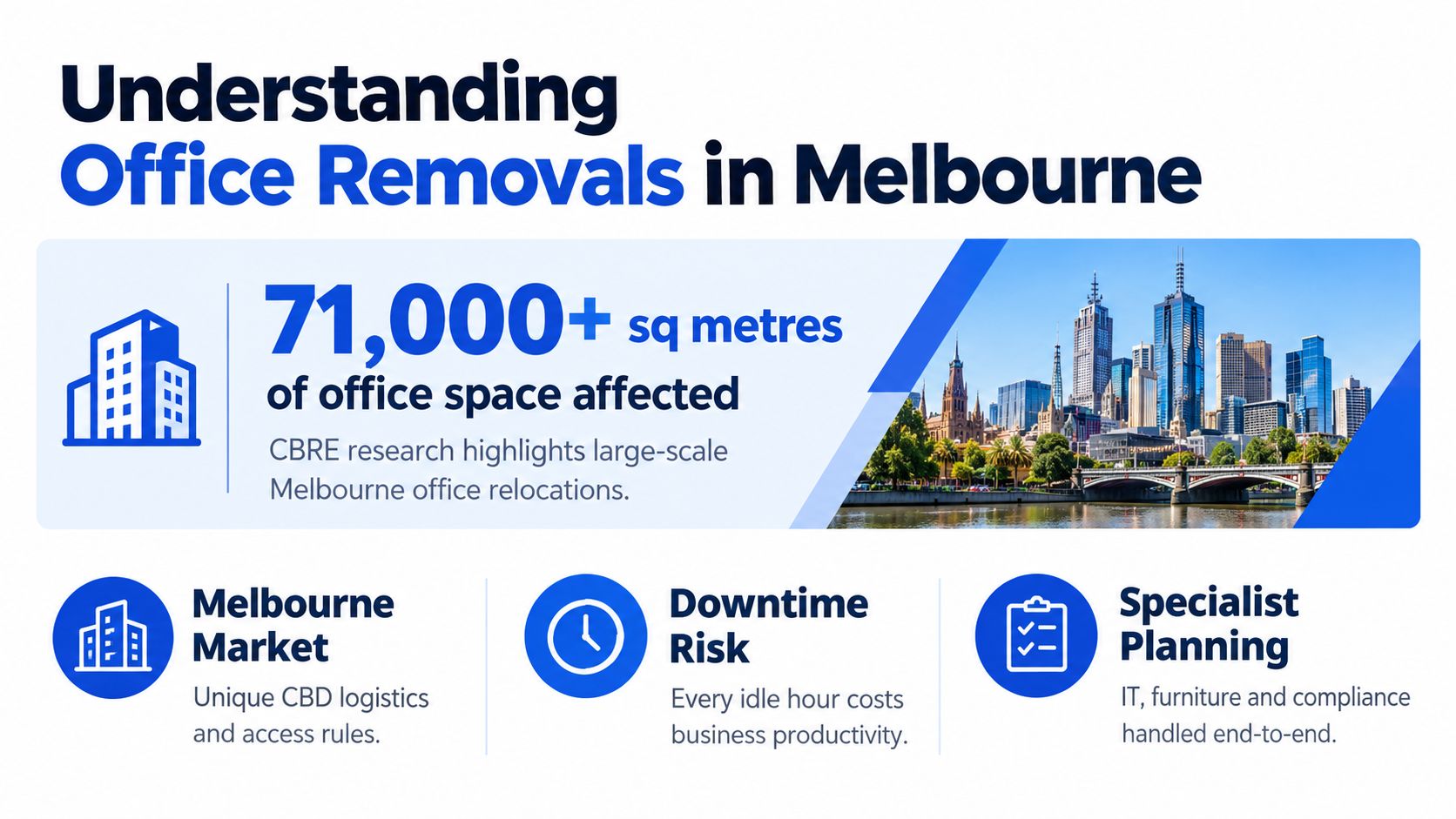
Melbourne's office market has seen more than 71,000 sqm of net centralisation into the CBD through tenant relocations, and the move pattern has run 11:1 in favour of businesses moving into the CBD versus moving out. That means office removals in Melbourne aren't just a transport job, they're part of a bigger reshaping of how companies use space.
A business doesn't feel that statistic on a spreadsheet, it feels it when the lease notice arrives, the server rack still needs to run, and the new address comes with tower rules, dock bookings, and a hard deadline.
Table of Contents
- Understanding Office Removals in Melbourne
- What Professional Office Removal Services Include
- Navigating Building Access and Permit Requirements
- Scheduling Your Move for Minimal Business Disruption
- Understanding Office Removal Costs in Melbourne
- Preparing for a Smooth Office Relocation
Understanding Office Removals in Melbourne
The scale matters because it changes the job. When CBRE tracked 189 tenant relocations and found more than 71,000 sqm of net centralisation into Melbourne's CBD, it showed that office removals in Melbourne are tied to market movement, not simple churn, and that the shift into central locations is still changing non-CBD precincts as older stock leaves the market CBRE research.
A growing firm in Richmond, South Yarra, or St Kilda Road doesn't just move desks. It moves people, records, screens, printers, meeting room gear, branded furniture, and often systems that can't go offline for long without affecting clients or staff. The actual challenge is keeping the business running while the physical space changes around it.
Why the Melbourne context is different
Melbourne's commercial property stock is dense, vertical, and rule-heavy. CBD towers often have strict loading windows, access cards, goods lifts, and building managers who want documentation before the crew touches a trolley. That's why a move can stall even when the truck and team are ready.
Practical rule: treat the building as a project stakeholder, not just a destination.
The best office removals in Melbourne start long before lifting day. A proper plan reads the lease timing, the building rules, and the team's operating hours together, then matches the move sequence to those constraints. Without that, crews spend time waiting, staging loads, or trying to solve access problems while the client is already paying for disruption.
In practice, that's why commercial removals are closer to logistics coordination than household moving. A house move is about handling belongings carefully. An office move is about handling belongings carefully while also protecting trading continuity, tenancy compliance, and the new fitout plan.
What Professional Office Removal Services Include
A professional office removal starts with a walkthrough, not a guess. A solid crew wants to see the access points, measure awkward items, note where the lift is, check parking, and understand what needs labelled reassembly at the new site. That first step usually tells you whether the move is simple, messy, or likely to fail without tighter planning.
The practical difference shows up in how the job is scoped. Good office removalists don't just quote a truck and a few hands, they break the work into packing, furniture disassembly, load sequencing, transport, reassembly, and any bridging storage that's needed between lease dates. The team should also confirm who is handling IT gear, files, and fragile items so nothing gets mixed into a generic pile.
A useful rule of thumb is to ask who is coming on the day.
If the quoting crew and the moving crew are different, ask how handover is managed. In office work, that gap is where mistakes creep in.
For Melbourne businesses, accountability matters. Company-owned trucks and employed crews are easier to manage than a loose network of last-minute labour because the same team can follow the same plan from start to finish. That consistency matters when desks need to be placed against a floor plan, not just unloaded into a room.
Professional service also means insurance documents are ready before the move. Building managers commonly want written proof of cover before granting access, so this shouldn't be treated as an afterthought. The same applies to post-move follow-up, because small issues like a missed label, a wobbly desk, or a missing part are much easier to fix when the removalist is still responsible for the job.
A practical example is a mid-sized office with open-plan furniture, a secure records room, and a few large monitors. The right team can pack, label, move, reassemble, and then return later if something needs adjustment. A DIY approach usually stops being cheap the moment staff lose a day to unpacking, searching, and fixing avoidable errors.
Navigating Building Access and Permit Requirements
Most office removals in Melbourne get harder than expected in the CBD and inner suburbs. Building managers commonly want loading dock time booked in advance, reserved goods-lift access, and insurance certificates before the first item moves building access guidance. If any one of those is missing, the crew can end up waiting in the street while the clock keeps running.
The lift matters more than many businesses think. If the lift dimensions, weight limits, or exclusive-use period don't suit the furniture or equipment, the move has to be reworked around the building rather than the team's original plan. That's why confirmatory paperwork needs to happen early, not the day before.
What to confirm before move day
- Loading dock window: Book it in writing and make sure the truck arrival time matches the access slot.
- Goods-lift rules: Confirm dimensions, weight limits, and whether the lift is dedicated to your move for the booked period.
- Insurance paperwork: Send certificates to the building manager before the crew arrives.
- Parking or road access: Check whether the truck can stand legally near the entrance.
- Building contacts: Keep the removalist, facilities manager, and building manager on the same thread.
For moves that affect a road or footpath, the City of Melbourne or transport authorities can require a reserved parking arrangement or a traffic management plan permit and dock guidance. That's especially important where a guaranteed bay is more reliable than hoping an on-street loading zone is free on the day.
The biggest mistake is assuming a visible loading area equals usable access. Clearways, tower rules, and lift bookings can override what looks available from the street. The move then becomes a queue of small delays, each one turning into lost time and building friction.
If the building manager hasn't signed off, the truck is too early.
The cleanest process is simple. Confirm the access details in writing, share them with the crew, and make one person responsible for coordination. When everyone knows the booking windows and the site rules, the job stays controlled instead of reactive.
Scheduling Your Move for Minimal Business Disruption
Weekend and after-hours moves work because they protect trading time. Staff can leave on Friday, the removal crew can shift the physical setup, and Monday starts with a functioning office instead of a half-finished room full of boxes. That's the main reason commercial clients ask for these windows, especially when there are servers, phones, or client-facing systems that can't be offline during business hours.
A weekday move can still work for a small team with light equipment and flexible operations. The downside is that staff often spend the day waiting for access, moving between old and new sites, and dealing with interruptions that break concentration. For larger offices, those interruptions multiply quickly because more people need the same lifts, the same sign-off, and the same unpacking coordination.
| Scheduling Option | Cost Considerations | Business Impact | Best For |
|---|---|---|---|
| Weekend move | Often more complex to book, but cleaner operationally | Lower disruption to staff and clients | Offices with live systems, larger teams, or strict trading hours |
| After-hours move | Can require more coordination with building access | Good for staged relocations and overnight setup | Businesses that can reset equipment outside office hours |
| Weekday move | Usually easier to schedule with some providers | More visible disruption and staff downtime | Smaller offices with simple layouts |
| Phased move | Depends on how many trips are needed | Keeps partial operations running | Teams that can relocate in stages |
For businesses comparing options, the question isn't just price. It's whether one interrupted trading day costs more than a coordinated off-hours move. That's why a staged relocation often makes sense for offices that can't shut down completely, because files, workstations, and equipment can move in sequence instead of all at once.
Office moving support in Melbourne is most useful when the schedule has to be matched to building access and staff availability, not just to the first truck slot that's free.
Understanding Office Removal Costs in Melbourne
The cheapest quote is often the least useful one. In office removals in Melbourne, the quote should reflect access difficulty, furniture volume, packing scope, reassembly needs, and any storage or specialty handling, because those are the things that change the job once the truck arrives. A fixed written quote based on a walkthrough is far easier to budget around than an hourly estimate that keeps climbing when the building slows the process down.
There's also a bigger business cost around the move itself. Melbourne office vacancy was reported at 17.9% in July 2025 in the CBD, and the market was still being shaped by stock withdrawals and cautious occupancy decisions Urban Property Australia report. That matters because many businesses are now weighing whether to move, shrink, or redesign rather than just relocate everything they already own.
What drives the price
- Crew and transport: The core labour and vehicle cost of the relocation.
- Packing scope: Full pack, partial pack, or only transport.
- Furniture work: Disassembly, labelling, and reassembly.
- Access complexity: Dock bookings, lift limitations, and tight loading conditions.
- Storage or extras: Bridging storage, specialty handling, or fixture placement.
A quote only becomes meaningful when it shows what's included and what isn't. If a provider won't explain the moving sequence or the assumptions behind the price, the final bill can become a surprise. Written scope is better than vague optimism.
The broader office market can also affect the relocation decision itself. In the Melbourne CBD, vacancy was reported at 19.0% in January 2026 and 18.9% in July 2026, while fringe vacancy sat at 24.7% and St Kilda Road at 31.8% Melbourne office market update. Those figures point to a market where businesses are often reassessing how much space they really need, rather than automatically moving every existing desk and cabinet.
If a new lease comes with a smaller footprint, the move cost can fall because there's less to transport and fewer items to reassemble. If the office is being redesigned around hybrid use, the smart spend may be on fitout and layout, not on shifting redundant furniture into a new address.
Requesting a written office quote is the better starting point when you want a clear comparison, because it forces the provider to define the scope before the first box is packed.
Preparing for a Smooth Office Relocation
A smooth office relocation is usually decided before the first desk is moved. In Melbourne's CBD and inner suburbs, building access can create more delay than the physical handling. Dock bookings, lift restrictions, loading permits, security procedures, and after-hours approvals all need to match the moving schedule. Confirm those details early, then give the removal crew a clear inventory and floor plan.
Start the readiness check at both buildings. Walk through the old and new sites, in person or by video, and record narrow doorways, loading zones, lift dimensions, parking limits, and delivery paths. Ask building management to confirm dock access, lift bookings, insurance documents, and any permit requirements in writing. A crew arriving without the right approval can lose hours before a single workstation reaches the lift.
Readiness checklist
- Inspect both sites: Record access restrictions and delivery routes.
- Confirm building rules: Obtain dock, lift, parking, security, and insurance requirements.
- Trim the inventory: Leave behind furniture and equipment that do not suit the new layout.
- Coordinate IT timing: Transfer equipment in an order that lets staff reconnect systems quickly.
- Assign responsibilities: Confirm who packs, labels, transports, disconnects, and reassembles each item.
- Schedule after-hours work: Match the moving window with building access and business operating needs.
- Plan the handover: Check for missing parts, damaged items, and workstation setup problems.
Separate packing from transport decisions where it helps. A business with organised staff may only need transport and reassembly, while a busy team may lose productive days sorting cartons at the new office. Packing and unpacking help can keep documents, cables, and workstation items grouped by department or destination.
The practical goal is a coordinated workplace handover. Keep the floor plan, asset list, IT sequence, contact details, and building rules in one shared plan. That gives the crew clear instructions when conditions change, rather than leaving decisions to be made at the loading dock.
House Moving Melbourne handles commercial relocations with fixed, written quotes, weekend and after-hours scheduling, and coordinated packing, transport, and reassembly. For an office move that depends on careful access planning and a clear handover, visit House Moving Melbourne to review how its service is structured for Melbourne businesses.
Prepared with Outrank app