
Office Movers Melbourne: The Complete Selection Guide 2026
Greater Melbourne's population grew by 105,000 people in 2024–25, and Melbourne's office vacancy sat at 15.5% metro-wide in January 2026, with the CBD at 19.0%. That's why the right office movers in Melbourne for an SME need a fixed written quote, company-owned trucks with employed crews, full transit and public liability insurance with certificates issued before moving day, weekend or after-hours scheduling, systematic item labelling, server-handling protocols, furniture reassembly to the supplied layout, a single point of contact, and a post-move follow-up within days.
Table of Contents
- Why Selecting Office Movers in Melbourne Requires More Than a Truck Quote
- Understanding Melbourne Office Relocation Conditions
- Evaluating Labelling, Server Handling, Reassembly, and Protection Practices
- Credentials and Documents to Request Before Booking
- Avoiding Hidden Transition Costs with a Pre-Move Asset Audit
- Realistic Melbourne Office Move Scenarios and Decision Takeaways
Why Selecting Office Movers in Melbourne Requires More Than a Truck Quote
A Melbourne SME that has just signed a smaller, better-located suite can't treat the move like a one-off furniture run. The lease might be tight, IT may be split across desks and a server cupboard, and the new floor plan may need more thought than the old one ever did. In that situation, a cheap truck quote tells you almost nothing about the job itself.
The right office movers Melbourne clients should shortlist are the ones who quote the transition, not just the lift. They give a fixed written price, use company-owned trucks with employed crews, handle weekend or after-hours work, label everything systematically, reassemble furniture to the supplied layout, provide insurance certificates before moving day, assign one point of contact, and follow up after the move. That's the standard that keeps the job controlled rather than improvised.
If you're comparing providers, start with a business relocation service that can manage packing, transport, placement, and reassembly as one scope, like House Moving Melbourne's business relocation service. A residential crew with a van can move boxes; a commercial crew should also protect trading time, records, and workstation order.
The rest of this guide focuses on what to inspect in a quote, how Melbourne's market conditions change the move, what a competent crew does with IT and furniture, and which documents you should demand before you commit. That's where the hidden cost usually shows up.
Understanding Melbourne Office Relocation Conditions
Melbourne moves often look simple on paper and turn messy in practice. A smaller or better-located office can still cost more to relocate if the job involves asset triage, storage, access restrictions, or a detailed reassembly plan. Greater Melbourne grew by 105,000 people in 2024–25, with overseas migration contributing 81,200 people and natural increase adding 32,400. Net internal migration was -8,600, so office change here often means people, equipment, and leases are shifting in different directions at once. ABS regional population release
Vacancy changes the kind of move you're buying
Melbourne's office market has also been under unusual pressure. Vacancy reached 15.5% across the metropolitan market in January 2026, while CBD vacancy hit 19.0%, the highest level reported since 1997, and the CBD added 100,618 square metres of stock over the six months to January 2026. Earlier reporting showed only 1,446 square metres of positive CBD net absorption in the six months to July 2025, far below the historical average of about 10,000 square metres. Melbourne office market research
That changes the job in front of the mover. Businesses are not only expanding. Some are consolidating, some are downsizing, some are splitting the move across dates, and some are clearing one tenancy while setting up another. A decent operator plans for short storage windows, overlapping leases, after-hours access, and make-ready work on both sites.
Practical rule: the easier the building access looks on paper, the more carefully you should ask about dock rules, lift bookings, and time windows.
Why commercial capability beats general transport skill
Residential movers can still be the wrong fit for office work. Commercial relocation demands crews who can work to a floor plan, protect files and monitors, manage fragile technology, and keep the site usable the next day. If a supplier cannot explain how packing, loading, reassembly, and handover fit together, they are offering transport, not continuity.
For Melbourne SMEs, that difference shows up quickly when there is a lease overlap, a partial fitout, or a move from older furniture into a tighter layout. A contractor with office experience sees those pressure points before the truck arrives. House Moving Melbourne office movers in Melbourne
Evaluating Labelling, Server Handling, Reassembly, and Protection Practices
Good office movers leave evidence before they ever unload a truck. Their labels match the floor plan, their team knows who owns each carton, and they don't treat screens, docks, or patch leads as random accessories. If a supplier gets vague when you ask about these basics, expect disorder on move day.
What competent handling actually looks like
Systematic labelling should work by room, owner, and destination. A box marked “accounts” isn't enough if the new floor has two finance desks, a shared printer point, and a storage room that's not yet decided. The stronger operator ties each label to a numbered plan and confirms where the item lands before the truck leaves the old site.
Server and IT handling should be treated separately from furniture. Australian government guidance on device management says office technology should be triaged for reuse, donation, or recycling, sanitised securely, and tracked through its lifecycle, with the National Television and Computer Recycling Scheme covering common office devices and related peripherals. For a move, that means each device needs a destination, a data status, and a disposal decision before transport, not after. Digital Transformation Agency device management guide
Furniture reassembly needs the supplied layout, not guesswork. Safe Work Australia recommends monitor placement directly in front of users at about arm's length, with keyboards and mice within easy reach, forearms supported, wrists neutral, and feet on the floor or a footrest. That's why crews should place workstations according to the new floor plan, then adjust them for task flow, not just return everything to the nearest wall. Safe Work Australia workstation set-up
A simple comparison you can use in quotes
| Practice | Good Operator Signal | Risky Operator Signal |
|---|---|---|
| Labelling | Boxes marked by room, owner, and destination | Generic labels like “misc” or “office” |
| IT handling | Devices logged, separated, and handed to named staff | Servers treated like desk furniture |
| Reassembly | Furniture placed to the supplied plan | Crew asks staff to sort it out later |
| Protection | Floors, lifts, and doorways covered before loading | Marks appear after the first trolley run |
A crew that can talk through these four points usually knows how to finish a commercial move cleanly. One that can't usually depends on the client to do the thinking on the day.
For storage between stages, some businesses also use climate-controlled holding space when the old and new premises don't line up neatly. That's useful when a move needs to be split, but it still works only if every item is identified and recorded first, not dumped into anonymous pallets. Climate-controlled storage facilities
Credentials and Documents to Request Before Booking
A proper booking conversation starts with paperwork, not optimism. If a mover can't produce certificates, won't itemise the quote, or keeps changing who'll turn up, the risk is already obvious.
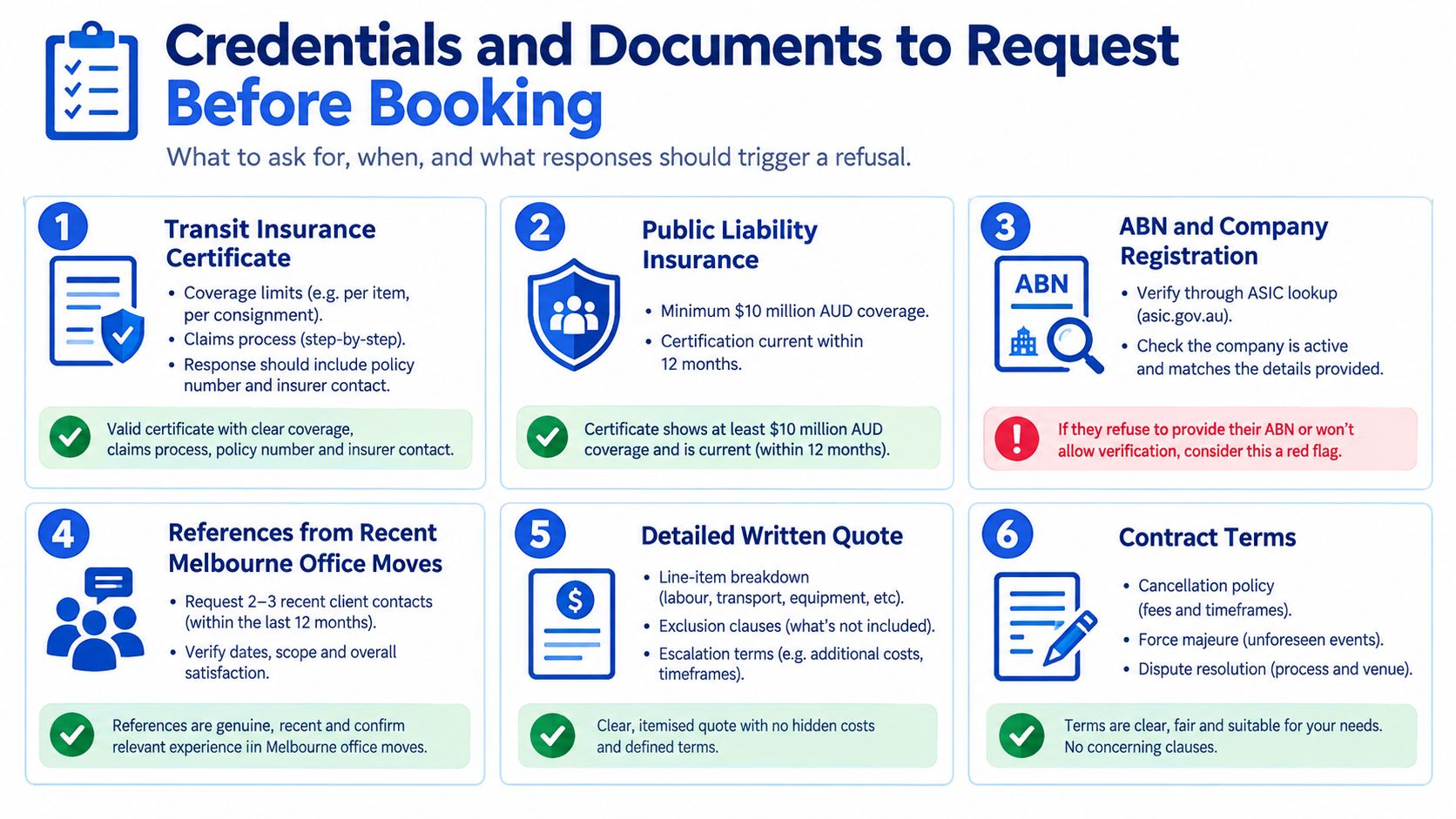
Ask for proof before you ask for a date
Request transit insurance and public liability insurance certificates before you accept the job. The certificates should show the policy number, current dates, and insurer contact details, and they should be available early enough for your building manager or landlord if approval is needed. If the provider delays, treats the request as unusual, or says the certificate will come later, walk away.
You should also check whether the crew is company-owned and employed, or whether the mover is filling the job with day labour. A consistent team is easier to brief, easier to hold accountable, and more likely to know how the last relocation was handled. That matters when the move includes files, screens, or sensitive rooms.
The booking pack should be specific
A competent office mover can provide:
- A fixed written quote that separates base move, packing, and extras
- Confirmation of weekend or after-hours availability
- A single point of contact for the whole move
- A written commitment to post-move follow-up
- Proof of access support for lifts, loading docks, or building paperwork
A vague hourly estimate is a red flag because it shifts the uncertainty onto your business. So is a quote that hides extras until after loading has started. You want line items, clear exclusions, and terms you can show to building management.
Rule of thumb: if a mover won't put the scope in writing, the final invoice usually fills the gaps for them.
When the supplier also helps with building approvals, it can remove friction with strata or property management. That isn't a nice-to-have, it's often the difference between a smooth move and a stalled dock booking.
Avoiding Hidden Transition Costs with a Pre-Move Asset Audit
A cheaper office does not automatically mean a cheaper move. In practice, a smaller tenancy can cost more to transition if you skip the asset audit and discover too late that you're paying to move redundant desks, surplus cabling, old storage units, or equipment you should have recycled.
Right-size before anyone packs a box
Start with headcount, peak attendance, assigned versus shared desks, meeting-room demand, IT hardware, archive volume, and lease obligations. Melbourne's hybrid patterns make that step even more important, because a business may need fewer fixed desks than its total staff count suggests. The central question is what the office needs on its busiest day, not what it looked like before the lease change.
That's also where consultation matters. Victorian relocation guidance says employers should consider hardship, disabilities, mobility aids, and reasonable adjustments when changing a worker's usual place of work. If someone uses adjustable furniture, accessible routes, or assistive equipment, those items shouldn't be left until the last truck load. They need to be mapped into the new layout before the move starts.
Decide what stays and what doesn't
A useful audit sorts every item into one of six paths.
- Retain what still fits the new floor plan and working pattern
- Redeploy items to another team or room
- Repair equipment that's still worth keeping
- Donate or resell items with value but no place in the new tenancy
- Recycle electronics and broken furniture through proper channels
- Securely destroy records and devices that shouldn't move at all
That approach reduces the chance of paying for transport, storage, and disposal on the same item. It also cuts the mess that comes from moving old gear only to throw it out a week later.
The circular-disposal side matters too. Australian reporting has estimated about 35,000 tonnes of commercial office furniture is discarded annually, and one government-linked reuse example reportedly avoided about $300,000 in replacement costs and 44 tonnes of CO2-e. Those are reminders that office moves are also asset decisions, not just logistics exercises. Victorian workplace relocation guidance
A strong mover can help you stage this audit and then work from the result. Some will offer packing and removal only, while others can combine storage, reassembly, and transport under one plan, including services like House Moving Melbourne. Used properly, that kind of support keeps the transition organised instead of padded with avoidable extras.
Realistic Melbourne Office Move Scenarios and Decision Takeaways
An inner-city accounting firm moving from a broad footprint into a tighter, better-addressed tenancy has one obvious temptation, to cut the move down to the cheapest truck quote. That usually backfires when the old desks don't fit the new rooms, the IT pile hasn't been sorted, and the landlord expects the outgoing floor cleared on time. The better decision is a mover that labels by room, reassembles to the supplied plan, and gives you the paperwork early enough to clear the building side of the move.
A different case is a growth-stage business that needs to keep sales, admin, and operations running while part of the team moves first. In that setup, the mover's job is sequencing. The crew should stage loads, protect shared files, and work around a weekend or after-hours window so the first team can keep functioning while the second team lands. If the provider can't explain how they separate critical work from everything else, they're not ready for a staged relocation.
A third example is a professional practice with sensitive files and several workstations that can't be disrupted during business hours. Here, the supplier has to coordinate secure file transport, server handling, workstation setup, and post-move adjustment without forcing staff to rebuild their own desks on Monday morning. The wrong crew leaves the practice with cables everywhere. The right crew leaves it with named cartons, fixed placements, and fewer interruptions.
A quick way to make the decision is to hold every quote against the same four questions:
- Is the price fixed and itemised?
- Are the trucks and crew confirmed, with insurance certificates already issued?
- Will the furniture be placed to the supplied layout, not improvised on site?
- Does the mover understand accessibility, data handling, and post-move follow-up?
If the answer to any of those is unclear, the booking isn't ready. Melbourne office relocations go wrong when the supplier treats the move as freight and the client treats it as a project. The successful ones are planned like a controlled handover, with inventory, timing, and people all aligned.
If you're planning an office move in Melbourne, House Moving Melbourne can help with fixed written quotes, labelled packing, after-hours scheduling, furniture reassembly, and commercial relocations that follow the layout you supply. Visit House Moving Melbourne to compare your move against a proper office-relocation scope and lock in a practical plan before the first box is packed.