Climate Controlled Storage Facilities in Melbourne
Most advice about climate controlled storage starts with a simple instruction: choose a unit that stays cool. That advice is incomplete. A cool storage unit isn't automatically dry, stable, well monitored, or protected from flooding and power failure. If you're storing timber furniture, documents, artwork, electronics, leather or family keepsakes in Melbourne, the label on the door is only the beginning of your checks.
The wider Australian and New Zealand self-storage market is already substantial. The Self Storage Association of Australasia reports more than 3,000 facilities, annual sector turnover of approximately A$2 billion, and storage used by more than 500,000 families. Its 2025 snapshot records 3,380 facilities, around 7.5 million square metres of storage area and average occupancy of 85% by area across Australia and New Zealand, as detailed in the SSAA industry snapshot. That scale gives customers plenty of choice, but it also means you need to separate genuine environmental protection from persuasive marketing.
Table of Contents
- The Truth About Climate Controlled Storage Labels
- Exact Temperature and Humidity Benchmarks
- What Items Actually Require Climate Control
- How to Verify Facility Environmental Controls
- Managing External Risks and Disaster Exposure
- Choosing the Right Unit Size and Pricing Model
- Preparing Your Items for Climate Controlled Storage
The Truth About Climate Controlled Storage Labels
“Climate controlled” is not a universal engineering specification. In many facilities, it means the building has a heating or cooling system that moderates temperature. It may not mean the operator controls relative humidity, records conditions inside individual units, or responds to environmental excursions.
That distinction matters because humidity is often the quiet cause of storage damage. Moist air can encourage mould and mildew on paper, leather, timber and textiles. It can contribute to corrosion on metal and create persistent odours in upholstery. A building can feel pleasantly cool during a site visit while still having damp corners, poor airflow or large changes between day and night.
The reverse problem exists too. A facility may lower temperature without removing enough moisture. If the operator only talks about a temperature range and can't show humidity readings, you're looking at temperature control, not necessarily complete environmental management. The Australian discussion of temperature-controlled storage makes this distinction useful: customers should ask whether the facility manages both temperature and relative humidity, rather than accepting the label at face value.
Practical rule: Treat “climate controlled” as a claim to verify, not a guarantee of preservation.
What the label should tell you
A credible operator should be able to explain:
- Temperature targets: The intended range, acceptable fluctuations and what happens when readings move outside it.
- Humidity targets: The normal relative-humidity range, how it's measured and whether dehumidification is installed.
- Monitoring practice: Whether readings are logged continuously, how often staff review them and where sensors sit.
- Fault response: The alarm process, maintenance escalation and arrangements during HVAC failure.
- Unit conditions: Whether sensors measure the storage rooms themselves or only a hallway or central plant room.
Don't choose a facility just because the corridors are indoors and the air feels comfortable. Ask for written specifications and recent environmental records. If the manager can't explain the humidity system clearly, assume the facility hasn't demonstrated humidity control.
Exact Temperature and Humidity Benchmarks
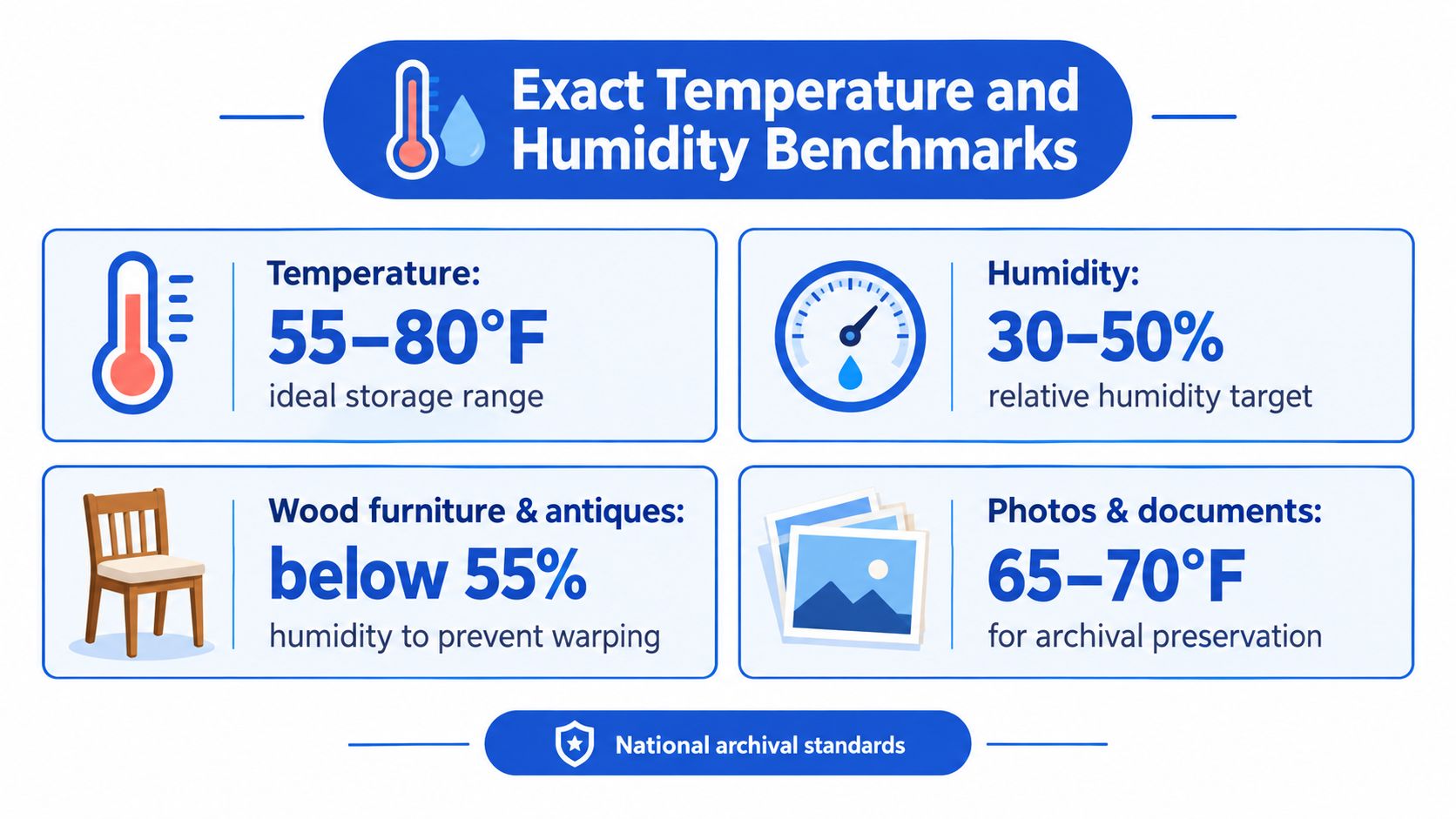
Storage decisions become much easier once the provider gives you measurable targets. For general household goods, paper records, artwork and mixed-material possessions, a practical Australian baseline is approximately 18–20 °C with 45–50% relative humidity. The National Archives of Australia guidance on preserving objects identifies this tighter range where specialised storage is available and recommends stable conditions around 20 °C with relative humidity below 60% more broadly.
The target isn't just a number on a thermostat. Stability matters just as much as the average. Higher temperature accelerates chemical deterioration, high relative humidity promotes mould, and excessively dry conditions can make paper and some organic materials brittle. Repeated changes can make wood, paper, textiles and painted surfaces expand and contract, placing stress on joints, coatings and fibres.
Use the right benchmark for the material
The National Archives specifies a temperature band of 17–23 °C for paper records, with continuous environmental control and 30–50% RH. For more sensitive composite materials, it recommends the same temperature band but a narrower 40–50% RH range.
Its guidance also sets tolerable daily changes at 3 °C for temperature and 10% RH for paper records. More sensitive composite materials have a tighter permitted daily humidity change of 5% RH. These figures are useful engineering benchmarks, not decorative numbers for a brochure.
| Stored material | Sensible environmental priority | What to ask the facility |
|---|---|---|
| Paper records and books | Stable temperature and controlled humidity | Whether readings are logged continuously and excursions are investigated |
| Artwork and framed works | Consistent humidity, limited rapid change and clean airflow | Whether sensors cover the storage area rather than only the entrance |
| Timber furniture and antiques | Protection from moisture and repeated dimensional movement | Whether the facility keeps general storage below the stated RH limit |
| Composite or mixed-material items | Tighter humidity stability | Whether alarms identify short-term changes, not just daily averages |
| Electronics and documents | Moderate, stable conditions and protection from condensation | How HVAC faults and power interruptions are handled |
Melbourne's seasonal changes make this particularly relevant. A unit that averages an acceptable annual temperature can still expose possessions to repeated warm-humid and cool-dry cycles. That is why a serious operator should use calibrated temperature and RH data loggers, distributed sensors and documented alarm thresholds, rather than relying on one thermostat.
A compliant average can hide a damaging excursion. Ask to see the trend, not just the set point.
The National Archives storage standard for non-digital archival records also supports a practical airflow requirement. Stagnant air encourages mould, while positive airflow through suitable mechanical systems, ceiling fans or cross-ventilation helps reduce dead zones. Packed goods shouldn't be pressed tightly against exterior walls, and dense stacks shouldn't block aisles or HVAC paths.
What Items Actually Require Climate Control
A standard unit is suitable for some durable possessions. It's a poor choice for items whose value depends on condition, appearance, operation or family history. The right question isn't whether an item is expensive to buy today. Ask whether you could easily replace it in the same condition if moisture, odour, warping or corrosion appeared.
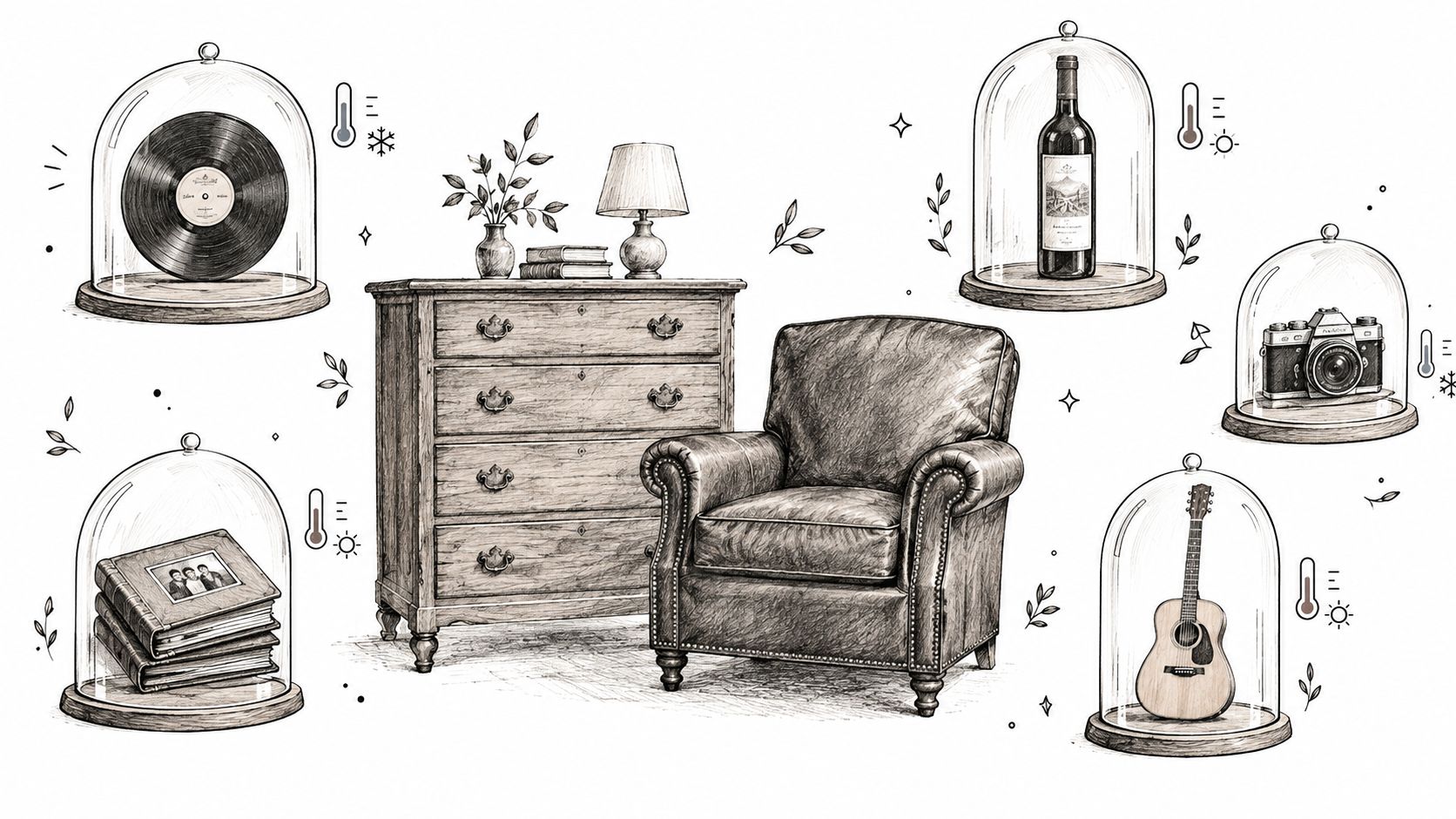
Consider a timber dining table moved into storage during a renovation. It might look perfect when loaded, but repeated environmental changes can cause movement in the timber and stress at joints or veneers. A leather sofa can absorb odours in damp air, while upholstered chairs and mattresses can hold moisture in areas that aren't visible during a quick inspection.
Sort possessions by consequence
Documents, photographs and artwork deserve the strongest environmental conditions. Paper can become brittle in overly dry conditions, while moisture can create sticking, distortion and mould risk. Framed pieces also contain several materials, including paper, wood, glass, adhesives and coatings, so a stable environment is more useful than a simple cool room.
Electronics should be protected from moisture, condensation, dust and large temperature changes. Keep original packaging where it provides cushioning, but don't assume a cardboard box makes an unsuitable environment safe. Remove batteries where appropriate, clean the equipment and follow the manufacturer's storage instructions for specialised devices.
Musical instruments, antiques and collectibles need a careful assessment. Timber instruments, vinyl records, comics, memorabilia and painted objects can all be sensitive to heat, humidity or dimensional change. A piano also needs controlled handling during the move, not just a suitable final storage room. For specialist equipment and safe transport planning, review piano moving with a trolley.
Sturdy items may not justify the premium. Clean plastic furniture, gardening tools, cookware, basic hardware and many sealed household goods can usually tolerate a standard storage environment better than paper, leather or timber. Keep them separate from sensitive possessions so you aren't paying for environmental protection across an entire inventory unnecessarily.
A removalist's decision test
Use three questions before booking:
- Would damage be difficult or impossible to reverse? If yes, choose stronger environmental control.
- Does the item contain paper, timber, leather, fabric, electronics or mixed materials? If yes, ask detailed humidity questions.
- Would you be comfortable leaving it in an unconditioned garage through Melbourne's seasonal changes? If no, don't place it in a basic unit.
The most expensive mistake is storing irreplaceable items beside ordinary goods because everything fitted into one cheaper space. Separate the inventory by risk, then choose the unit and environmental specification around the most vulnerable possessions.
How to Verify Facility Environmental Controls
Don't sign a storage agreement after a five-minute walk through a clean reception area. Tour the actual building, ask technical questions and request written answers. A trustworthy operator won't treat humidity monitoring as an unreasonable request, especially when you're storing documents, artwork, antiques or commercial records.
Use this inspection checklist
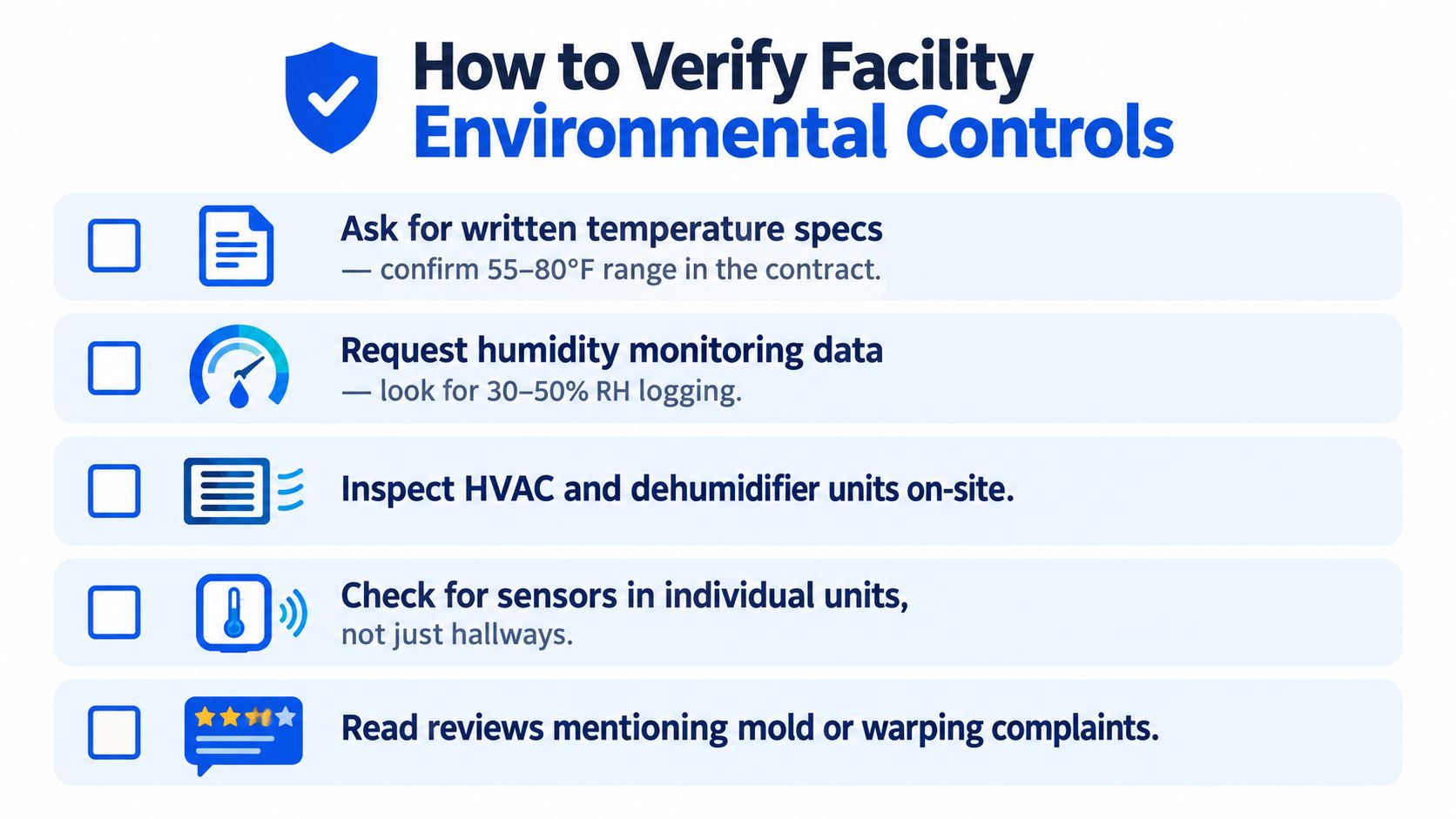
- Request written temperature specifications. Ask for the normal target, permitted variation and escalation process when conditions fall outside it.
- Ask for humidity records. Look for continuous or regularly captured temperature and RH data, not a verbal assurance that the room is “dry”.
- Locate the sensors. Sensors in hallways may not reflect conditions behind dense stacks or inside separate storage rooms. Ask whether the facility uses distributed monitoring.
- Inspect HVAC and dehumidification equipment. You don't need to be an engineer, but you should see maintained equipment and receive a clear explanation of what each system does.
- Ask about alarms. Find out who receives an alert, what threshold triggers it and how quickly staff investigate.
- Check airflow. Look for unobstructed vents, sensible aisle spacing and evidence that goods aren't packed hard against exterior walls.
- Review inspection records. Ask how staff identify mould, leaks, condensation, pests and blocked airflow before they affect stored goods.
- Clarify failure procedures. Confirm backup power, emergency access, maintenance contacts and customer notification arrangements.
A site tour should also include the loading path. Check whether doors open directly to the outside, whether wet weather can reach goods during loading and whether the facility keeps cartons and furniture raised off the floor. These details don't replace HVAC control, but they can expose practical weaknesses in the facility's moisture management.
The short video below provides another way to think about checking storage conditions before committing:
Read the rental agreement carefully. It should identify access conditions, prohibited goods, insurance responsibilities, environmental promises and what happens if the facility experiences a service interruption. If the contract only says “climate controlled” without defining temperature, humidity, monitoring or fault response, ask for an addendum or choose a provider with clearer documentation.
Managing External Risks and Disaster Exposure
Internal climate control can't compensate for a poor site or weak emergency planning. A well-regulated unit may still be exposed to floodwater, smoke, fire-weather disruption, power loss, blocked roads or delayed access if the building and its operating systems aren't resilient.
Australian insurers recorded A$3.5 billion in extreme-weather losses during 2025, while five-year disaster claims reached A$20.9 billion, according to the Australian self-storage industry research paper. The same research describes a south-eastern Australian heatwave in which maximum temperatures reached 10–15 °C above average, with extreme to catastrophic fire danger affecting Victoria and nearby states. Those figures don't predict what will happen at a particular Melbourne site, but they show why environmental protection must include the building's surroundings and continuity plan.
Inspect the site beyond the unit
Ask the operator:
- Is the building elevated or flood-prone? Find out how water enters the site, where floor drains sit and whether goods are stored above likely water levels.
- What happens during a blackout? Ask whether security, access control, alarms, ventilation, monitoring and HVAC remain operational.
- How are smoke and fire risks managed? Confirm detection, suppression, evacuation and post-incident procedures.
- Can customers access belongings during an event? A policy may cover physical damage while you still face a serious delay in retrieving essential records or stock.
- What does insurance cover? Ask specifically about flood, stormwater, smoke, mould, heat-related damage and delayed access.
Don't confuse the facility's insurance with your own coverage. Storage agreements often contain exclusions, limits or customer obligations, and environmental damage may be treated differently from theft or transit damage. Have your insurer confirm whether the policy covers the full replacement or declared value of the stored goods.
Think in terms of business continuity
For a household, external risk may affect passports, furniture, photographs and access to everyday possessions. For a business, it may interrupt stock availability, records access or office recovery. Store a separate inventory, photograph condition before loading and keep essential digital copies outside the facility.
The strongest climate controlled storage facilities combine stable internal conditions with sensible flood planning, backup systems, monitoring and clear incident communication. If a manager can describe the thermostat but can't explain the emergency plan, the protection is incomplete.
Choosing the Right Unit Size and Pricing Model
Choose space around the goods you need to protect, not around the largest unit a sales representative can offer. Overpacking blocks airflow and makes inspections difficult. Underestimating space forces you to stack fragile items, place furniture against walls or abandon an access route.
Start with an inventory by room. Separate large furniture, cartons, appliances, specialist items and possessions you'll need to retrieve. Then allow enough clearance to inspect the unit and reach the items at the back. A compact, carefully organised unit can outperform a larger room that has been packed tightly from floor to ceiling.
| Scenario | Estimated size | Best for |
|---|---|---|
| Small transition | Small unit | Cartons, seasonal goods and selected furniture during a short gap |
| Apartment relocation | Medium unit | Bedroom, living-room and kitchen contents with organised stacking |
| House move or downsizing | Large unit | Major furniture, appliances and boxed household possessions |
| Commercial overflow | Large or flexible space | Stock, files, office furniture and equipment requiring planned access |
| Specialty collection | Space based on item dimensions | Artwork, antiques, instruments and other goods needing careful separation |
These are planning categories, not promises of a particular floor area. Measure wardrobes, sofas, pianos, refrigerators and display cabinets before accepting a quoted size. A large item may dictate the unit's width, doorway clearance or loading method even when the total volume appears modest.
Compare the whole pricing model
A low weekly rate isn't good value if the provider adds unclear fees, restricts access or requires a long commitment that doesn't suit your move. Look for weekly billing, written inclusions, transparent access charges and a clear process for changing unit size. Weekly billing works well for settlement gaps, lease changes and staged renovations because you can match the storage period to the actual timeline.
Compare these points in writing:
- Base rent: What environmental specification is included?
- Access: Are visits restricted, scheduled or charged separately?
- Handling: Does the provider offer loading, unloading, pallet movement or special-item handling?
- Insurance: What is excluded, and what evidence of value is required?
- Notice period: How quickly can you vacate or move to a smaller unit?
- Price changes: How and when can the weekly rate change?
If you're coordinating a relocation rather than just renting a room, Melbourne removalist services can help you compare transport, handling and storage as one operational plan. The key is still the same. Pay for the environmental protection your possessions need, but don't pay to climate control tools, plastic furniture or other sturdy goods that could occupy a separate standard space.
Preparing Your Items for Climate Controlled Storage
A controlled room won't fix poor packing. If you load damp furniture, dirty fabric or condensation-prone goods into sealed plastic, you can carry the problem into an otherwise suitable facility. Preparation starts before the removal truck arrives.
Clean and dry everything
Vacuum upholstery, wipe hard surfaces, remove food residue and clean metal items before packing. Let furniture, mattresses, carpets and textiles dry completely. Don't wrap damp goods in plastic, because the covering can trap moisture against the surface and create a local environment where mould and odour develop.
Photograph valuable items from several angles and record existing marks, serial numbers and accessories. For business records, label cartons with department, retention category and access priority. Keep an inventory outside the unit so you don't have to open every box to find one document.
Pack for airflow and inspection
Use clean, sturdy cartons for paper and household goods. Avoid overfilling boxes, especially with books, because excessive weight can damage cartons and make safe handling harder. Wrap fragile objects with suitable cushioning, but don't compress textiles or artwork against a damp wall or floor.
Follow these loading practices:
- Raise furniture and cartons: Use pallets, shelving or suitable platforms so goods aren't sitting directly on the floor.
- Leave air paths: Keep space around packed goods and don't block vents, aisles or access points.
- Keep walls clear: Exterior walls can be cooler and more vulnerable to condensation, so place furniture and cartons with clearance.
- Separate materials: Keep leather, paper, timber, textiles and electronics from goods that may leak, shed dust or retain moisture.
- Label access points: Put frequently needed items near the front and create a clear route to them.
- Use breathable protection where appropriate: Fabric covers can protect against dust while allowing more airflow than sealed plastic.
Load sensitive items deliberately
Place framed artwork upright where suitable, supported and protected from impact. Keep electronics off the floor and avoid abrupt movement between a cold vehicle and a warmer building. Don't place heavy cartons on upholstered furniture, musical instruments or fragile boxes.
For packing support and a room-by-room preparation plan, use professional packing and unpacking assistance. A good packing process protects the items before climate control becomes relevant, which is exactly where many storage plans fail.
Climate controlled storage facilities are worth the extra cost when they provide measured humidity control, stable temperature, airflow, documented inspections and a credible disaster plan. Before you book, tour the site, read the agreement, photograph your goods and demand clear answers rather than relying on the label. House Moving Melbourne can coordinate packing, careful transport, specialty handling and weekly-billed climate-controlled storage for Melbourne and regional Victoria moves. Visit House Moving Melbourne to arrange a practical assessment and receive a fixed written quote for protecting and moving your belongings.