
Movers in Melbourne: A Practical Local Hiring Guide
You've got a moving date, a lift window to secure, and three quotes that look comparable until you read the fine print. One mover offers a low hourly rate, another gives a flat figure by phone, and a third asks for a video walkthrough before quoting. In Melbourne, that third approach is usually the one worth taking seriously.
The headline price isn't the right comparison. Access, crew size, loading time, parking restrictions and quote structure decide what your move really costs. A fixed written quote can protect you from a slow loading day, but only if the mover has assessed the actual job and documented what's included.
Table of Contents
- What Hiring Movers in Melbourne Actually Looks Like
- How Fixed Written Quotes Work in Practice
- The Right Questions to Ask Before You Book
- Coverage Areas Across Melbourne and Regional Victoria
- Specialty Items, Packing, and Storage Options
- Why the Cheapest Hourly Rate Often Costs More
- Choosing the Right Mover and Final Checklist
What Hiring Movers in Melbourne Actually Looks Like
Take a common move from a two-bedroom apartment in South Yarra to a Brunswick flat. The move may look short on a map, but the distance between suburbs is only one part of the job. You might need to book a service lift at the origin, arrange building access at the destination, and confirm whether either street allows a removal truck to stop legally.
That's why a proper booking starts with more than a list of furniture. A mover should ask about both buildings, inspect the access route, and record anything that could slow the crew down.
The booking process
A sensible Melbourne moving process usually follows these steps:
- Initial enquiry: Give the mover both addresses, the property types, the moving date and a rough inventory. Mention apartments, narrow streets, stairs, lifts and restricted parking immediately.
- Walkthrough: Complete an in-home or video survey. The mover should look at furniture volume, doorways, corridors, stair turns, lift dimensions and the distance from each entrance to the truck.
- Written quote: Check whether the quote is fixed or hourly. It should identify the inventory, access conditions, crew, vehicle and inclusions rather than just stating a total.
- Booking confirmation: Confirm the moving window, lift booking, loading arrangements, payment terms and cancellation conditions in writing.
- Moving day: The crew should arrive with the right truck, protection materials and a documented plan. Photographing valuable furniture before loading gives both sides a clear condition record.
Melbourne's rental sector creates sustained demand for apartment moves and short-notice relocations. Almost 30% of Victorian households were renters in 2021, while the renter share in Greater Melbourne rose from 27.2% in 2011 to 30.2% in 2021, according to Victorian government housing research (Victorian rental market technical report). That makes lift access, loading zones and lease-change logistics central to the local removalist market.
What changes the duration
A small apartment move can become slow when the crew waits for a lift, carries items through a long corridor or shuttles belongings from a legal parking point. A house move may be more predictable when a driveway sits close to the front door, but stairs, steep access and a large inventory can remove that advantage quickly.
Winter adds another practical issue. Wet floors, slippery paths and poor visibility require more protection and slower handling. A professional crew should protect flooring and keep boxed items covered rather than rushing to preserve an optimistic time estimate.
Practical rule: Treat the access plan as part of the move itself. A short suburb-to-suburb distance doesn't guarantee a short job.
How Fixed Written Quotes Work in Practice
A genuine fixed quote is not just a flat number typed into an email. It's a written commitment based on a defined scope. The easiest way to test it is to inspect the line items.
A useful quote should identify:
- Inventory: The rooms, furniture and packed items included in the move.
- Access: Stairs, lifts, loading docks, long carries, laneways and parking conditions at both addresses.
- Crew and vehicle: The number of movers and the vehicle type planned for the job.
- Travel: Any travel, toll or call-out charges, stated before booking.
- Additional services: Packing, disassembly, reassembly, crating, storage and specialty handling.
- Final price: The amount payable for the documented scope, including applicable fees.
If a quote says “fixed price” but adds hourly top-ups when the move runs over, it isn't fixed in the way most customers understand the term. The same applies when fuel, tolls, stairs or waiting time appear only in the fine print.
Why the walkthrough matters
A mover can only commit to a fixed figure if the crew understands what it has to handle. A video survey can show the sofa that won't turn through the stairwell, the fridge that needs a wider route, or the apartment lift that can't accept the planned trolley. An in-person inspection can reveal details customers often forget to mention, such as a rear entrance, basement storage cage or furniture already partly dismantled.
The customer also has a responsibility. If the inventory changes materially, the access information was incomplete, or a specialist item wasn't disclosed, the original scope may no longer apply. A reputable mover should discuss the change before doing chargeable extra work, not surprise you at the end.
Read the quote as an operating plan, not just a price. If the document doesn't explain how the mover reached the figure, it hasn't reduced much uncertainty.
For a clear starting point, use House Moving Melbourne's quote request page and provide a complete inventory with photographs, floor plans and access notes. The more accurate the brief, the more meaningful the written price becomes.
Australian removalist work is also a skilled handling task, not just a matter of driving a truck. The national training material requires furniture-and-effects handling to comply with relevant industry codes of practice, while consumer guidance recognises guarantees around due care, skill and reasonable time (national furniture and effects handling guidance). That supports a practical approach: documented scope, careful handling and clear terms are controls against both damage and disputes.
The Right Questions to Ask Before You Book
A walkthrough is only useful if it produces useful answers. Don't let a mover glance at the furniture and ignore the route it must travel. Ask questions that connect directly to delays, extra labour and damage risk.
Start with access
Ask the mover to confirm the following at both properties:
- Where can the truck legally stop? A loading bay, driveway or nearby legal parking point can make a major difference to carrying time.
- How far is the entrance from the truck? Measure the route, including gates, paths, corridors and basement ramps.
- Are there stairs? Count flights and note tight turns, narrow landings and handrails that restrict large furniture.
- Is a service lift available? Confirm its dimensions, weight limit, booking process and permitted moving hours.
- Does the building require protection or a certificate of insurance? Body corporate rules may require floor coverings, lift padding or paperwork before the booking is approved.
CBD loading rules deserve special attention. Eligible commercial vehicles typically have only 30 minutes in a loading zone while actively loading or unloading, and some zones become general two-hour parking after 4pm (Melbourne CBD loading and apartment access guidance). A building dock booking combined with a street-side shuttle plan is often more reliable than assuming a large truck can sit directly outside the entrance.
Disclose difficult items
Tell the mover about pianos, safes, marble tops, pool tables, large televisions, antique cabinets and gym equipment. These items affect equipment, crew numbers and handling technique. An undeclared piano may require a specialist trolley, additional protection or a different route. A heavy safe can change the loading plan entirely.
Disassembly also needs to be explicit. Identify beds, wardrobes, dining tables, modular sofas and exercise equipment that need to come apart. Ask whether disassembly and reassembly are included, and whether the crew will label fixings and photograph complex connections.
Prepare before the survey
Have a floor plan available and mark where larger items will go at the destination. Photograph narrow stairwells, lifts, gates and unusual access points. Confirm with the building manager whether a moving truck, lift and loading bay can be booked for the same window.
A mover can quote the furniture accurately and still quote the job badly if the access route is missing.
Don't describe an apartment as “easy access” unless the truck can stop legally, the lift is available, and the crew can move items from the vehicle to the door without an unplanned carry.
Coverage Areas Across Melbourne and Regional Victoria
The right quote changes with the type of move. A one-bedroom apartment in Southbank has a different risk profile from a three-bedroom house in Glen Iris, even if the inventory is similar. A regional relocation adds travel, route planning and return logistics that shouldn't be hidden inside a vague hourly estimate.
| Location Type | Typical Crew | Duration Estimate | Key Access Factors |
|---|---|---|---|
| CBD and inner suburbs, such as Southbank, Carlton, Richmond and Fitzroy | A crew sized for lift work, street loading and careful shuttle handling | Usually a half-day style booking when access is organised | Lift reservations, loading-zone rules, truck height, loading dock access and parking distance |
| Middle-ring houses, such as Camberwell, Glen Iris, Preston and Brunswick | A standard residential crew matched to the inventory and stairs | More predictable when a driveway or close kerb access is available | Driveway width, single-flight stairs, narrow side paths, gates and furniture placement |
| Regional Victoria, such as Geelong, Ballarat, Bendigo and the Mornington Peninsula | A crew and vehicle planned around the larger route and load | A longer booking with travel time built into the scope | Travel distance, toll roads, return-trip planning, overnight requirements and property access |
An inner-city apartment quote should focus on vertical transport and loading control. The mover needs to know whether the lift is booked, whether the truck fits the building's height limits, and whether the street allows a practical loading position.
A middle-ring house generally offers more direct access, but don't assume it's automatically straightforward. A long driveway, steep slope, locked gate or furniture that must pass through a side path can add handling time. Give the mover photographs rather than relying on a suburb name to describe the property.
Regional jobs need a particularly clear written scope. The quote should state whether tolls, overnight accommodation, return travel and storage are included. If the destination is outside the main metropolitan route, confirm how the mover handles delays, access changes and delivery timing before paying a deposit.
For a broader view of available service areas, review House Moving Melbourne's coverage information. Match the service to your actual route, not just the nearest suburb listed on a website.
The safest comparison is side by side. Put the access conditions, vehicle, crew, travel and services in one document, then compare the total scope. A cheaper figure that excludes a regional return journey or apartment shuttle isn't cheaper. It's incomplete.
Specialty Items, Packing, and Storage Options
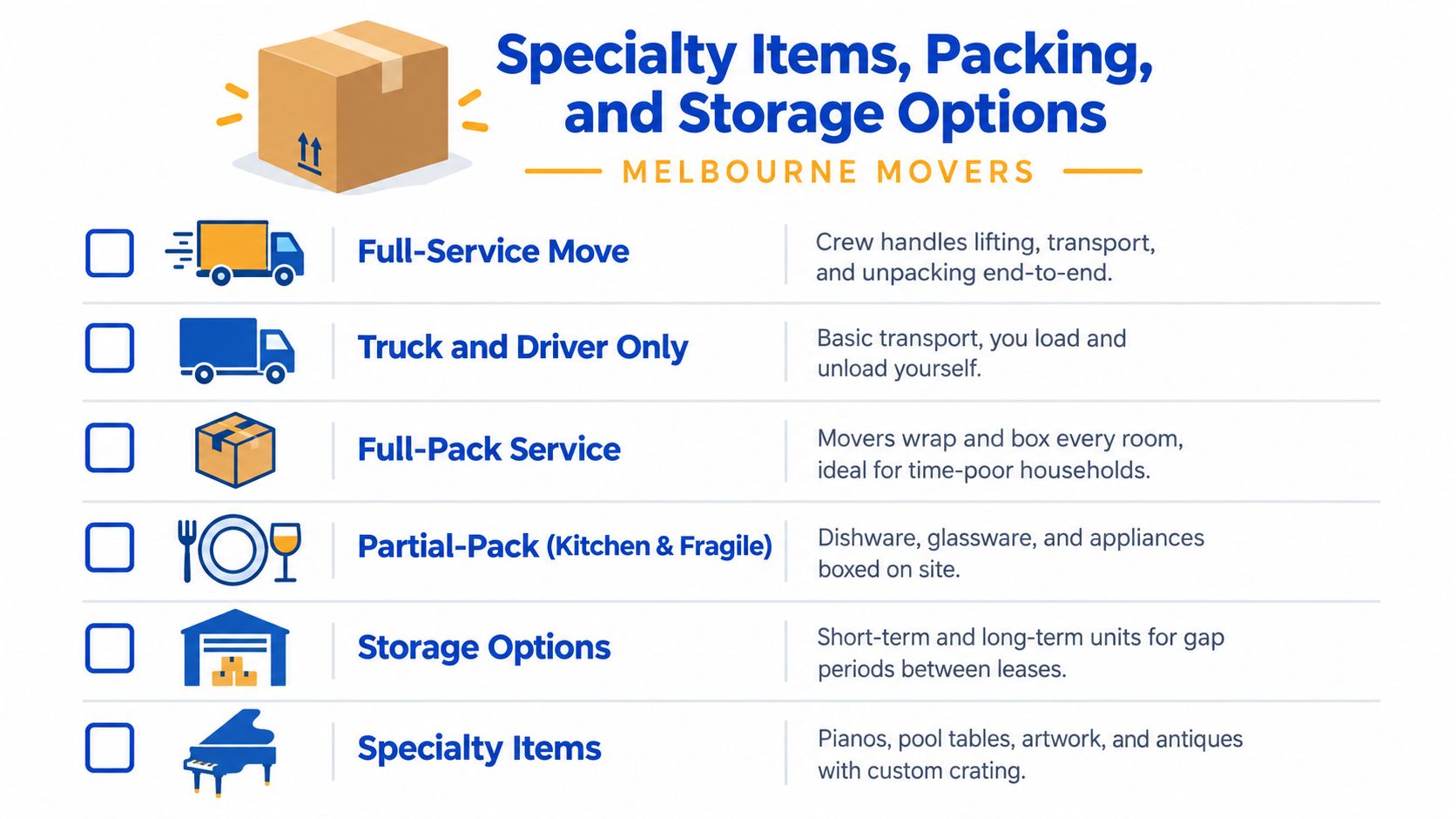
A basic truck-and-driver service can work for a prepared household with standard furniture and a clear loading route. It isn't the right fit for every move. The service tier should match the parts of the job that create the most risk or consume the most of your time.
Packing that earns its place
Full packing makes sense when you're short on time, managing a large household or handling a difficult settlement date. The crew boxes, labels and protects the contents before loading. Partial packing is more targeted. Ask for the kitchen, glassware, artwork or other fragile areas to be packed while you handle clothing and ordinary items.
Supply-only sits at the other end. The mover provides boxes, tape, blankets and protective materials, while you do the packing. It can reduce labour cost, but only if you can organise the inventory and finish before the crew arrives.
A useful packing quote should specify whether it includes:
- Boxes and materials: State the type and quantity of cartons, paper, tape, wrap and protective blankets.
- Labelling: Confirm whether boxes are labelled by room, contents or both.
- Unpacking: Check whether cartons are opened and materials removed at the destination.
- Fragile handling: Identify artwork, mirrors, glass tabletops and large televisions separately.
Specialty handling and storage
Pianos, antiques, marble surfaces, pool tables, safes and gym equipment need more than extra muscle. They may require a piano trolley, lifting straps, furniture blankets, custom crating or a route assessment. Confirm who will handle the item and whether specialist equipment is included in the quote.
A large television or glass tabletop may be fine with professional wrapping, but valuable artwork and fragile pieces can justify custom crating. The correct choice depends on the item's value, shape, route and sensitivity to movement.
Storage is useful when settlement dates don't align or a lease ends before the new property is ready. Ask whether storage is short-term or long-term, how goods are inventoried, how access is arranged and whether delivery out of storage is quoted separately. Climate-controlled storage can be sensible for sensitive furniture, artwork and documents.
Use piano moving equipment information as a prompt for the right conversation, not as a substitute for a site assessment. If a quote lists “special handling” without naming the item, equipment or protection method, ask for clarification.
Some add-ons are practical protections. Others are vague upsells. Pay for a service that changes the handling outcome, protects a fragile item, saves meaningful packing time or solves a real access problem. Don't pay for a label that just renames ordinary loading.
Why the Cheapest Hourly Rate Often Costs More
A low hourly rate only saves money when the crew can finish within the estimated time. Melbourne apartment moves often make that assumption unreliable. Lift waits, loading-zone restrictions, narrow laneways, long carries and double-handling can turn a cheap rate into an expensive final invoice.
The comparison below shows why headline rates need context.
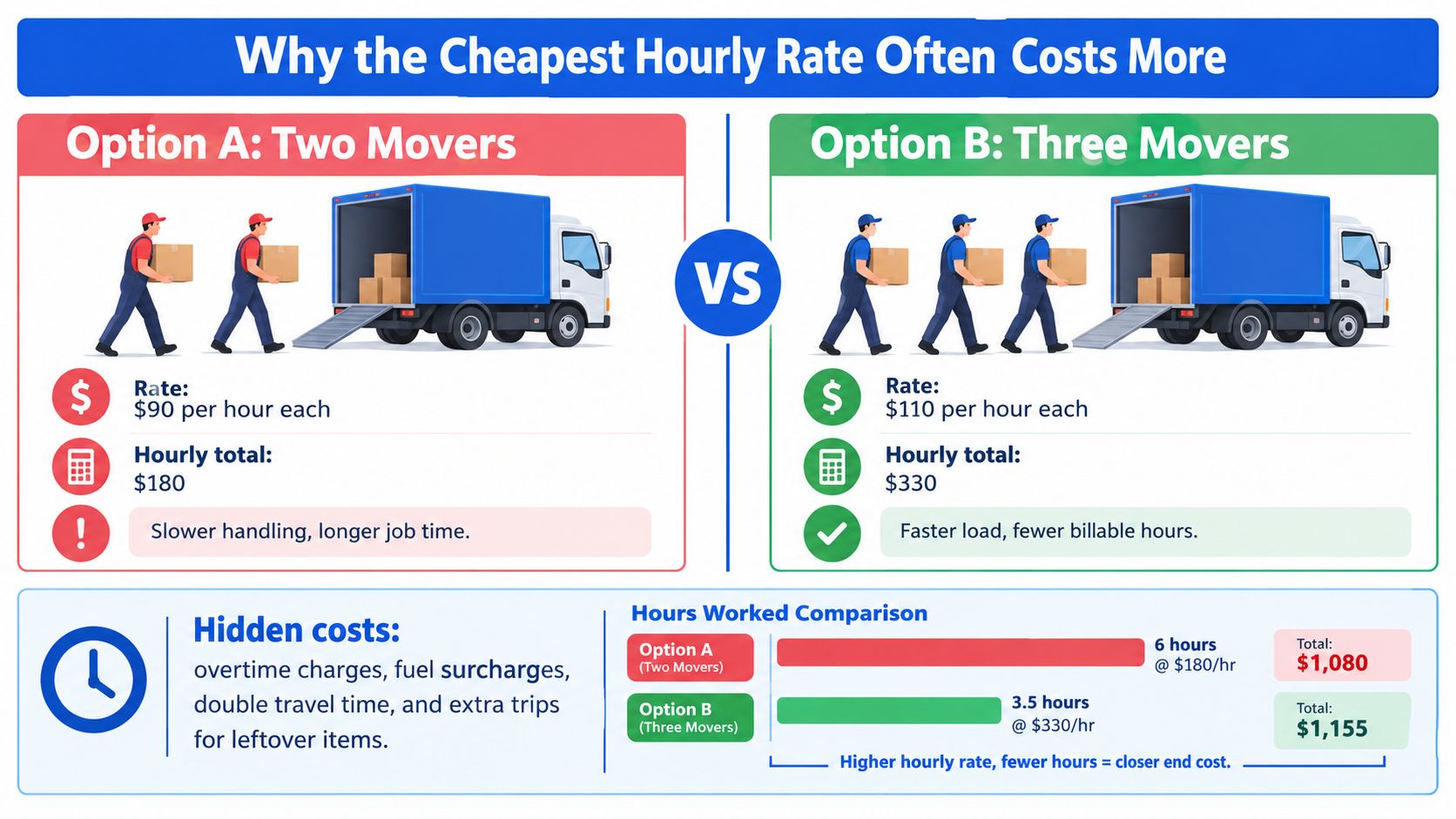
Two movers may look cheaper than three. But if the smaller crew spends longer carrying items to a shuttle vehicle, waits through a lift booking and handles the same boxes multiple times, the lower hourly rate doesn't tell you the final cost. A larger crew can sometimes complete the labour-intensive stage faster, although the correct choice depends on the inventory and access.
The important question isn't “What's your hourly rate?” Ask:
- What crew size do you recommend? Require the mover to explain how the number relates to the inventory and access.
- What is the minimum booking? A low rate may still come with a minimum charge.
- What starts the clock? Clarify whether billing begins on arrival, at the depot or when loading starts.
- Which extras apply? Ask about stairs, long carries, travel, fuel, tolls, waiting and packing materials.
- What happens if access causes delay? Get the answer in writing before booking.
Consumer guidance in Australia identifies removalist complaints involving damage, poor service and overcharging, while CHOICE's removalist guidance warns that voluntary industry oversight doesn't reliably prevent these problems. That makes scope clarity more valuable than a promotional rate.
The same principle applies to a fixed quote. If the quote is based on an accurate inventory and documented access, the mover carries the risk of an ordinary overrun. If you omit a staircase, add a room or fail to reserve the lift, the price may need to change because the job itself has changed.
A fixed quote is not automatically good. An hourly quote is not automatically bad. The winning structure is the one that matches the uncertainty in your move and explains who carries the risk.
The video below illustrates the kind of cost comparison customers should make before choosing a crew.
Choosing the Right Mover and Final Checklist
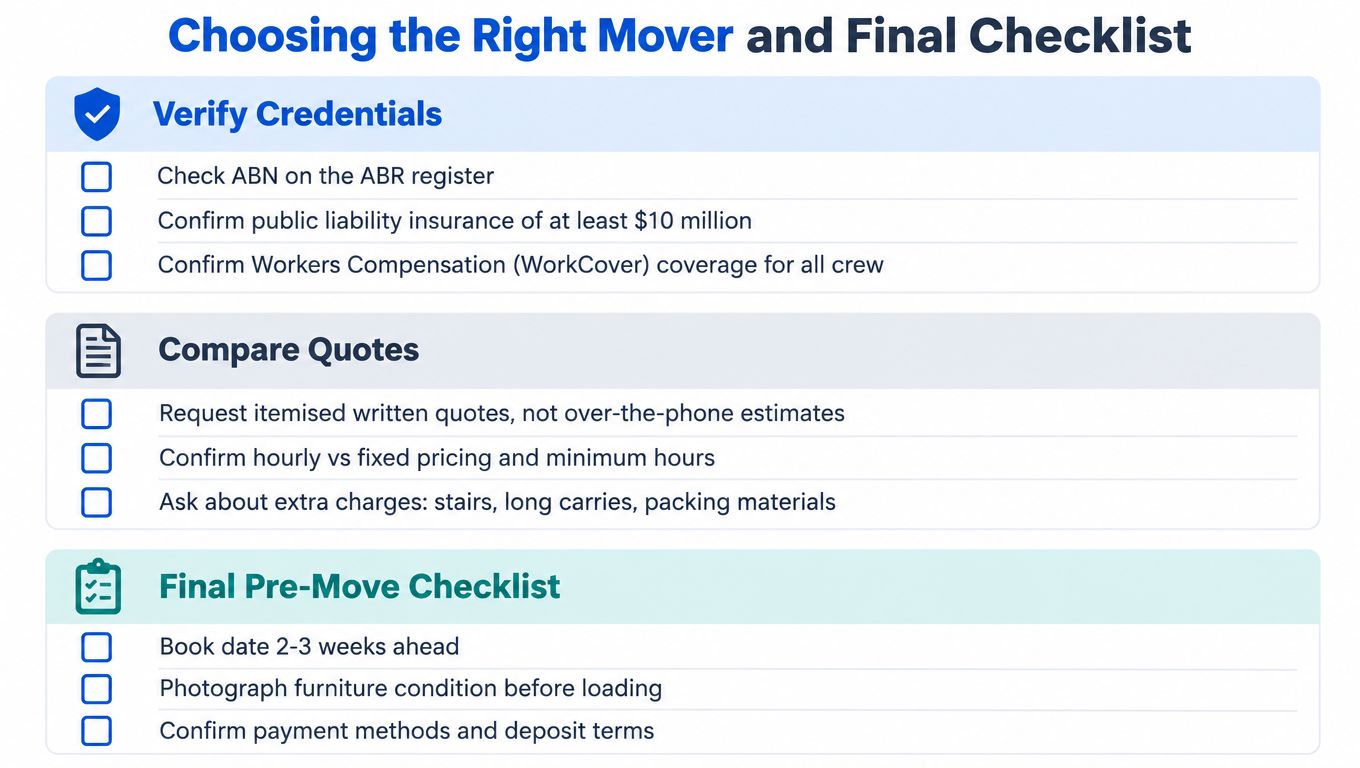
Start with credentials, then assess the quote. A polished website and a friendly phone call don't tell you whether the operator is prepared for your building, your furniture or your access restrictions.
Ask for the mover's ABN and check that the business details match the contracting entity. Request evidence of public liability cover and Workers Compensation coverage for the crew. Public liability protects against certain property and third-party incidents, while Workers Compensation relates to employees injured at work. Neither replaces careful handling, but missing documentation is a clear reason to pause.
Documents that should be in the quote
A fixed written quote should contain enough detail for another person to understand the job without calling the salesperson. Look for:
- Pickup and delivery addresses: Include unit numbers, entrances and relevant access points.
- Inventory: List rooms, large furniture, appliances, fragile items and anything requiring disassembly.
- Access notes: Record stairs, lifts, loading docks, parking, long carries, narrow paths and truck restrictions.
- Inclusions: State loading, transport, unloading, protection, disassembly, reassembly, packing and placement.
- Exclusions: Identify services that require separate approval, such as crating, storage or specialist handling.
- Payment terms: Show the deposit, balance timing, payment methods and any cancellation conditions.
- Change process: Explain how an altered inventory or access problem affects the price.
Don't accept “subject to final inspection” as a blank cheque. Ask what would trigger a revised quote and whether the mover must obtain your approval before doing additional chargeable work.
Your pre-booking checklist
- Complete a walkthrough. Choose an in-home inspection or video survey that covers both properties, not just a verbal inventory.
- Check recent reviews. Look for comments about apartment access, punctuality, damage handling and final billing. Recent feedback is more useful than a long list of undated testimonials.
- Book building access. Confirm the service lift, loading dock, parking permit and moving window with the building manager.
- Photograph furniture condition. Take clear photos of timber edges, mirrors, appliances and existing marks before loading.
- Confirm the deposit and balance. Check when payment is due and whether card, transfer or another method is accepted.
- Ask about the insurance excess. Confirm what cover applies during transit, what exclusions exist and who pays an excess if a claim is accepted.
- Freeze the inventory. Tell the mover about additions, items removed from the job or changes to either property before moving day.
Common questions before booking
Is transit insurance the same as full-value cover
No. Transit insurance generally relates to goods while they're being transported, subject to the policy terms and exclusions. Full-value cover may involve a different level of protection and valuation basis. Ask for the policy wording, claim process and excess in writing rather than assuming the mover's general insurance covers every item at replacement value.
Should I tip the crew
A tip isn't an automatic requirement. If the crew provides careful, professional service and you want to recognise it, you can offer a tip. You can also provide a clear review or written feedback. The agreed quote and payment terms should stand without an expectation of cash on the day.
What happens if the move runs long under a fixed quote
If the inventory and access match the written scope, an ordinary delay should generally be dealt with under the agreed fixed price. If the job changes, such as undisclosed stairs, additional furniture or unavailable lift access, the mover may request a variation. Ask for approval before extra work starts, and keep the original quote and any written change record.
A move is easier to control when the quote reflects the work. Compare total exposure, not just the hourly rate, and choose the mover that documents access, handling and payment clearly.
House Moving Melbourne provides residential and commercial relocations across Melbourne and regional Victoria, with walkthrough-based fixed written quotes, packing, specialty handling and storage options. If you want the access details and inventory assessed before you commit, visit House Moving Melbourne and request a quote for your move.