
Removal Company Charges in Melbourne: 2026 Cost Guide
Removal company charges in Melbourne are usually driven more by crew size, access conditions, and billing increments than by distance alone, and same-state moves typically sit around $300 to $3,500. If you only compare hourly rates, you can miss the line items that push the final bill up after the truck has already arrived.
The first mistake I see is simple: people ask, “What's your rate?” when the actual question is, “What's included, and what changes the meter?” A short move in a tight apartment building can cost more than a longer suburban run if the lift is slow, parking is poor, or the crew spends time carrying items through long corridors. The quote tells you the story if you read it properly.
Table of Contents
- Understanding Removal Company Charges in Melbourne
- Fixed Quotes Versus Hourly Rates
- Common Line Items in a Removal Quote
- How Size, Distance, and Access Change the Price
- Hidden Triggers That Change Your Final Bill
- Practical Steps to Avoid Bill Shock
Understanding Removal Company Charges in Melbourne
Melbourne clients often assume distance sets the price. It doesn't. A short move across town can cost more than a longer suburb-to-suburb job if the building has stairs, no loading bay, or awkward access.
What moves the number
Canstar's removalist cost guide shows same-state moves commonly run from about $300 to $3,500, while interstate moves often land in the $2,000 to $6,000 range. It also shows metro pricing shifting with dwelling size, from about $125 per hour for a one-bedroom apartment to $315 per hour for a large family home with four or more bedrooms. Those figures make it clear why a Melbourne quote should name the crew size, truck size, estimated hours, access conditions, and included services instead of hiding everything behind one hourly number.
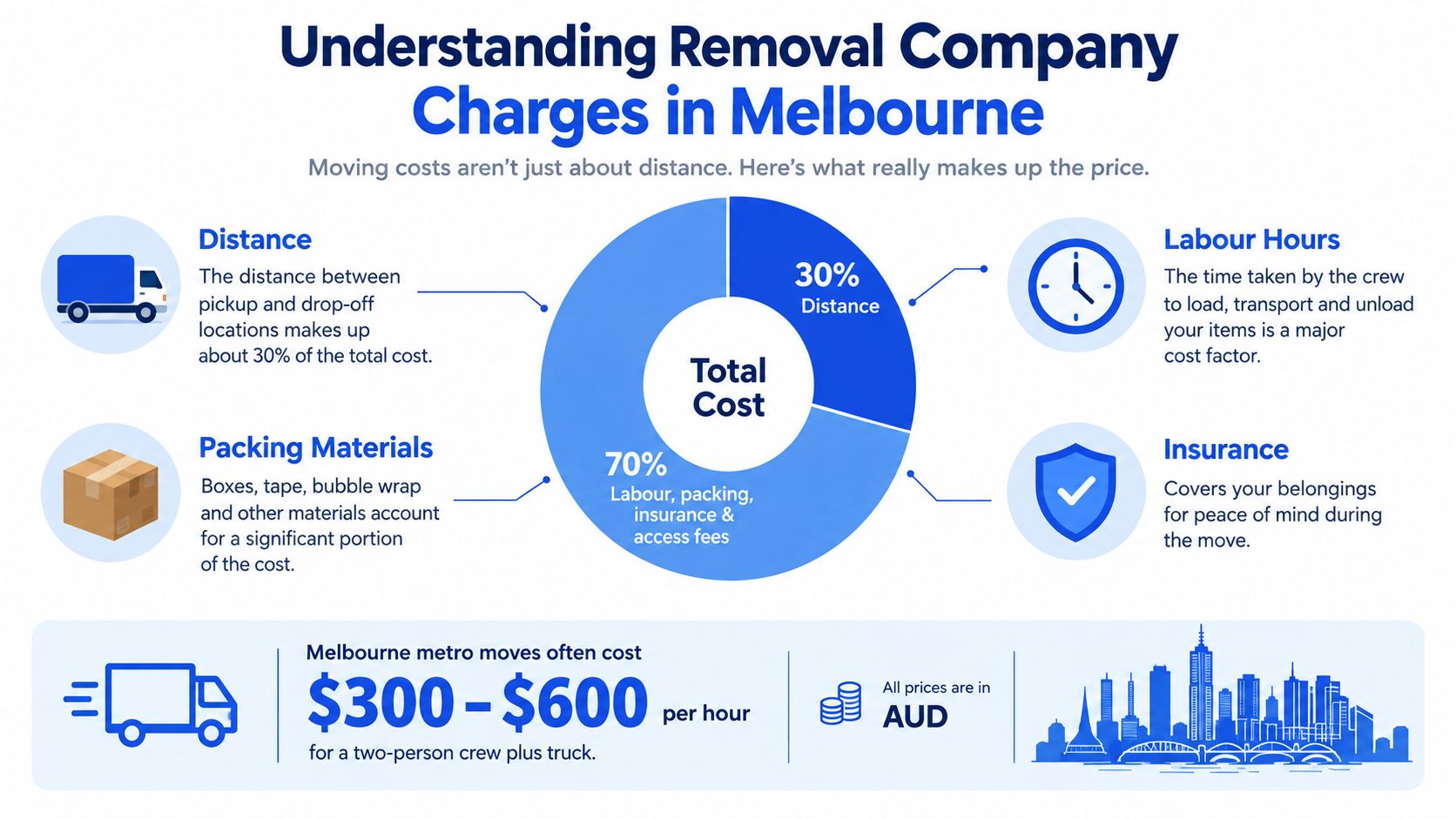
Practical rule: if the quote doesn't separate labour, truck, access, and extras, you don't have a real comparison.
Why the cheapest-looking job often isn't
I've seen customers pick the lowest advertised hourly rate, then lose the savings to slow access and unclear billing. Removal company charges may be billed by the hour, half-hour, or 15-minute increments, so waiting time, stairs, lifts, and travel can keep the clock running even when nothing is being loaded.
The better benchmark is the estimated total price under the same assumptions, not the smallest number on the flyer.
A quote audit beats bargain hunting. If the paperwork doesn't say how the job starts, what happens if access is delayed, and what's included in the base price, the customer takes the risk.
Fixed Quotes Versus Hourly Rates
Hourly billing sounds flexible, but it only works well when the job is simple and predictable. Fixed, written quotes work better when the move has unknowns, because they lock the scope before loading begins. That's why a walkthrough-based estimate is often the cleaner option for apartments, busy streets, and homes with fragile or bulky items.
When fixed quotes protect you
A fixed quote gives you price certainty if the mover has inspected the property or reviewed a detailed video walkthrough. It's especially useful when the quote spells out the base move, packing, materials, insurance, storage, access issues, and specialty handling. House Moving Melbourne uses fixed, written quotes based on a walkthrough, so the customer gets a defined scope instead of a moving target. House Moving Melbourne movers in Melbourne
That approach matters because a verbal estimate can drift once the crew sees the building conditions. If the provider has already measured the access and listed the inclusions, there's less room for argument when the truck turns up.
When hourly billing still makes sense
Hourly billing can work when access is open, parking is easy, and the item list is small. If the route is simple and the crew can move without delays, the final invoice may stay close to the estimate. The problem is that the estimate depends on everyone seeing the same job the same way.
A fair hourly quote starts with a clear question, how long will this take if nothing goes wrong?
That's the part many customers forget to ask. If the answer depends on a lift booking, parking window, or how much dismantling turns up on the day, the hourly option becomes less predictable than it looked on paper.
Common Line Items in a Removal Quote
A decent removal quote should read like a checklist, not a mystery total. The base move is only the starting point. What matters is whether every extra charge is named before the crew arrives.
The line items worth checking
The main items I look for are base transport, crew and truck configuration, travel time, stairs, lift access, parking delays, packing materials, storage, insurance, tolls, and specialty handling. Storage needs its own line in the quote, because the cost can change once the goods sit off-site. If that item is relevant, ask how billing works by checking storage and removals in Melbourne. Consumer Affairs Victoria also notes that removal pricing is not capped under the ACL, which is why the quote specification itself is the main protection, not a supposed price ceiling. Consumer Affairs Victoria pricing guidance
Good quote habit: if a fee can appear later, get it written down now.
A vague quote usually hides one of three things, incomplete access planning, unlisted labour, or a service that's broader than the customer expected. That is how a cheap-looking number turns into a bigger invoice once the job has started.
What a clear quote should say
A proper quote should define the charging model, the minimum charge, the crew and truck setup, and how scope changes are approved. It should also state whether stairs, lift delays, parking issues, packing materials, or storage are included or billed separately. That level of detail reduces arguments because both sides are pricing the same job, not two different versions of it.
I would rather see a quote that is slightly longer than one that is slightly cheaper. The longer version usually tells you what is really being sold. The shorter one often just postpones the surprise.
How Size, Distance, and Access Change the Price
Dwelling size and travel distance both matter, but they don't behave the same way. Bigger homes need more labour and truck space, while longer routes add driving time and fuel exposure. Independent Victorian benchmark data shows that average moving prices rise as both distance and home size increase, with moves up to 25 km averaging about $307, 25 to 100 km averaging about $394, and 100 to 250 km averaging about $748. Bedroom-size averages in Victoria also climb from about $331 for 0 to 1 bedrooms to $660 for homes with more than four bedrooms. Airtasker's Australian moving report
Why access can cost more than distance
The surprise factor is access. A ground-floor townhouse move with clear parking can be easier than a shorter apartment move that involves stairs, a narrow doorway, and a lift booking that keeps the crew waiting. Access problems add labour without adding kilometres, so they can push the final bill harder than people expect.
That's why I tell customers to treat the move like an operations problem, not a postcode problem. Measure the tight bits, not just the distance between addresses. If the truck can't park near the door or the crew has to carry everything a long way, the labour clock is still running.
The benchmark that actually helps
A useful comparison starts with the same assumptions. Compare quotes only after you've documented the item count, floor level, lift dimensions, parking constraints, and any disassembly requirements. That's the only way to know whether one provider is genuinely cheaper or just quoting on a looser set of assumptions.
If you need a local reference point for building access and suburb-specific conditions, removalists in Richmond are a good example of how inner-city access can shape the job. Richmond is exactly the kind of area where parking, lane access, and stair work can matter more than the map distance.
Best comparison method: line up identical scope, then compare the total. Anything else is guesswork.
Hidden Triggers That Change Your Final Bill
The cheapest hourly rate is often the most expensive move. That sounds backward until you watch a crew sit in a driveway waiting for a lift, a parking permit, or a customer who thought packing was included. The meter keeps running, and the invoice grows for reasons that had nothing to do with transport itself.

The triggers I'd ask about first
Ask whether the hourly rate includes return travel, whether there's a minimum charge, and whether the business bills in half-hour or 15-minute increments. Ask who pays if the truck can't park nearby, and ask what happens if the scope changes after the crew starts loading. Those are the points where a quote turns into a dispute.
Consumer guidance also treats changes between the agreed service price and the final amount paid as a common source of complaints. That's exactly why vague wording causes trouble. If the access conditions are unclear, the mover and the customer may each believe they agreed to something different.
Why scope changes need permission
A solid removalist won't treat a new item or access issue as a blank cheque. The quote should say how additional work gets approved before it happens. If it doesn't, the customer loses control of the cost and the crew loses clarity on what they're being paid to do.
The pattern is familiar. The advertised rate looks low, but the final bill reflects waiting time, travel, access problems, and extra handling. Genuine protection is simple: insist that every added charge gets explained before the work continues.
Practical Steps to Avoid Bill Shock
Start with written quotes, not verbal estimates. A written quote gives you something to compare, especially if the move has stairs, tight parking, or storage needs. If you get three quotes, compare them on the same scope, not on the prettiest headline.
A pre-move checklist that actually helps
- Get it in writing: Ask for a fixed-price quote or, if the mover charges hourly, make sure the inclusions are listed clearly.
- Confirm the extras: Check packing, materials, insurance, storage, tolls, and specialty handling before you accept the job.
- Measure the access: Note stairs, lift size, driveway width, and how far the truck must carry items to the door.
- Ask about timing rules: Confirm minimum charges, travel billing, and how the crew handles delays.
- Protect the handover: Do a final walkthrough and photograph valuables before the first box moves.
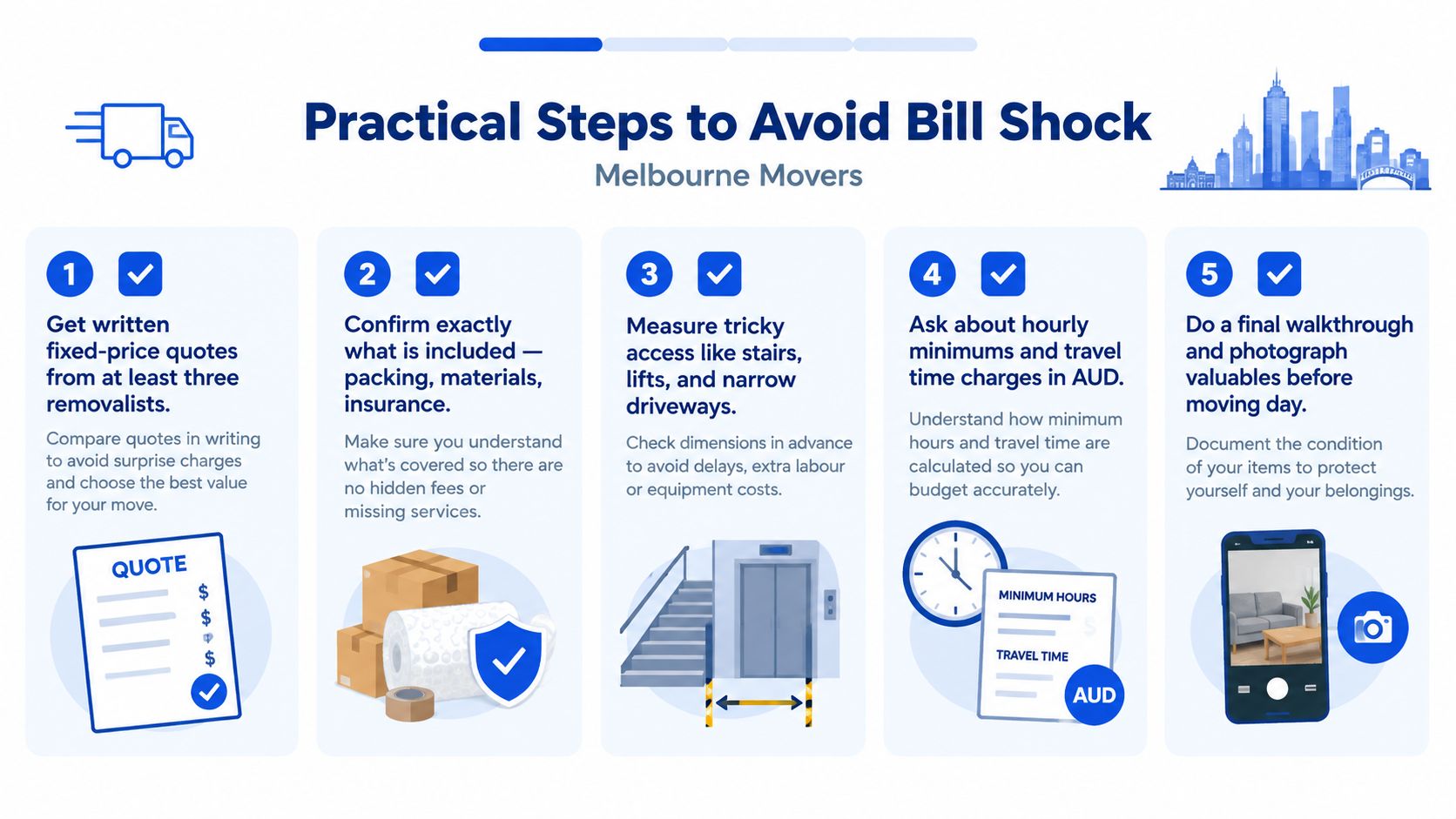
The best quotes come from people who've already measured the job properly. That usually means a walkthrough, a video assessment, or a detailed inventory before moving day. A provider that can explain the cost line by line is far easier to deal with than one that keeps everything in a single lump sum.
What to do when the scope changes
If the job changes, ask for written approval before the crew continues. That one habit prevents almost every ugly argument I've seen over final invoices. It also gives you a clean record if you need to question a charge later.
For households and businesses that want that kind of quoting process handled by one team, House Moving Melbourne offers walkthrough-based quotes, packing, transport, specialty handling, and storage across Melbourne and Victoria. If you're comparing removal company charges and want the scope pinned down before moving day, that's the kind of conversation to start with today.