
Office Moving Melbourne: The Business Guide
You've got a lease expiry, a half-packed store room, and a team that's already asking whether the new office will function as intended. That's the core office moving Melbourne problem, not the cardboard boxes. The hard part is choosing a building, timing the move, and keeping the business open while everything else gets shifted, re-labelled, and plugged back in.
Melbourne makes that harder than most cities because the market is behaving in two directions at once. Vacancy is still high, yet quality stock can still be tight, and the best fitted options don't stay “available” in any meaningful sense for long. If you treat the move like a furniture job, you'll lose time, money, and control.
Table of Contents
- Planning Your Office Relocation Strategy
- The Importance of Professional Assessment and Fixed Quotes
- Navigating Melbourne Office Building Compliance
- Minimising Downtime with After-Hours and Weekend Moves
- Systematic Labelling and Reassembly for a Controlled Transition
- Final Steps and Post-Move Support
Planning Your Office Relocation Strategy
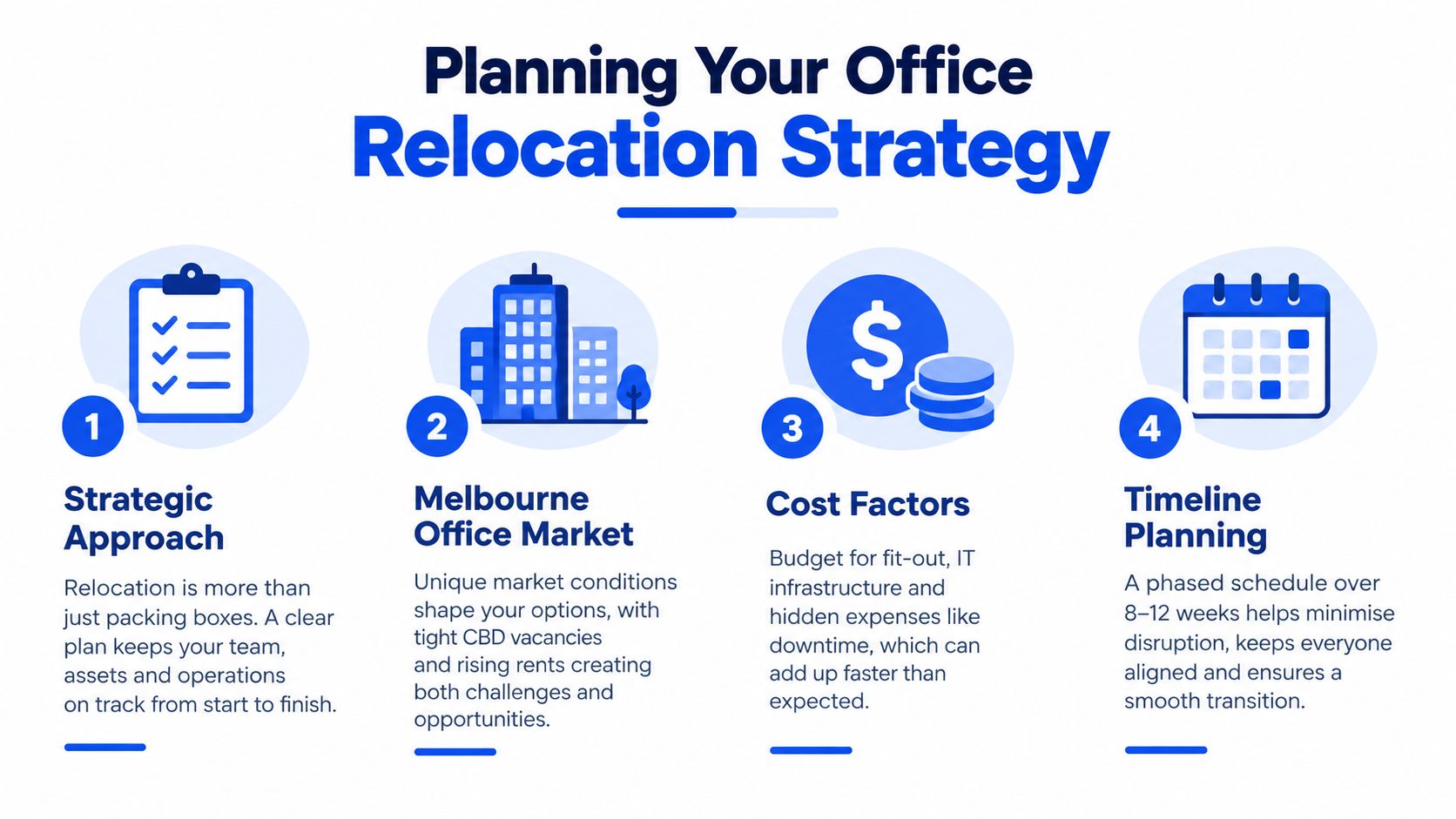
A business owner rings up after seeing plenty of empty floors in the CBD and assumes the move will be easy. Then the search starts, the floorplates don't match the team's actual headcount, the lift booking rules are awkward, and the fit-out gaps become obvious fast. That's why office moving Melbourne should start with strategy, not cartons.
Start with the space you actually need
High vacancy doesn't mean an easy choice. Melbourne's CBD vacancy climbed from 16.4% in March 2024 to 17.9% in H1 2025, then 19.0% in H2 2025, after sitting at 3.2% just four years earlier, so the market shifted sharply as supply increased and demand softened Knight Frank. That's useful context, but it doesn't mean every office is worth moving into.
The smarter question is whether your team needs more area, better layout efficiency, or a cleaner tenancy with less disruption. If you're moving because the lease is ending, use the relocation to fix workflow problems, not just swap addresses.
Practical rule: don't choose a building until you've mapped desks, meeting rooms, storage, server space, and client-facing areas against the way your team actually works.
Treat timing as a business decision
Melbourne's supply cycle changes the deal you can strike. Independent market coverage says there were no new office towers reaching practical completion in H1 2025, with the next major completions not scheduled until 2026 to 2027, and no major office developments under construction after 2027. That tightens the choice set for businesses that want quality fitted stock.
That's why waiting can be expensive even when vacancy looks comfortable on paper. If you need an upgraded tenancy, the competition is for the best existing space, not for any empty floor. A clear relocation plan lets you move on the right timetable instead of reacting to a landlord deadline.
For a practical planning checklist and workflow, use House Moving Melbourne's process overview.
The Importance of Professional Assessment and Fixed Quotes
A proper assessment is where most office moves are won or lost. Without one, you're guessing at access, labour, downtime, and the awkward items that never fit the neat version of the plan. With one, you can see the move for what it is, a coordinated workplace change with physical, building, and operational constraints.
Walk the site before anyone quotes the job
A removalist should inspect the current office and the destination, either in person or by video, before putting numbers on the table. That walkthrough should catch the obvious troublemakers, narrow passages, stairs, loading access, fragile equipment, and any item that needs special handling. It should also show who owns each part of the move, so the project doesn't turn into a chain of crossed wires.
The point of a walkthrough is not politeness, it's accuracy. A fixed, written quote based on a real assessment is the only serious way to avoid bill shock once the truck is already loaded.
Ask for one person who owns the job
When too many people are involved, small decisions get delayed and the move slips. You want a single point of contact who can coordinate packing, access, truck timing, and reassembly against the same plan. That matters even more when desks, files, and IT gear all need to land in the right spot first time.
House Moving Melbourne is one example of a provider that offers fixed, written quotes after a walkthrough, along with a single point of contact. Other firms may do the same, but the principle is essential: the quote should reflect the actual building and the actual scope, not a vague hourly estimate.
Clear rule: if a removalist can't explain how the quote was built, assume there's still risk hiding in the fine print.
If you want to request a fixed assessment-based quote, use this quote request page.
Navigating Melbourne Office Building Compliance
Office moves in Melbourne fail for boring reasons, and most of them are building rules. The truck is ready, the crew is there, and then the lift booking isn't confirmed, the loading dock window is wrong, or the street access can't take the vehicle you've booked. That is not a moving problem, it's a compliance problem.

Building access rules are part of the move
Commercial towers often control lift bookings tightly because tenant traffic, deliveries, and security all compete for the same access points. Loading docks can have time windows, vehicle limits, and supervision requirements. If your removalist hasn't already checked those conditions, you're gambling with the move schedule.
Street parking and truck access can also trigger extra friction. In Melbourne, a professional crew should organise the practical side of access early, because a truck that has nowhere to stop will burn time while everyone argues with the clock.
Safety on the floor matters as much as timing
Victoria's WorkSafe guidance treats an office move as a planned risk-control exercise. Employers should appoint a move coordinator, consult employees and health and safety reps, assign roles, and keep access routes clear so trolleys and equipment can move safely. It also says manual handling should be controlled by eliminating or redesigning the task where possible, then using workplace and work-system changes and mechanical aids before relying on training alone WorkSafe Victoria.
That means the move has to be sequenced around protected walk paths, lift usage, and mechanical assistance. Don't let anyone tell you safe lifting technique alone solves the problem. It doesn't.
Keep the route clear, keep the roles clear, and keep the lift booked. That's how you avoid the stupid delays that turn a move into an argument.
Minimising Downtime with After-Hours and Weekend Moves
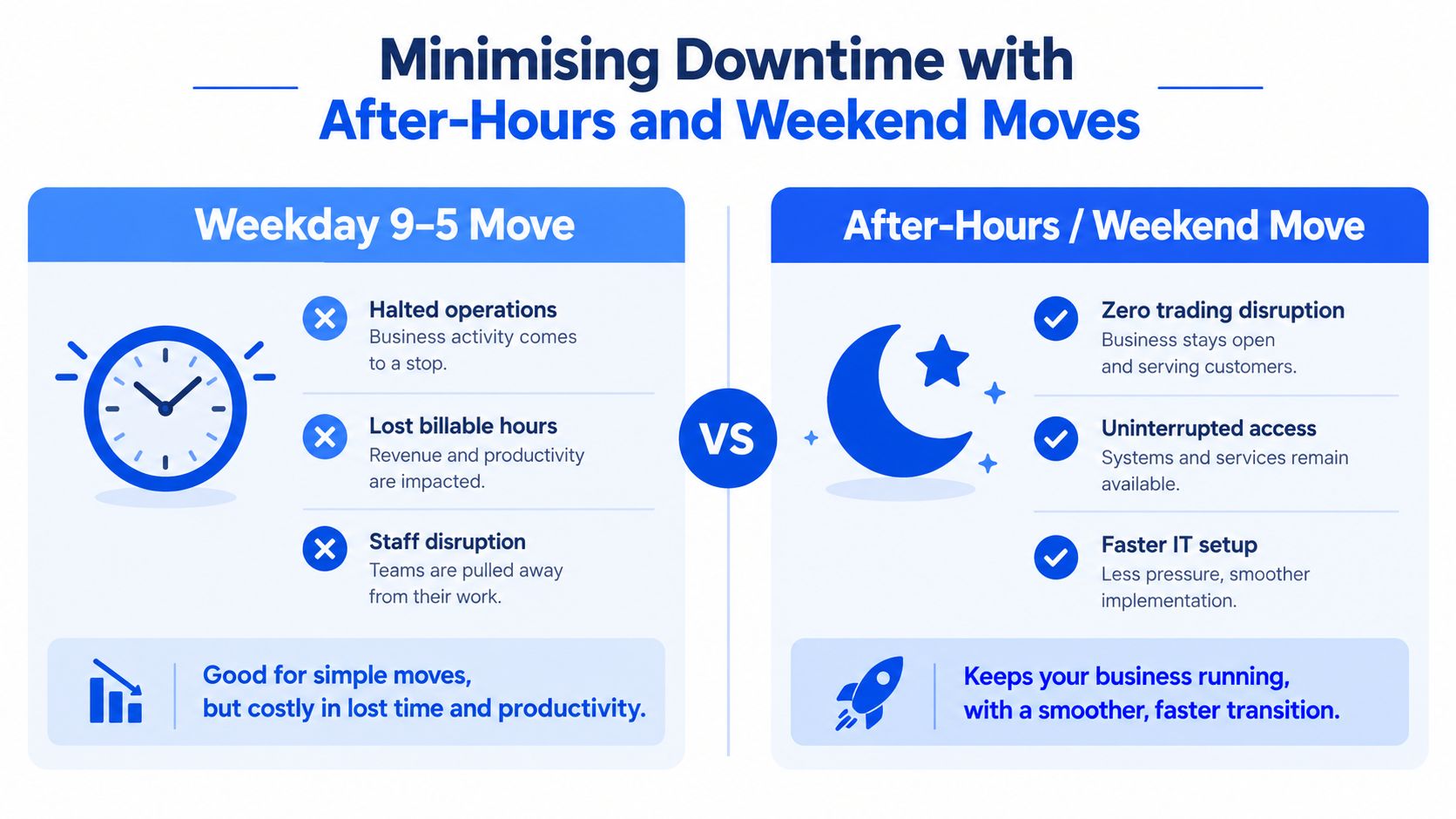
If your office earns money while people are in it, moving during business hours is the wrong default. It looks cheaper on paper, then the phones stop being answered, the client work pauses, and the staff spend a whole day half-shifted between two locations. After-hours and weekend moves solve that problem properly.
Weekday moves interrupt the business twice
A standard weekday move disrupts both the old office and the new one. Teams are pulled away from work to supervise packing, answer access questions, and wait for IT handover. Even if the truck is efficient, your staff still lose the day.
That's why weekday moves are rarely the right call unless the business is tiny, the scope is light, and the downtime cost is low. For most office users, the damage isn't the carting, it's the interruption.
Weekend and after-hours moves protect trading
After-hours and weekend moves let the office stay open during the day and shift the physical work into the dead time. That helps with continuity, especially when clients, servers, phones, and meeting rooms all need to keep functioning. It also gives the crew a cleaner workspace because they're not weaving around staff and visitors.
The gain is practical, not glamorous. Fewer people in the way means faster loading, less confusion, and a more controlled setup at the destination. If your IT setup needs to be ready first thing Monday, a night move is the only sensible option.
Use the schedule to control the sequence
A good after-hours move doesn't just happen outside trading hours. It uses the quiet period to stage critical items first, then brings in desks, files, and non-urgent items in the right order. That matters when staff need to sit down and work immediately, not find their own chair under three layers of packing tape.
The right move window depends on your operations, but the principle is simple. If business continuity matters, protect it with timing, not wishful thinking. For most Melbourne offices, that means a controlled evening or weekend relocation, not a midweek scramble.
Systematic Labelling and Reassembly for a Controlled Transition
A move turns messy fast when labels are vague and the new layout is left to guesswork. The fix is strict organisation before the first box leaves the floor. If every carton tells the same story as the floor plan, the office comes back online faster and with less risk of damage.
Label for destination, not just contents
Labels need to show where each item belongs, not only what is inside it. A box marked “files” slows everyone down compared with one marked “Finance, shelf 2” or “Reception storage, west wall”. Use the same rule for desks, monitors, small equipment, and anything that must be reconnected in a set order.
That matters most for laptops, servers, and shared devices. Once those items are mixed into general furniture loads, reassembly drags and staff waste time hunting for the basics instead of getting to work.
Use a room-by-room plan for reassembly
The packing stage should follow the destination layout. A mover working from a supplied floor plan can place items where they belong instead of dumping everything into one pile and leaving the office manager to sort it out later. That shortens the first day in the new premises and cuts the chance of breakage.
A structured packing and unpacking service also helps when the move needs to be staged. For detail on boxing, staging and room-by-room placement, see the packing and unpacking service overview at https://housemovingmelbourne.com.au/packing-unpacking/. That suits offices that need more than brute force and a few marker pens.
Don't leave the final setup to staff
Hard truth: if employees are unpacking boxes while trying to do their real jobs, the move was not finished properly.
Make the crew responsible for placement, basic reassembly, and the final walkthrough against the plan. Staff can then return to their actual work instead of building their own workstation from scratch. In Melbourne, that discipline matters more when you are moving into tighter-quality stock where building access, loading windows, and fit-for-purpose space all need to line up on the day.
Final Steps and Post-Move Support
The move is not finished when the last trolley rolls out. It's finished when the office can function, the building manager is happy, and the obvious faults have been fixed. That's why post-move checks matter more than most business owners expect.
Check the space before everyone settles in
Do a same-day or next-day walkthrough and confirm the basics. Desk placement, power, access, signage, and any damage or missing items should be checked immediately, while everyone still remembers where things went. If something is wrong, you want it logged and corrected quickly, not discovered a week later when the office is already in routine use.
Storage can also keep the transition clean if the old lease and new handover don't line up neatly. It gives you a buffer when the business needs time to dispose of surplus furniture, wait for fit-out work, or hold items safely between settlements.
Use insurance and follow-up as part of the plan
Don't treat insurance as paperwork. It's part of the risk control, especially when specialty items, commercial equipment, and high-traffic buildings are involved. A professional crew should also follow up after the move, confirm completion, and deal with any remedial work that's still outstanding.
Melbourne's market is still shifting, and office users are still moving into the CBD. CBRE analysed 189 tenant relocations over the past two years and found more than 71,000 square metres of net centralisation into Melbourne's CBD, with businesses moving in at an 11:1 ratio compared with those relocating out CBRE. That tells you the move decision is still live, but it should be made around the quality of the space and the quality of the move, not just vacancy headlines.
Finish the job with a checklist, a follow-up call, and a clear owner for any remaining issue.
If you're planning an office moving Melbourne project and want the move handled with fixed quotes, a single point of contact, and proper packing, transport, and reassembly, speak with House Moving Melbourne. They work on commercial relocations across Victoria and can help you plan the move around access, downtime, and building requirements. Visit House Moving Melbourne and get the process started before the next lease deadline starts running the show.
Drafted with the Outrank app