
Packing Unpacking Services: Levels, Costs and Choices
You've started packing the kitchen, the cupboards still look full, and moving day is getting closer. You could use help, but you're not sure whether booking packers means someone will also unpack the boxes, arrange the new home and take away the cardboard.
That uncertainty is worth resolving before you book. Packing unpacking services are a decision about labour, handover and waste, not how many boxes a crew can fill. The useful comparison is what the crew takes responsibility for and what you'll still need to do after they leave.
Table of Contents
- Packing and Unpacking Service Levels Compared
- How a Packing Crew Packs and Labels Your Home
- Protecting Fragile, Valuable and Specialty Items
- Packing Consent for Downsizers and Older Movers
- Packaging Waste, Disposal and Council Rules
- Pricing Drivers and Confirming the Quote
Packing and Unpacking Service Levels Compared
A family moving from a home with bedrooms upstairs needs a different plan from a renter who only wants the kitchen packed. The family may need furniture dismantled, access protected and contents set out at the destination. The renter may just need help wrapping glasses and boxing cookware.
Local moves deserve that planning too. The Australian Bureau of Statistics housing mobility survey found that 1.14 million households, or 12% of Australian households, had moved at least once during the year preceding its 2019–20 survey; 65% of moves in the previous five years were within the same state or territory but outside the same suburb or locality. Moving a short distance doesn't remove the work of preparing and setting up household contents.
Compare responsibility, not package names
Use these service levels as a starting point, then have the provider confirm the actual inclusions.
Packing and unpacking service levels
| Service level | What the crew does | Best suited to | Unpacking included |
|---|---|---|---|
| Same-day kitchen pack | Packs and labels kitchen contents on moving day. You pack other rooms and manage the destination setup and packaging. | Renters and families packing the rest themselves | No |
| Room-by-room packing | Packs selected rooms to a written list. You finish excluded rooms and handle unpacking and cartons unless added. | Households wanting help with kitchens, garages or other bulk rooms | Optional |
| Full-house packing and move | Packs, protects, loads, transports and delivers the agreed contents of every room. You retain sorting decisions and any unpacking or waste tasks not booked. | Homeowners and families moving across suburbs or to regional Victoria | Optional |
| Full-house pack, move and unpack | Places boxes by room, sets furniture to plan and fills agreed shelves. You approve placement and handle excluded personal items; confirm packaging recovery separately. | Families, downsizers and busy professionals | Yes |
| Specialty and fragile item service | Handles pianos, artwork and antiques using dedicated techniques and custom crating where needed. You identify items and approve their handling scope. | Clients with valuable, fragile or irreplaceable possessions | Specialty handling at both ends |
| Unpack-only with packaging recovery | Unpacks delivered boxes, places contents as agreed and removes or sorts packaging for recycling. You provide placement instructions and approve disposal. | Clients who packed themselves and want setup and clean-up | Yes |
Optional means separately agreed, not automatically included. Transport may also need booking separately for a packing-only or specialty job.
A carton delivered to the kitchen isn't an unpacked kitchen. Ask whether the crew stops at room delivery, bench placement or shelf placement.
That final distinction matters most. Emptying boxes onto benches can leave substantial work behind, while filling shelves requires decisions about where everyday items belong. Neither description automatically includes removing used cartons.
How a Packing Crew Packs and Labels Your Home
A well-run pack starts with the destination layout, not an open carton. The crew needs to know where belongings will finish so they don't combine items that you'll later have to separate.
The process below connects preparation with delivery.
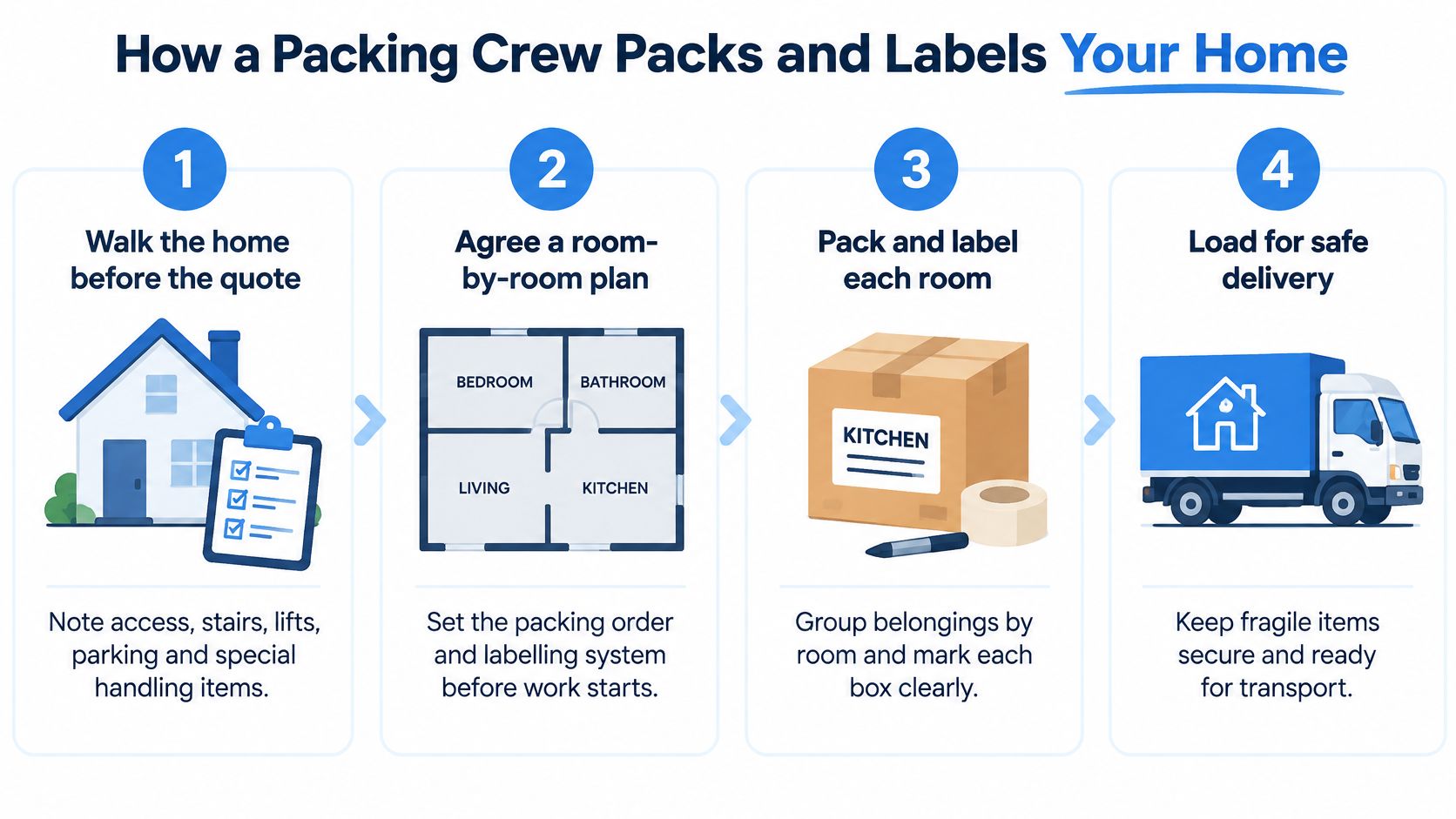
The packing sequence
Walk through the home before quoting. Show the planner stairs, lift access, parking, narrow doorways and items requiring special handling. Include sheds and cupboards so the assessment captures contents that aren't visible from the hallway.
Agree a room-by-room plan. Match labels to the new address, using names such as front bedroom or study rather than relying on the old layout. Decide who supplies cartons, tape, wrapping and protective covers.
Protect the working route. Fit appropriate floor and doorway protection before moving equipment through the home. Keep walking routes clear so workers don't have to step around loose possessions while carrying loads.
Separate items only where authorised. If sorting is included, use keep, store, donate and review groups before sealing cartons. Anything awaiting your decision stays out of the disposal stream.
Pack by room and density. Put dense belongings into smaller cartons and lightweight, bulky contents into larger ones. Mark the destination room, approximate contents and handling information on a visible side.
Stage and load to the delivery plan. Group finished cartons in an agreed collection area without blocking exits. The crew should plan loading around access, load stability and the order needed at the destination.
Choose cartons for handling, not just capacity
There's no universal safe carton weight: WorkSafe Victoria's hazardous manual handling guidance considers posture, movement, force, frequency and duration as well as weight. Smaller loads, suitable trolleys and fewer repeated carries are more useful controls than treating a weight label as permission to lift.
Carton categories and handling rules
| Carton type | Typical contents | Handling rule |
|---|---|---|
| Small book carton | Books, records, tools and dense kitchenware | Keep the load manageable for the planned lift; label approximate weight and use assistance where needed |
| Medium carton | Kitchenware, linen, office files and mixed household items | Balance dense and light contents without leaving items free to move |
| Large carton | Lightweight bedding, cushions and soft toys | Don't fill with dense items; use a trolley for transfers |
| Wardrobe carton | Hanging clothes | Use its rail and plan handling to avoid awkward floor-level lifts |
| Custom crate | Artwork, antiques and instruments | Fit supports to the object, release restraints carefully and inspect at delivery |
If you're supplying materials, review where to get moving boxes and confirm the crew accepts their condition and dimensions before packing day.
A finished pack should have legible labels, cartons that close without bulging and a condition record for fragile belongings. A pile of sealed but unidentified boxes isn't a complete handover.
Protecting Fragile, Valuable and Specialty Items
Document the object before covering it. The Western Australian Museum's packing guidance recommends recording and photographing condition before packing, so existing defects can be distinguished from transport damage; it also describes packaging that controls shock, movement, moisture and environmental change.
Photographs should show the whole object and close views of vulnerable areas, including corners, handles, joints and existing marks. Give the object an identifier that also appears on its carton or crate record.
This documentation belongs before the wrapping stage.
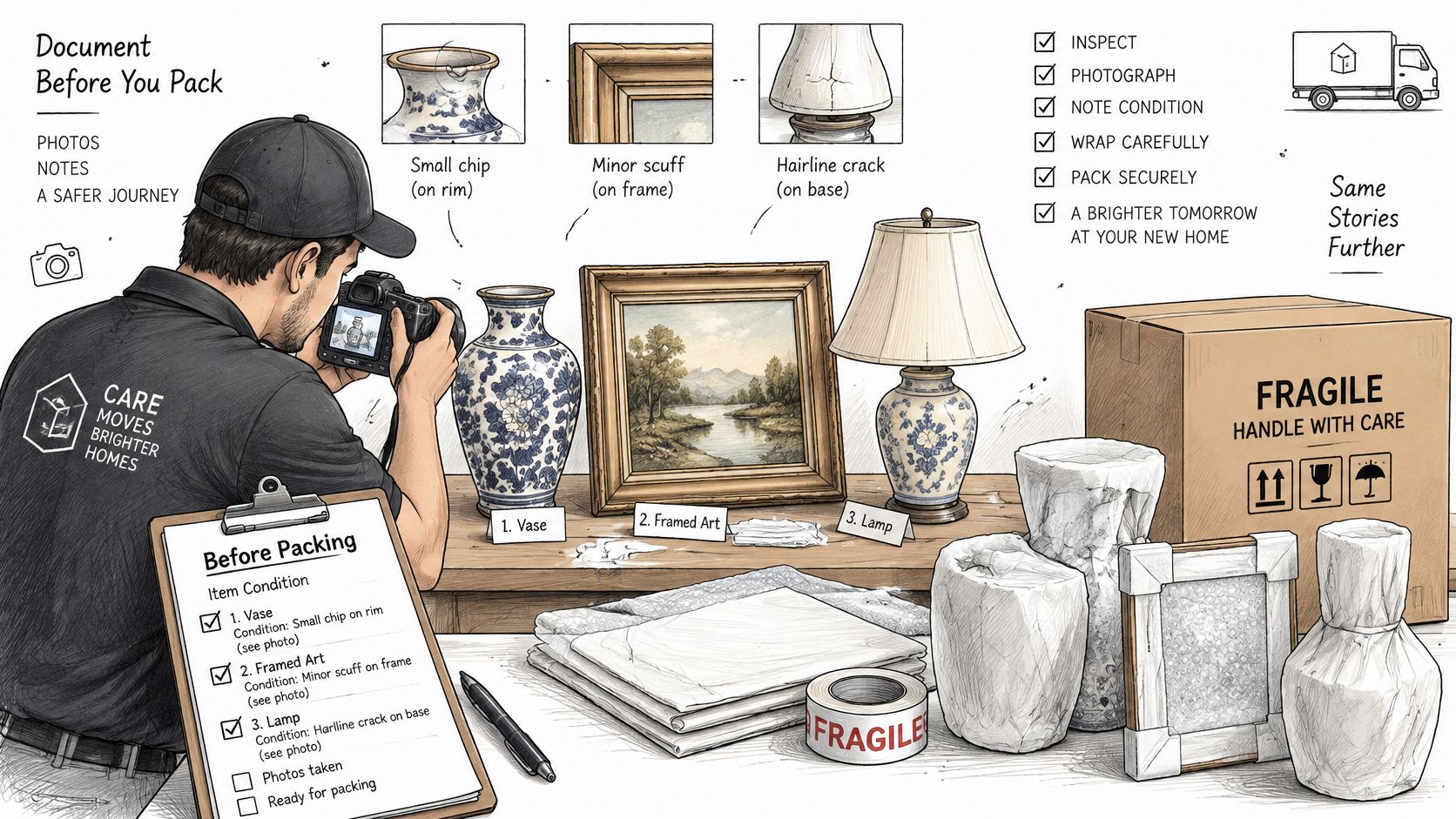
Fit the protection to the object
The packer should wrap each item individually using materials compatible with its surface. Abrasive materials, adhesive tape and rough supports shouldn't touch delicate finishes.
Next, the crew immobilises the item within a correctly sized carton, cradle or crate. Oversized packaging allows movement, so an object can settle or strike its container during handling. Over-tight packing creates a different problem: pressure and shock can pass directly into the object rather than being absorbed by cushioning.
A framed artwork, for example, needs support that protects its edges without pressing against a vulnerable surface. An instrument needs restraints designed around its structure, not extra wrapping around protruding parts.
For high-value artwork, antiques, instruments and electronics, discuss whether temperature and relative-humidity loggers or shock and vibration loggers are appropriate. Road travel, repeated loading and temporary storage create different exposures, so the handling plan should cover the entire journey.
A piano also needs a route and equipment assessment, not just protective blankets. This guide to moving a piano helps identify the access questions to raise before booking.
The video below provides an additional moving reference.
Inspect before completing the handover
At delivery, the unpacking crew should compare the object with its condition record and release restraints without levering against it. Any discrepancy needs recording immediately, before packaging and identifying labels disappear.
- Keep the evidence together: Retain pre-move photographs, the packing record, any applicable insurance certificate and the delivery report.
- Describe damage precisely: Record its location and appearance in writing, with photographs taken at delivery.
- Check the claims procedure: Confirm whom to notify and what documents the insurer or provider requires.
Documentation supports a claim, but it doesn't establish automatic cover. Read the policy terms and ask how owner-packed items, specialty goods and storage are treated.
Packing Consent for Downsizers and Older Movers
A downsizing move can involve giving up familiar routines as well as furniture. Someone else may see a crowded drawer; its owner may see correspondence, family history and objects that help them feel at home.
Research on mobility-based disadvantage in older age describes relocation as material, economic, physical and emotional, with repeated moves potentially affecting identity and the sense of home. Extra labour alone doesn't address those stakes.
Full packing should transfer physical work, not decision-making authority. A crew shouldn't interpret a smaller floor plan as permission to donate possessions, discard paperwork or reorganise medical supplies without consent.
Make uncertain decisions reversible
Agree who can approve decisions before work begins. The client remains central, and any family member or nominated representative should have a clearly understood role.
Use categories with distinct instructions:
- Keep: Pack for the new home and identify its intended room.
- Store: Record the contents and storage destination so they remain traceable.
- Donate: Release only after the authorised person confirms the selection.
- Review: Photograph and hold uncertain belongings for a later decision.
A review category prevents a busy packing day from becoming a deadline for irreversible choices. It also gives the crew a practical response when they find an unfamiliar document, sentimental object or unlabelled medical item.
Consent safeguard: If nobody authorised can decide, hold the item for review rather than treating silence as approval.
Preserve familiar routines
Prepare a first-night kit that stays accessible throughout the move. Include medication, essential documents, chargers, toiletries and the kitchen items the client uses routinely; keep mobility aids available rather than buried in the load.
At the destination, placement should support the person's habits and reach. Everyday cups shouldn't go onto an inaccessible shelf just because that cupboard has space, and walking routes need to remain clear of unpacked cartons.
For a move into a lift-accessible apartment or a lower-maintenance home, map the actual storage before filling it. A familiar arrangement may need adapting, but the client should approve the change rather than discover it later.
Offer a follow-up visit within days to adjust placement and review unsettled items. Confirm whether that means an on-site visit or a phone check, what work it includes and whether any additional charge applies.
Packaging Waste, Disposal and Council Rules
An apartment can be unpacked yet still be difficult to use if flattened cartons occupy the hallway and wrapping fills the laundry. Packaging recovery needs its own handover, especially where shared bins, loading areas and building access restrict removal.
Don't assume council hard rubbish is the answer. The City of Yarra hard-rubbish collection rules generally allow two free collections per household each calendar year, cap collections at 2 cubic metres, require individual items to weigh under 50 kg, and note that apartment residents may need to book through a building manager or owners' corporation.
Those conditions don't make every material eligible. Check accepted items and the property's booking arrangements before placing anything outside.
Separate recovery from general disposal
A useful waste plan identifies the material and its destination rather than promising to remove everything.
| Material stream | What to confirm |
|---|---|
| Reusable cartons | Whether the provider collects suitable cartons for reuse and when collection occurs |
| Cardboard recycling | Who flattens and separates cartons, and where accepted cardboard goes |
| Wrapping and cushioning | Which materials the provider accepts and how they must be separated |
| Donation goods | Who approves release and whether the receiving organisation has accepted them |
| E-waste, mattresses and unwanted furniture | Whether a separate booking or private contractor is required |
| Excluded materials | What remains your responsibility and how it must be handled |
For apartments, the plan should also identify the permitted collection route and staging area. A crew can't safely solve a waste problem by leaving cartons beside a lift or obstructing a shared corridor.
Ask for a removal record
Request a disposal manifest, meaning a simple record of material collected, its intended reuse, recycling or disposal destination, and any exclusions. It doesn't need to be elaborate, but it should make responsibility visible.
Ask whether recovery happens during unpacking or through a later collection. If you'll keep cartons while deciding where belongings go, establish where they can be stored and who books the return.
A separately priced unpack-plus-packaging-recovery option makes the comparison clearer. You can then choose between doing the separation yourself and paying for the handling, without discovering after delivery that clean-up was never included.
Pricing Drivers and Confirming the Quote
A useful quote separates the base move, packing, unpacking, specialty work, storage and disposal. A single total may look straightforward, but it can hide the exact task you expected someone else to complete.
There isn't a meaningful universal price for packing unpacking services without knowing the contents and working conditions. A sparsely furnished home and a home with full cupboards can have similar floor plans but very different packing requirements.
Read the quote by task
The planner should explain how each driver changes labour, materials or equipment. Use the following breakdown to compare like-for-like offers rather than comparing totals for different scopes.
Pricing drivers and what they change
| Cost driver | How it changes the quote | Where it appears on the quote |
|---|---|---|
| Number of rooms and cartons | Changes packing labour and the quantity of cartons and wrapping | Packing line |
| Packing scope | A kitchen-only pack requires different crew time and materials from full-house boxing | Packing line |
| Access through stairs, lifts and parking | Changes carrying time, equipment needs and any applicable permit costs | Extras line |
| Specialty items | Adds dedicated handling, protective supports or custom crating where specified | Separate specialty line |
| Storage between settlements | Adds holding charges and potentially separate delivery handling; confirm climate control and billing intervals | Storage line, with the agreed billing interval |
| Unpacking and shelf placement | Adds time for the specified reassembly, placement and shelf-setting tasks | Unpacking line |
| Carton and packaging disposal | Adds separation, collection, recycling or private-contractor handling | Extras line |
Storage deserves particular attention because the move can involve more than holding space. Ask whether the quoted amount includes transport into storage, handling there and delivery out again, or whether those appear separately.
For materials, establish whether cartons are purchased, hired or supplied within the packing charge. If you provide your own, ask what happens when the crew finds damaged cartons or needs specialist packaging that wasn't available.
Distinguish a fixed quote from an estimate
An hourly estimate describes expected time and charges under stated assumptions. A fixed written quote should identify the agreed work and price, along with exclusions and the process for approving changes.
A walkthrough, either in person or by video, helps the planner inspect what a room count misses. Open cupboards, show outdoor storage and explain anything that will arrive or leave before moving day.
A fixed quote doesn't mean unlimited work. Adding an unlisted garage, changing the destination or requesting extra unpacking can change the scope, so agreement should happen before the crew performs the additional task.
Before approving a change: Ask what extra work is proposed, what it costs and whether it changes the completion plan.
Any preliminary figure given without a walkthrough should be confirmed in writing after assessment. Avoid relying on a verbal assurance that everything will be included.
Confirm the handover before signing
Use a short approval checklist:
- Match the scope to the room list. Check included rooms, excluded contents, materials, transport and each separately priced task.
- Identify adjustable lines. Ask which charges can change and how you'll approve a change before work begins.
- Verify working conditions. Confirm stairs, lift bookings, parking arrangements, loading access and any building restrictions.
- Define completion. Specify furniture assembly, shelf placement, outstanding packaging and any follow-up attendance.
- Inspect insurance documents. Request current certificates and ask about applicable cover, exclusions and the notification procedure.
When comparing providers, ask whether you'll have a named contact and whether the crew will remain consistent through the job. If follow-up support is offered, distinguish a check-in from an included return visit.
Book a walkthrough through the move-in quote request, with your room list and fragile-item list ready. Request the scope and price in writing before choosing the service level.
House Moving Melbourne offers packing from a kitchen-only service through to full-house packing, transport and agreed shelf placement, with fixed written quotes based on a walkthrough. Arrange an assessment and ask for packing, unpacking and packaging recovery to be identified separately, so you can see exactly what you'll still need to handle.