
Storage Melbourne Prices: A Practical 2026 Guide
Melbourne self-storage currently averages about AUD 393 per square metre per year, which works out to roughly AUD 32.75 per square metre per month. A typical 6 square metre unit sits near AUD 196.50 per month before premiums, discounts or fees.
That's the number people want when a settlement slips, a lease ends early, or the new place isn't ready. But the quote you get on the phone rarely tells the whole story, and that's where storage budgets get blown.
Table of Contents
- When Storage Becomes Part of the Moving Plan
- How Melbourne Storage Is Actually Priced
- Choosing the Right Unit Size
- Climate Control and Weekly vs Monthly Billing
- Typical Melbourne Price Ranges in 2026
- How to Compare Providers Beyond the Headline Rate
- When Storage Is Worth It and When It Is Not
- Booking Storage Alongside a Melbourne Move
When Storage Becomes Part of the Moving Plan
A family gets the keys pushed back by a week, boxes are already packed, and the removalist truck is booked. An office has finished vacating its old floor, but the new fit-out won't be ready for another fortnight. A downsizer has signed for the smaller place, but the spare-room furniture won't fit through the lift. In Melbourne, storage turns up in all three situations, and it usually turns up fast.
The mistake is treating storage as a side note. It isn't. Once a move crosses a settlement date, lease boundary, or renovation timeline, storage becomes part of the move budget and part of the risk management.
The three moments storage stops being optional
A short settlement gap is the obvious one, because the handover dates don't line up cleanly. Lease gaps are just as common, especially when tenants are forced to leave one property before the next one is available. Downsizing is slower and messier, because the decision is rarely about one couch or one dining table, it's about everything that no longer earns its place.
Practical rule: if your move has two dates and one of them can move, storage should already be on the plan.
Melbourne pricing also changes with facility type, access rules, and whether the provider is offering climate control. That's why the headline rate matters, but it never deserves the whole conversation. A storage quote should be read as a holding-cost decision, not just a price-per-box exercise.
How Melbourne Storage Is Actually Priced
Melbourne storage is usually priced by square metre, so the actual question is how much floor area you are paying for, not how many cartons you can stack inside. That pricing model has consequences most quotes hide, especially when a move stretches across a settlement gap, renovation, or downsizing window.
The same unit can land at very different prices depending on suburb, facility type, access hours, and security arrangements. A quote is only the starting point. The market benchmark cited earlier gives you a check against what is being offered, but it does not capture every cost that ends up on the invoice.
Why smaller units often cost more per square metre
Smaller units usually carry a higher cost per square metre because the fixed operating load sits on less rentable area. Security, lighting, access control, management, and building infrastructure still have to be paid for.
That is why a compact unit can look expensive beside a larger one on a per-area basis. It is basic unit economics, not a trick. The provider is covering the same building and labour costs either way.
For movers, the useful comparison is not the headline rate alone. It is the total holding cost once you factor in access restrictions, added visits, and any setup that forces you to pay for space you cannot use efficiently.
Melbourne storage pricing makes more sense once you treat it as a holding decision. If a slightly higher weekly rate gives you better access, less repacking, and fewer extra trips, it can be the cheaper option over the life of the move.
Choosing the Right Unit Size
A lot of people choose storage like they choose a pizza size, by instinct. That's how they overpay. The better approach is to treat the move as an inventory problem, then match the packed volume to the unit instead of guessing from a photo on a website.
Match the unit to what you actually own
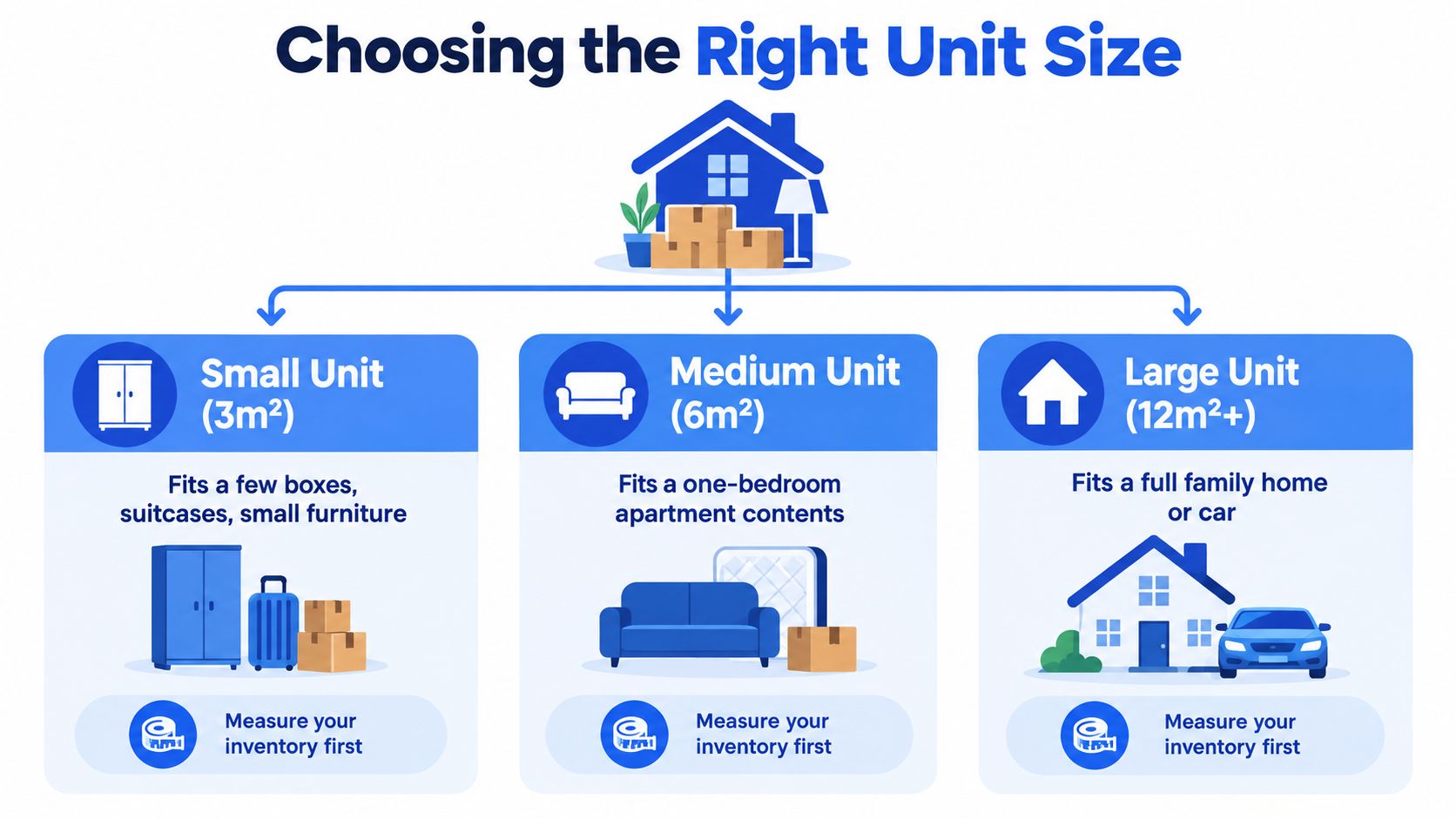
A 3 square metre space is usually for the overflow you can stack neatly, a few cartons, suitcases and one or two smaller pieces. A 6 square metre unit is a more realistic fit for the contents of a one-bedroom apartment, especially if you've already sold or discarded bulky extras. Once you move into 12 square metres and above, you're dealing with broader household contents or business stock, not just temporary overflow.
The important part is not the label, it's the stackability. Flat-packed furniture, mattress protection, and the ability to nest boxes all change how much usable volume you get. If your removalist inventory says you have a lounge suite, two tallboys, whitegoods and a half-dozen cartons, you should not be guessing at a unit based on floor area alone.
Rule of thumb: if you're close between two sizes, pick the one that lets you walk in and out without repacking every time.
A simple sizing check before you sign
- Count the bulky items first: couches, mattresses, fridges, dining tables and wardrobes decide the footprint.
- Estimate the remaining cartons carefully: people undercount boxes every time.
- Leave a working aisle if you need access: a cheaper unit becomes expensive fast if you have to empty half of it to reach one item.
- Use the removalist inventory, not memory: if the list came from the truck crew, trust that before the website photos.
The right unit size saves money twice. First, you avoid paying for air you'll never use. Second, you reduce the odds of needing a second unit because the first one was optimistic rather than realistic.
Climate Control and Weekly vs Monthly Billing
The two decisions that change the bill are climate control and billing cadence. Get those wrong, and the “cheap” quote stops being cheap.
When climate control is worth paying for
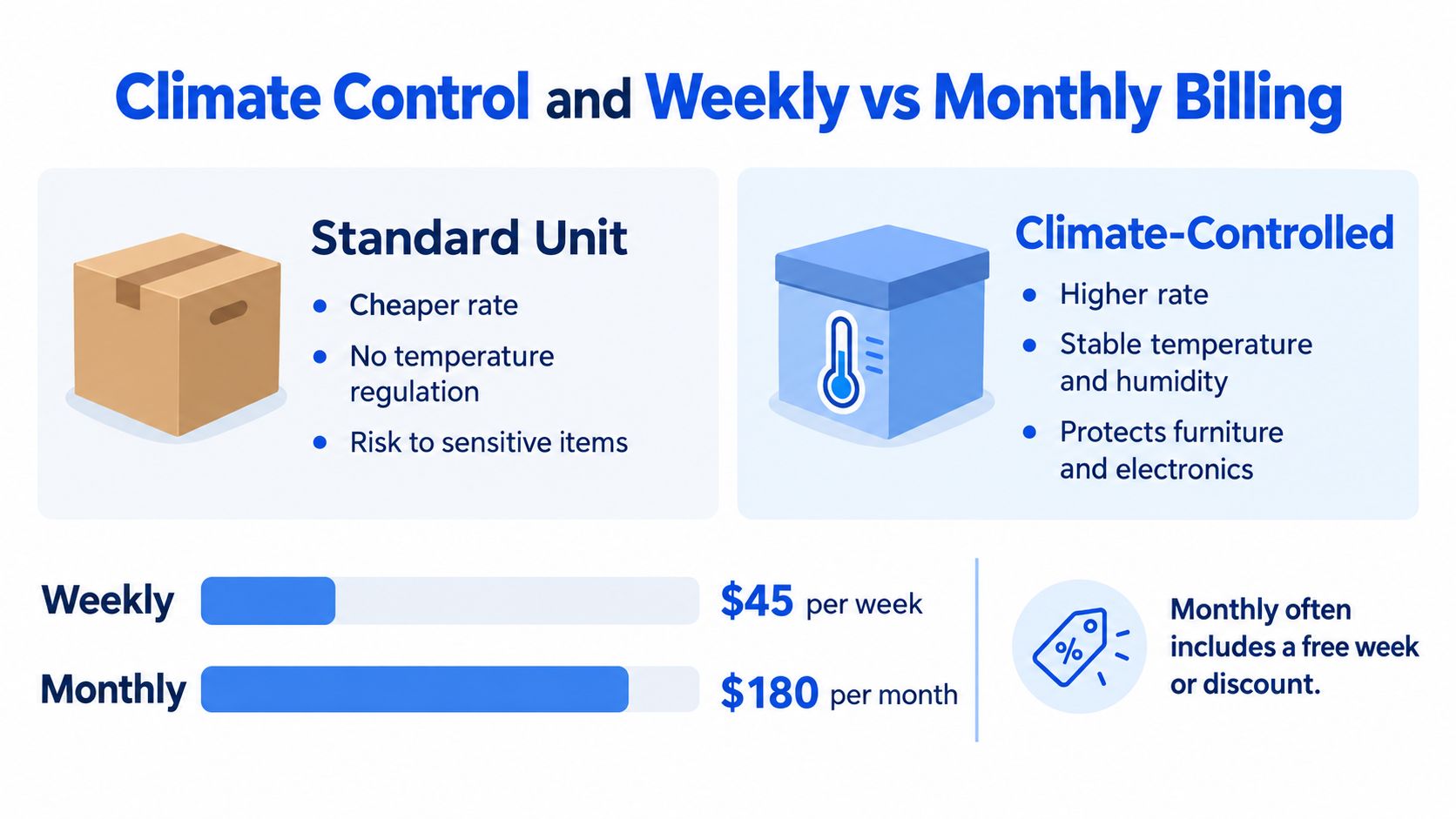
Climate-controlled storage makes sense for timber furniture, electronics, artwork, documents and anything you'd hate to see warped, moulded or heat-stressed. A standard unit is fine for sturdy household goods, sealed cartons and short holds where the inventory is not temperature-sensitive. If you're storing good furniture for a longer period, the premium is easier to justify.
The point isn't that climate control is always better. It's that it's better for the right inventory. Sensitive items need a stable environment more than they need the lowest sticker price.
Weekly billing versus monthly billing
Weekly billing suits short holds because it keeps the cost tied to the actual gap in your move. That's ideal for settlement delays, quick renovation holdovers and temporary staging. Monthly billing can look tidier on paper, but it usually suits longer holds where the extra commitment makes sense.
A provider that bundles a few useful extras can also beat a lower headline rate once you add up the full cost. Read the quote line by line, then compare the total, not the marketing number. If you want to compare climate-controlled options in more depth, this guide on climate-controlled storage facilities is the right place to start.
Ask these questions before you sign
- What temperature or humidity control is included? Don't accept vague language.
- Is the rate weekly, monthly or both? The billing period changes the cash flow.
- What's the minimum term? A low rate is useless if you're locked in longer than your hold.
- Are access hours restricted? Limited access can make a cheap unit expensive in practice.
Typical Melbourne Price Ranges in 2026
Translating the benchmark introduced earlier into real unit sizes gives the ranges below. Suburb, access, unit size and hold length all move the quote, and the total cost changes again once you factor in move-in fees, access trips and the length of the hold.
Price guide by unit size
| Unit size | Approx monthly range | Approx weekly range | Typical use |
|---|---|---|---|
| 3 sqm | About AUD 98 to AUD 115 | About AUD 23 to AUD 27 | Studio overflow, small household items, boxes |
| 6 sqm | About AUD 196.50 to AUD 230 | About AUD 45 to AUD 53 | One-bedroom contents, temporary settlement gap |
| 12 sqm | About AUD 393 to AUD 460 | About AUD 91 to AUD 106 | Two to three-bedroom household hold |
| 20 sqm | About AUD 655 to AUD 765 | About AUD 151 to AUD 177 | Larger family move, business stock, long hold |
These are working ranges, not fixed promises. Inner-Melbourne sites usually sit higher in the range, while outer-suburb facilities are more likely to sit near the benchmark introduced earlier.
What changes the total over time
A three-week hold should not be priced like a six-month hold, even if the unit is the same size. The longer the storage period, the more the quote has to absorb access charges, insurance and transport timing. Repeated trips for extra access can turn a cheaper headline rate into the more expensive option.
That is why a higher weekly rate can still be the smarter choice if it reduces add-ons or avoids costly access restrictions. For settlement gaps, renovation holdovers and downsizing, compare the full holding cost, not the advertised rent alone.
How to Compare Providers Beyond the Headline Rate
A cheap quote can be expensive once the extras land. That's the part that's easy to miss, and it's the first thing I check when I'm comparing Melbourne storage options for clients.
Read the quote like a line-item invoice
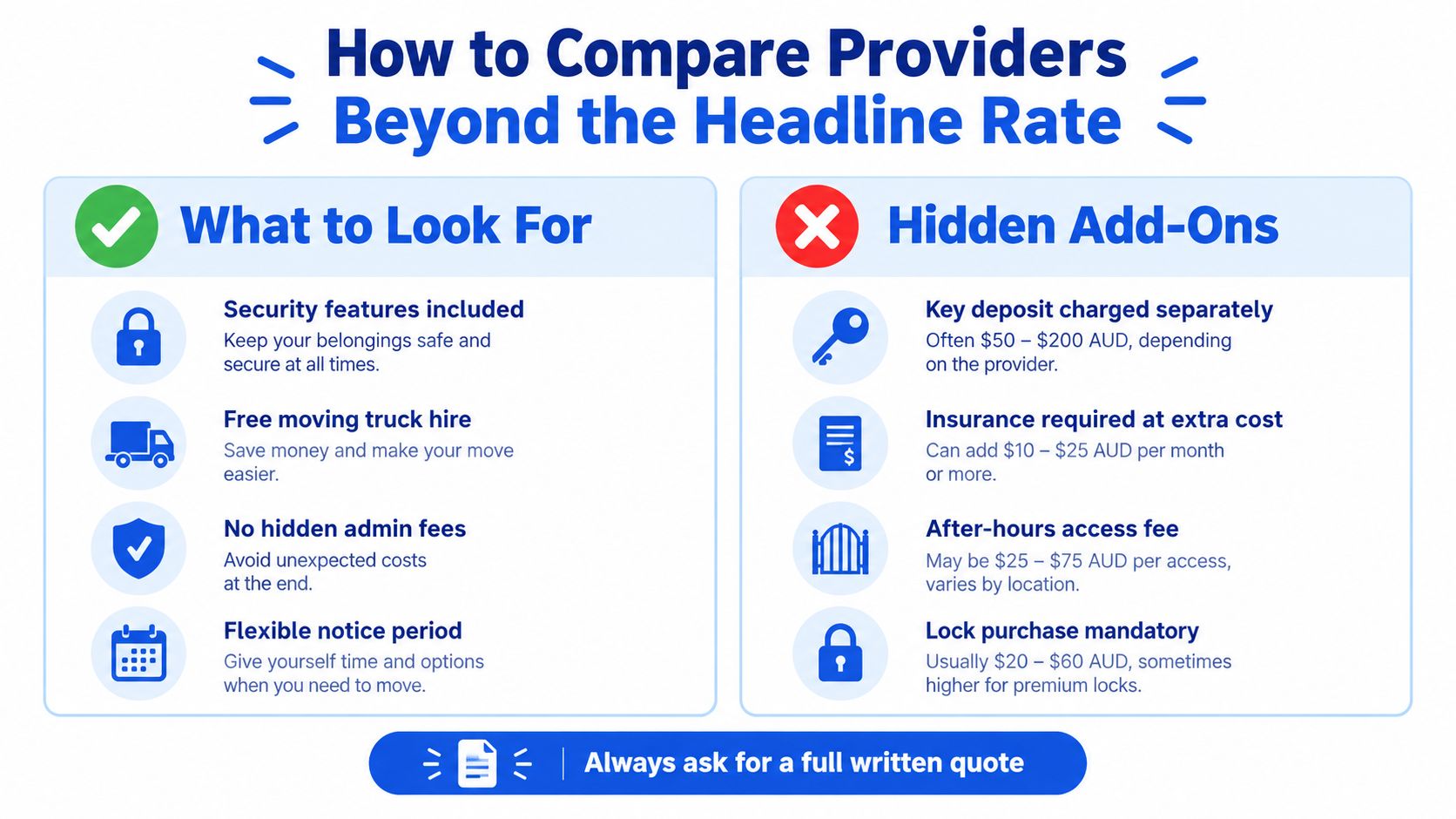
The base rent matters, but it's only one line. Insurance, administration fees, security deposits, lock charges, minimum terms, access surcharges and GST can all change the final number. If the quote doesn't spell those out, assume you're missing part of the cost.
A provider can also look pricier on paper while being cheaper in reality. Flexible access, included insurance or fewer handling charges can easily offset a slightly higher weekly rent. That's especially true when the storage hold is tied to a move with multiple dates and moving truck coordination.
The most expensive quote is not always the one with the highest rent. Sometimes it's the one that hides the cost in every small print line. Always ask for the full written quote and compare the same service level across both providers.
For a breakdown of the other moving-related costs that tend to show up around storage bookings, review removal company charges.
The comparison table that actually helps
| Item | Budget quote | Mid-range quote |
|---|---|---|
| Weekly rent | Lower | Higher |
| Insurance | Extra | Included |
| Admin fee | Charged separately | None or bundled |
| Access flexibility | Limited | Better |
| Lock or key charges | Extra | Included |
The table is the test. If the low quote wins only when you ignore the add-ons, it isn't the better quote.
When Storage Is Worth It and When It Is Not
Storage is useful when it protects time, solves a date gap, or keeps valuable items out of the way. It stops making sense when the things you're storing are worth less than the total cost of holding them.
Short, medium and long holds need different maths
For a short settlement delay, storage usually makes sense if it prevents rushed decisions or a double move. A three-to-six-month renovation or lease gap needs a stricter calculation, because the fees accumulate and the transport component starts to matter more. Long-term downsizing storage should be treated as a holding strategy, not a default home for everything you haven't decided about yet.
The key question is simple. Does the item's replacement value justify the cost of keeping it in storage? If the answer is no, sell it, gift it or let it go. Bulky low-value furniture is the usual trap.
A decision rule that holds up
Use three inputs, item replacement value, cubic volume and expected storage duration. If the replacement cost is low and the storage period is long, don't keep paying for it. If the item is valuable, awkward to replace, or part of a temporary life transition, storage earns its keep quickly.
People often overcomplicate the choice. They focus on the monthly rate and ignore the full holding period. The better question is whether storage buys you enough flexibility to justify the total spend.
Booking Storage Alongside a Melbourne Move
Booking storage at the same time as the removalist keeps the move cleaner. The pickup, storage start date and final delivery should all be locked in before moving day, not worked out after boxes are already sitting in the driveway.
What to confirm before you book
Make sure the written quote states the weekly rate, included insurance level, access hours, minimum term, end-of-hold delivery fee and notice period. If a provider can't put those in writing, keep looking. A move with a storage gap needs clarity, not verbal assurances.
A single point of contact makes a real difference when the move and the storage hold are linked. It cuts down the back-and-forth, reduces timing errors, and keeps the plan aligned if the settlement date shifts. That matters even more for downsizers and apartment moves, where lift bookings, parking windows and access timing all need to line up.
For moving support that can be coordinated with storage, see movers in Melbourne.
The final checklist
- Written weekly rate: Don't rely on a phone estimate.
- Insurance details: Know what's covered and what isn't.
- Access hours: Confirm whether you can get to the unit when you need to.
- End-of-hold delivery fee: Some quotes jump here.
- Notice period: Short notice keeps flexibility alive.
A good storage plan doesn't just store items. It keeps the move under control.
If you want one team to handle packing, transport and storage without juggling separate suppliers, House Moving Melbourne can coordinate the move and the hold under a single written plan. If you're comparing storage Melbourne prices for a settlement gap, renovation or downsizing move, get the quote in writing and make sure every add-on is clear before you book.