
Move in Quote Explained: What It Covers and How to Prepare
You're standing in a hallway with tape on the floor, a lease end date in one hand and a settlement date in the other, trying to work out why one removalist sounds cheap and another sounds expensive for the same house. That's exactly where buyers get caught. The move in quote is usually not a price problem, it's a scope and access problem, and Melbourne punishes anyone who treats those as the same thing.
A proper quote tells you what the crew is moving, how they're getting to it, what they can access, and what happens if those assumptions change. If that sounds detailed, good. A vague number is how people get bill shock on moving day.
Table of Contents
- The Quote Call That Changes Everything
- What a Move In Quote Is and What It Should Cover
- Reading a Fixed Quote Line by Line
- How the Walkthrough Shapes the Number
- Two Quotes, Same Home, Different Total
- Exclusions and Surprise Charges Worth Knowing
- Preparing Your Home for an Accurate Quote
- Confirming the Quote and Moving Forward
The Quote Call That Changes Everything
A couple in Carlton rings three removalists on the same afternoon. They say the same thing each time, a three-bedroom apartment, a fridge, a couch, beds, a few boxes, and no, they haven't checked the lift booking yet. The first number sounds friendly, the second sounds cautious, and the third is higher but oddly specific. That gap usually tells you more about the company than the figure itself.
What you want from that call is not the cheapest answer. You want to find out whether the company is pricing a real job or guessing at a job. A serious move in quote starts with questions about access, furniture type, stairs, lifts, parking, and any items that need special handling. A lazy quote starts with a room count and hopes the rest sorts itself out on the day.
Fixed price or open-ended estimate
A fixed written quote is built around an agreed scope. If the inventory, access, and services are properly documented, the price should stay put unless you ask for changes. An hourly estimate leaves labour and truck time open, which means the final total can drift when the job takes longer than expected.
That difference matters in Melbourne because access often drives the cost. Apartment buildings, narrow streets, parking restrictions, and storage gaps don't care what the headline number looked like on the phone. The best companies price the job they can see, not the one you wish you had.
Practical rule: if the quote doesn't describe the job, it isn't a quote yet, it's a placeholder.
The Australian Competition and Consumer Commission's removalist example shows why that matters, a company tried to lift the price after loading, but the consumer only had to pay what was originally agreed in the quote. A customer shouldn't be negotiating while the truck is already loaded. That's not quoting, that's a bargaining advantage.
What a Move In Quote Is and What It Should Cover
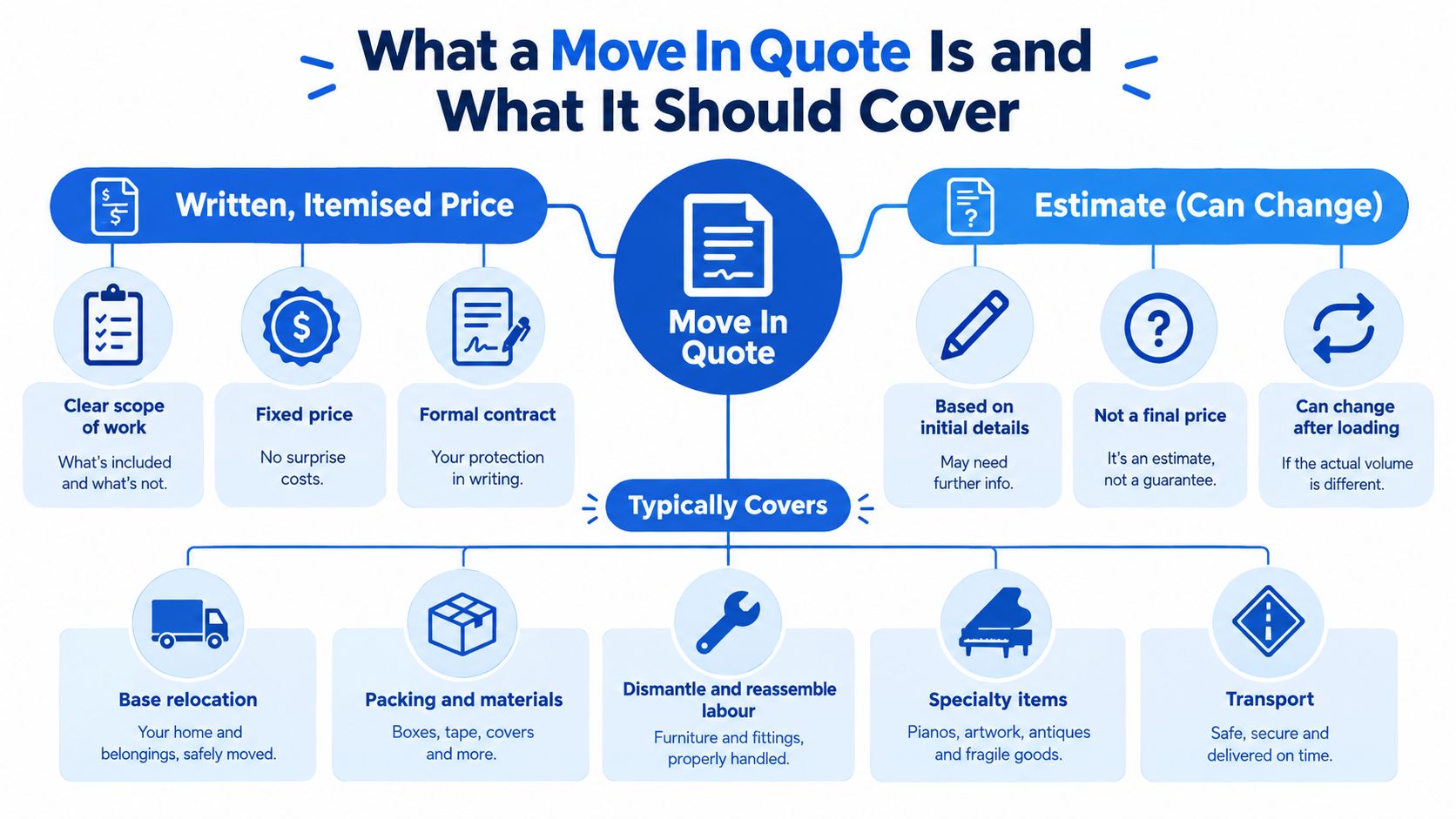
A proper move in quote is a written, itemised price built from a documented scope. It should spell out what is included, what is excluded, and the assumptions the company is making before a single box is moved. If those basics are missing, the number is weak no matter how polished it looks.
The parts that should be written down
A serious quote should cover the inventory or volume basis, pickup and delivery addresses, dates, labour scope, stairs and lift requirements, packing, storage, specialty handling, waiting time, and all applicable fees. It should also record the assumptions that can change the job, such as parking distance, building booking requirements, and whether the crew is dismantling and reassembling furniture. In Melbourne, that includes apartment lift bookings, regional-Victoria permit fees where they apply, and storage gaps between settlement dates. If those items are not in the document, they become arguments later.
Wording matters as much as the number. The ACCC example shows a removalist quoting one amount per cubic metre and then trying to increase the price after loading. The consumer did not owe the higher amount because the work had already been agreed. A quote should work the same way in Melbourne, clear scope first, payment second.
For people comparing providers, it helps to see how a fixed written quote can be presented after assessment rather than hidden behind a vague phone number.
A quote is only honest when the scope is honest.
Fixed quote versus estimate
A fixed quote locks the agreed scope, so the customer knows what the documented job will cost. An estimate still has a place for small, simple moves, but it should not be used where access, specialty items, or storage timing can shift the work.
You should also expect the quote to separate the base relocation from optional extras. Packing, crates, storage, dismantling, reassembly, and access-related charges should be visible on the page, not buried in a casual sentence or omitted until move day. A company that refuses to itemise those parts is keeping its options open at your expense.
Reading a Fixed Quote Line by Line
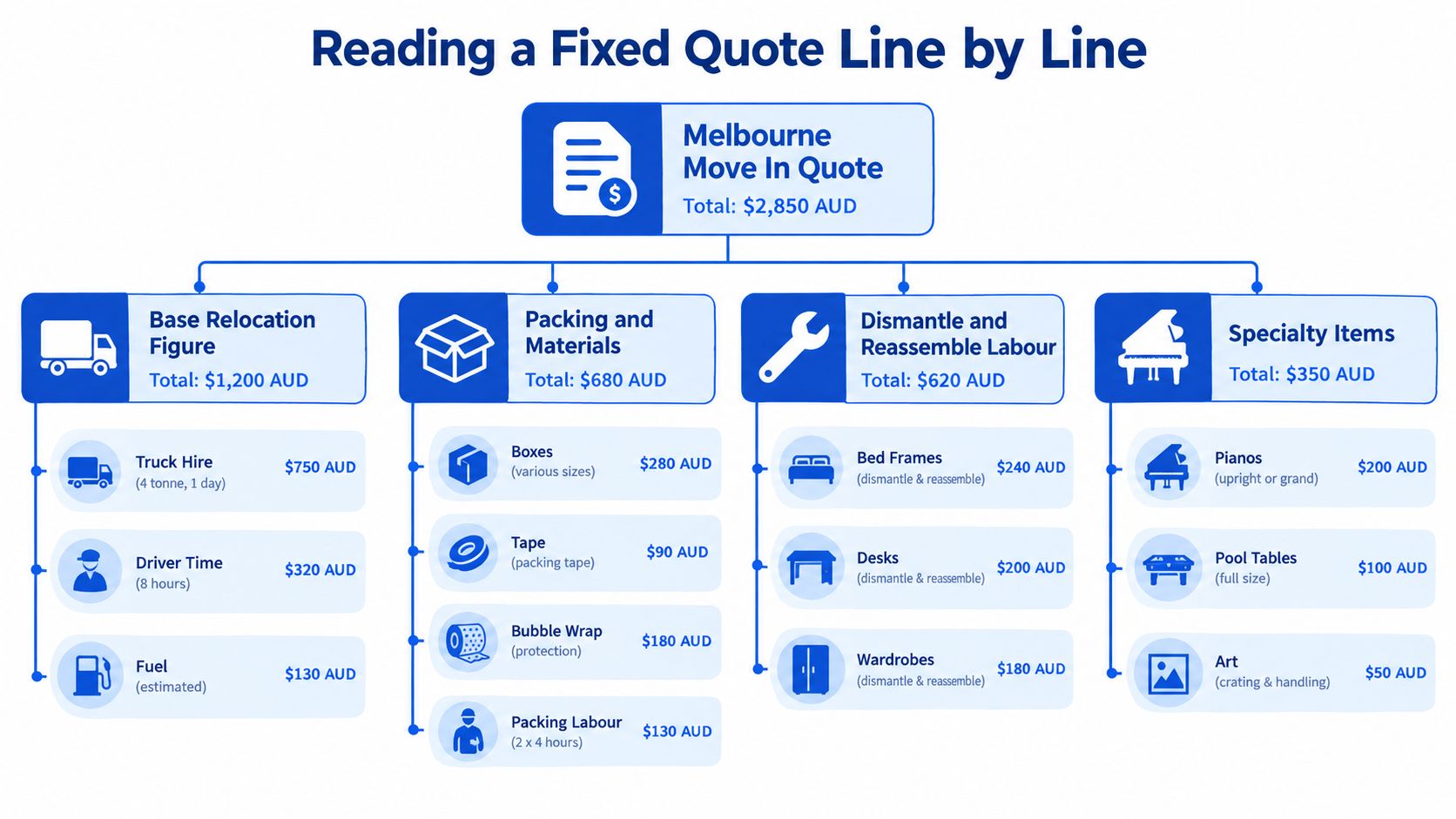
A move quote fails when the total looks tidy but the scope is vague. Read the line items first. They show whether the mover priced the actual job, or left room to add charges later.
The core items to inspect
The base relocation figure should cover the truck, crew, travel between addresses, and the main transport work. If that line is too low to carry the job, the quote is likely hiding cost somewhere else.
Packing and materials need their own line if you are paying for them. Boxes, tape, bubble wrap, and labour are different charges. If you pack yourself, that line should shrink or disappear.
Dismantle and reassemble labour should also be clear. Beds, desks, wardrobes, and similar items take time and tools. If the company expects you to strip everything down but has not said so in writing, you carry the risk.
Specialty items need separate treatment too. Pianos, pool tables, artwork, and antiques are not standard furniture, and the quote should say so plainly. For a worked example of how a Melbourne removalist presents these lines, see the movers in Melbourne page.
Where hidden costs usually live
Storage is a common trap, especially when settlement dates do not line up or there is a gap before lease handover. If the quote does not spell out duration, billing method, and release conditions, the price can climb after the truck leaves.
Access charges do the same thing. Long carries, stairs, lift bookings, and parking permits all change the labour required. In Melbourne, that matters in apartment moves with lift bookings, and it can matter in regional Victoria where permit fees apply.
Simple test: if you cannot explain a line item in one sentence, do not sign until the mover does.
Use a checklist against every fixed quote: transport, packing, access, storage, specialty items, and waiting time. If one of those is missing, the quote is not fixed enough to trust.
How the Walkthrough Shapes the Number
A proper walkthrough is where the quote becomes real. Phone estimates work for tiny jobs, but once you have stairs, lifts, awkward furniture, or building rules, the assessor needs to see the route from front door to truck. That can happen in person or by video. The point is simple, turn guesswork into measured inputs.
What the assessor actually measures
They are checking stairs, lift dimensions, booking windows, doorway clearances, parking distance, loading-dock restrictions, and anything that needs special handling. Those details affect crew-hours, truck dwell time, and the chance of a failed delivery attempt. That is why they shape the quote.
For inner-suburban moves, access is often the cost control. A short carry from truck to door is cheaper than a long one. A booked lift is easier than a stair carry. A proper loading zone is easier than gambling on street parking.
Regional Victoria brings its own details. Mount Alexander Shire, for example, requires applications for residential parking permits where restrictions apply and lists an annual permit fee of $58, so permit rules belong in a serious quote before move day, not after the truck is already on site.
Why the walkthrough puts you in control
Be exact here. Tell the assessor about the fridge that barely clears the doorway, the cupboard that needs dismantling, the artwork that cannot be stacked, and the lane that does not suit a truck. The more complete the walkthrough, the fewer surprises later.
A good assessor turns the route into a job plan. A weak one counts rooms and hopes for the best.
Two Quotes, Same Home, Different Total
Two households can have the same rooms and still end up with very different totals because one prepared properly and the other didn't. The difference isn't luck. It's information.
The household that under-shared
One homeowner gives a quick phone description, skips the walkthrough, forgets to mention a piano and several antiques, and leaves the lift booking unresolved. The apartment is on the fourth floor, the building is tight, and there's a fortnight gap between lease end and settlement, so storage has to be added later. By the time the actual job is visible, the quote has to absorb more labour, more handling, and more logistics.
The issue isn't that the company suddenly changed its mind. The issue is that the original scope was thin. A quote built on missing information can't stay precise.
The household that prepared properly
The second homeowner gives a room-by-room inventory, names the specialty items, confirms the lift booking in writing, and aligns storage with the handover dates before the quote is issued. The removalist can price the job accurately because the job is visible. The result is usually less drama on moving day and fewer expensive add-ons.
| Quote Driver | Unprepared Move | Prepared Move |
|---|---|---|
| Inventory | Items mentioned loosely | Room-by-room list |
| Specialty items | Piano and antiques left out | Declared in advance |
| Building access | Lift booking unclear | Booking confirmed in writing |
| Timing | Storage added later | Storage planned upfront |
| Result | Scope changes after quoting | Scope stays stable |
The point is blunt. The same home can produce different pricing because the customer either helped define the job or left the removalist to guess. You control more of the quote than many assume.
Exclusions and Surprise Charges Worth Knowing
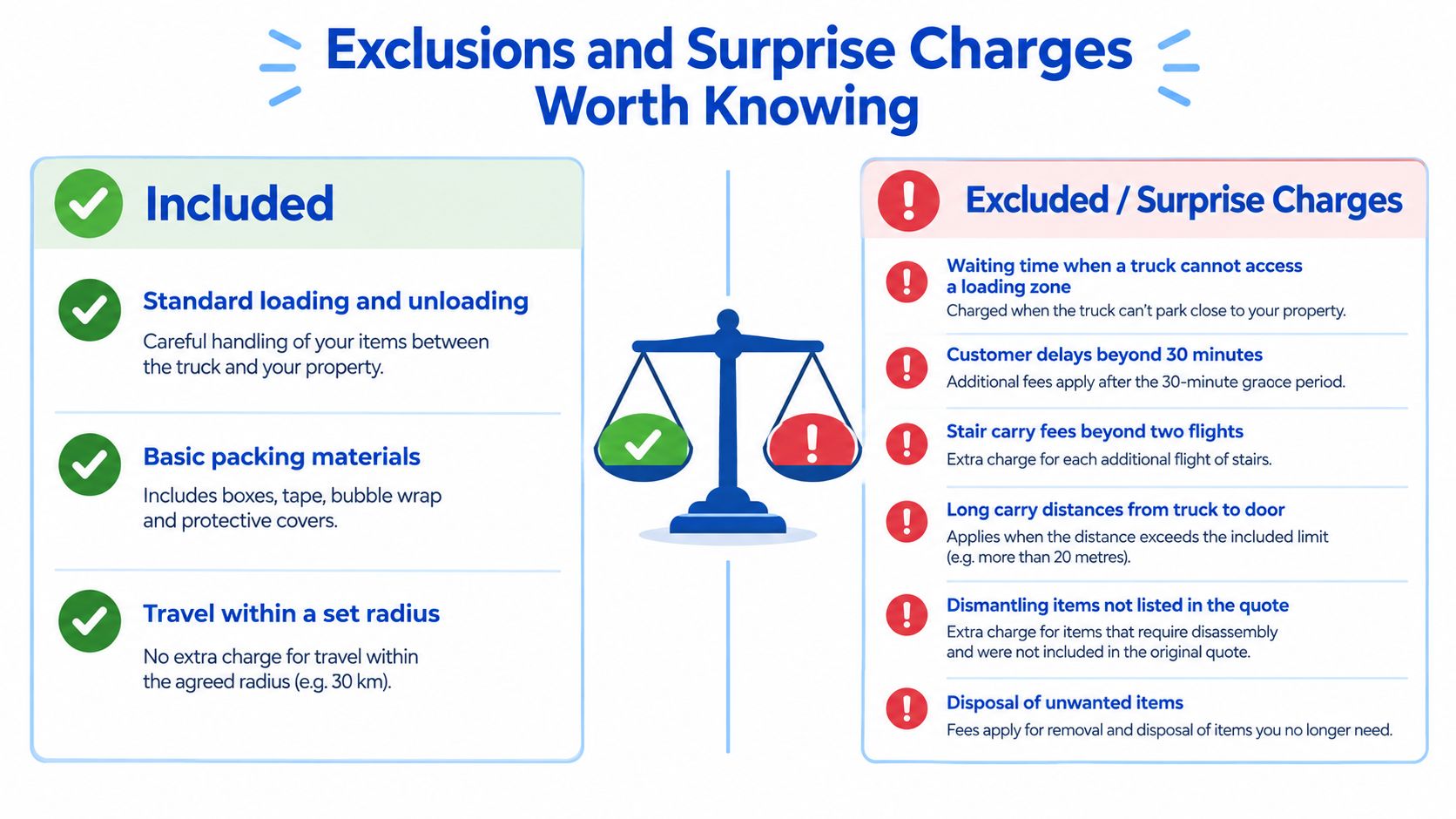
The quote looks tidy until the truck cannot park, the lift booking slips, or a second trip becomes necessary. That is where a move-in quote turns from a scope question into an access problem, and the bill grows.
The charges people miss
Waiting time is the first trap. If the truck cannot use the loading zone, or the customer is not ready when the crew arrives, the clock keeps running. Long carries are another common charge, especially when street parking is tight and furniture has to travel farther than the quote assumed.
Storage release fees can appear when settlement dates do not line up and a split delivery is needed. After-hours or weekend loading can also cost more on commercial moves. Dismantling is another line item people miss. If the quote does not spell it out, the crew may treat it as extra work once they are on site.
The housing angle matters too. Analysts at Muval reported in the 2025 Muval Index that reducing living costs became a more common moving reason, while upgrading to a better home became less common. That shift matters because cost-driven moves often bring different logistics. People may move farther out, use storage between settlement dates, or accept harder access to reduce housing costs. A low transport price does not mean the total move is cheap.
What to ask before you sign
Ask who pays for access problems, how waiting time is charged, whether storage is billed separately, and what happens if the move needs to be split. Ask how specialty items are handled and whether council parking permits are your responsibility, especially in Melbourne apartments and regional Victoria jobs where access rules change the price fast. If the answer is vague, the quote is too.
[Smart question: what exactly happens if the truck can't park where we expected?]
For practical examples of the extras that show up on a job, see this guide to removal company charges. Anything that changes access, timing, or handling should be visible before you confirm the booking.
Preparing Your Home for an Accurate Quote
A quote stays honest only when the job is visible before the truck arrives. Clear inventory, access, permits, and timing let the removalist price the scope instead of guessing.
What to prepare first
Start with the inventory. Walk room by room and list the big furniture, fragile items, and anything awkward to carry. Leave out the junk drawer count, but do not hide the piano, the mirror, or the antique cabinet.
Then confirm the building rules. Get lift bookings, loading dock windows, and any protection requirements from the building manager in writing. If the removalist has to work around other tenants, that belongs in the quote, not in a message on moving day.
Parking comes next. A truck that cannot get close to the door changes the job straight away. For regional and outer-suburban moves, check whether any permit or local restriction applies before the assessment.
Why timing matters as much as items
The gap between lease expiry and settlement date often forces storage, split delivery, or temporary holding. That is not a pricing trick, it is a scope issue. If the date gap is real, the quote should show it.
Melbourne moves also stretch beyond the city more often than people expect, and access planning changes with that. The ABS internal migration data for Greater Melbourne shows the pressure of households moving between metropolitan and regional Victoria, which affects travel time, storage needs, and the way a job is set up. That is exactly why the quote needs to reflect the addresses, not just the furniture list.
Useful habit: keep the quote, the inventory, and the access notes together in one place.
If you still need packing supplies, start with where to get moving boxes. It helps you plan the packing side without losing sight of the move's scope. A quote is only as accurate as the information you feed into it.
Confirming the Quote and Moving Forward
A strong Melbourne move in quote is written, itemised, and based on a documented walkthrough. It should show the scope, the access assumptions, and the extra services separately, so there is no confusion about what is included. If the company wants to change the price later, that variation should be agreed before the extra work happens.
The three confirmations to require
First, get the quote in writing and keep a copy. Second, make sure the inventory and access plan match what was discussed. Third, confirm how storage, lifting, packing, and specialty items will be handled if the conditions change.
Because more than 40% of Australian households move within any five-year period ABS household mobility release, this document is worth keeping, not filing and forgetting. It is the working record of how the move is supposed to happen, and it matters when housing dates, access, or timing shift.
Book the walkthrough first, prepare the home properly, and treat the resulting quote as the plan for moving day, not a rough guess. If the document does not protect the scope, it does not protect you.
House Moving Melbourne provides fixed, written quotes after a practical assessment, along with packing, transport, specialty item handling, and storage across Melbourne and regional Victoria. If you want a quote that is built around access, timing, and the actual scope of the move, visit House Moving Melbourne and book the assessment first.